Where the word comes from
“Diss” started as slang for disrespect and became a verb: to diss someone is to put them down. A diss track turns that into a song with a clear address. It names the target, or describes them so plainly that everyone knows who it is.
A reply to a diss is called a response track. A diss that never names anyone, and relies on hints, is a subliminal. A song that is only half aimed at someone, with a verse or two of shots inside a normal track, is usually called a song with shots, not a full diss.
Diss, roast or battle: which one you need
The three get mixed up because they all aim jokes or criticism at a person. They differ in setting, tone and who is in on it. Pick the one that fits, because a diss aimed at a friend who wanted a roast reads as a real attack.
- Diss track: a recorded song about one target’s actions, meant to be heard by them and by others
- Roast: affectionate teasing among friends, often at a birthday or in a group chat; the target is in on it
- Battle round: a timed verse said face to face, judged on wordplay and reaction, where both sides agreed to it
What makes a diss land
Strip the diss track meaning down to one rule and you get receipts. A good diss rests on details the listener can check or picture: a date, a number, a habit everyone has seen. “You’re fake” is a shrug. “Three release dates, zero songs, and a countdown you deleted” is a scene. The more specific the line, the harder it is to wave away.
Order matters too. Open with the claim, give two or three receipts, then close with a short couplet that sums up the case. Save the line you are proudest of for the last two bars, and leave a beat of silence after it.
- Example receipt: “You booked the studio twice and both times sent a selfie from the lobby”
- Example closer: “All that talk about the work, but the work never showed / you got a ring light and a password, that’s the only thing you own”
Lines that weaken a diss
Attacks on someone’s looks, family, background or identity make the writer look like they ran out of material. They also turn listeners against you and can break platform rules. Threats are worse: they can get a song removed and cause real trouble. Keep every line on habits and choices.
The same goes for targets. Write about public behaviour of someone who is part of the music conversation, or about an invented character. A private person who never signed up for this, such as a classmate or a coworker, is off limits.
- Weak: anything about weight, skin, height or other parts of their body
- Weak: threats, even as a joke
- Strong: missed deadlines, borrowed flows, claims that don’t match the facts
Write a short diss in four steps
Start with an invented target if you are practising. Call them Rico Static, a rapper who announces more than he releases. Then work through the steps below and keep each verse to 16 bars or fewer.
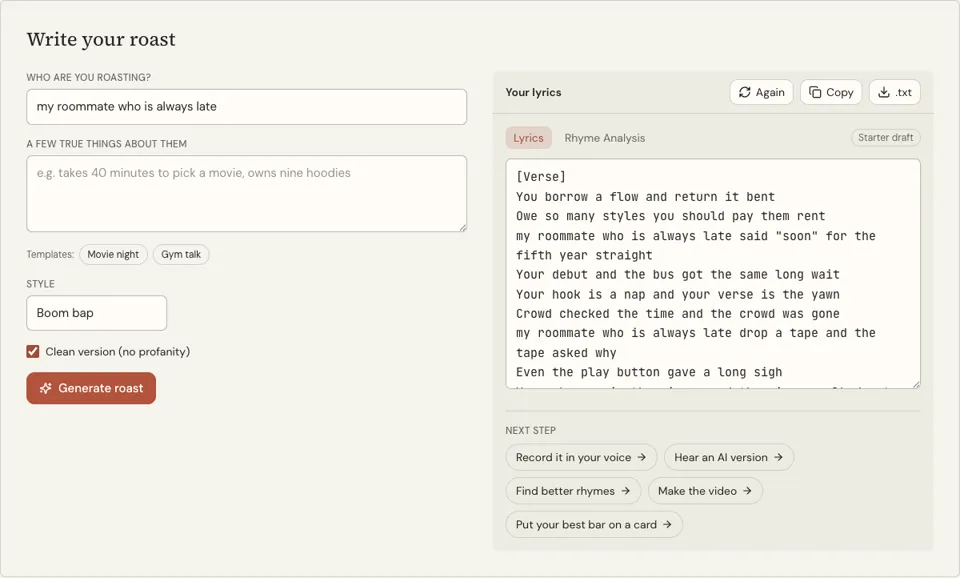
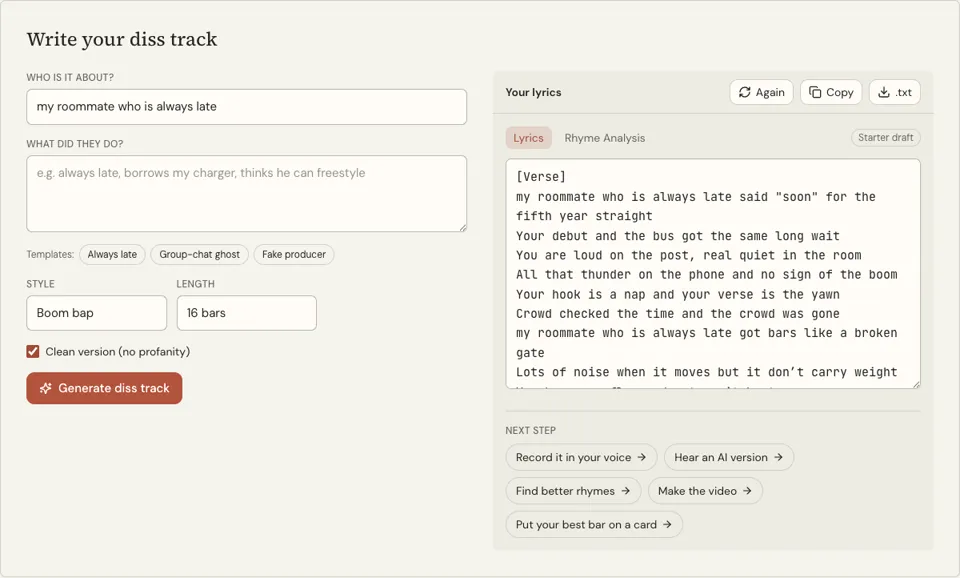
The Diss Track Generator takes a “who” and a “what did they do” box and writes a verse with a two-line closer in seconds, free. The Roast Generator is the lighter version for a friend’s birthday. The Rap Battle Generator writes three rounds of four bars aimed at an opponent’s weak spots.
- Write down three things the target did, one sentence each
- Turn each into a two-bar receipt with one concrete detail
- Add a four-line hook built on one phrase the listener can repeat
- End on the closer couplet and cut any line about appearance
Go deeper
The Diss Track Lyrics guide has four original diss sections and the structure of a full track, from intro to the last hook. The Battle Rap Lyrics guide shows how a round sets up a punch and lands it in about 90 seconds. Read one, then rewrite your weakest receipt with a sharper detail.