Rhyme Scheme Analyzer
Paste a verse or poem and see its rhyme scheme as letters, one per line, with a syllable count beside each. Results update as you type. Free, no sign-up.
Free·No sign-up·AABB letters·Runs in browser
Analyze your rhyme scheme
Rhyme scheme
Counts update as you type. Nothing is sent to a server.
See it in action
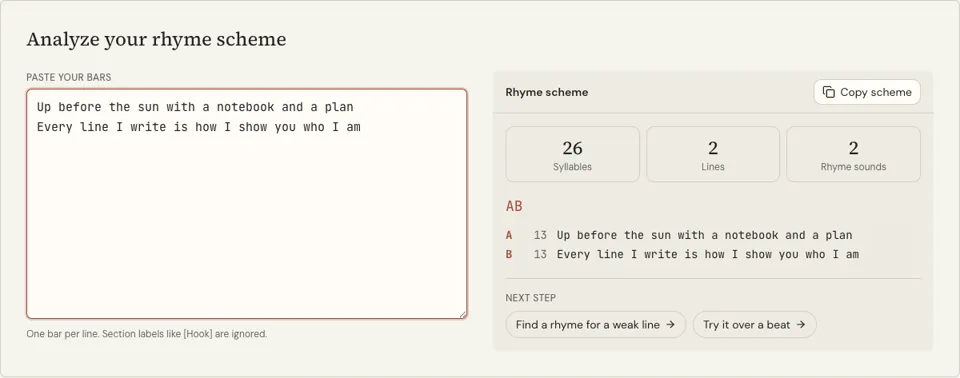
What this rhyme scheme analyzer does
It reads the last word of every line and gives lines that end on the same sound the same letter. The first sound is A, the next new one is B, and so on. The full pattern is printed in one string, such as AABB or ABAB, and each line is listed with its letter and its syllable count.
Three tiles summarise the text: total syllables, number of lines and number of distinct rhyme sounds. Bracketed labels such as [Hook] are ignored, and words inside round brackets, the usual way to write ad-libs, are skipped when the end word is chosen. Copy scheme puts the letter string on your clipboard.
The matching is an estimate from spelling. It knows that "night" and "white" share a sound and that "flow" and "though" do, but it cannot hear your accent, and it marks end rhymes only. Internal rhymes and slant rhymes that depend on delivery will not get a shared letter.
Why use a rhyme scheme analyzer
See the pattern you wrote
Writers often think a verse is AABB when the third couplet drifted. The letter column shows exactly where the scheme holds and where a line is left without a partner.
Scheme and rhythm side by side
Each line carries both its rhyme letter and its syllable count. A couplet that rhymes but differs by five syllables is as visible as one that matches in length and misses the rhyme.
Instant and private
The analysis runs on your device while you type. No text leaves the page, so drafts, coursework and unreleased verses are seen by nobody until you decide to share them.
How to use the rhyme scheme analyzer
- 01
Paste your lines
Put one bar or one line of verse per row in the box. Leave section labels in if you like: anything written as [Label] on its own row is skipped.
- 02
Read the letters
The pattern string appears at the top of the result, with every line listed under it. Matching letters mean the analyzer found the same end sound.
- 03
Repair or keep
A letter that appears only once marks a line with no rhyme partner. Rewrite its last word, or leave it if the break is intended, and watch the pattern update as you edit.
Common rhyme schemes and what they do
A rhyme scheme is the order in which end rhymes repeat, written with one letter per line. Couplets, AABB, are the backbone of rap verses: two bars, one sound, move on. Alternating rhyme, ABAB, delays the payoff by a line and is common in sung hooks and in classic poetry.
Holding one sound, AAAA, builds intensity and shows off vocabulary, though it gets harder with each bar. Enclosed rhyme, ABBA, wraps two inner lines in an outer pair and gives a stanza a closed, finished feel. Mixing schemes between verse and hook helps a listener hear where one section ends.
- AABB: couplets, the default for a 16-bar verse
- ABAB: alternating, common in hooks
- AAAA: monorhyme, one sound for four bars
- ABBA: enclosed, an outer pair around an inner pair
- ABCB: only the second and fourth lines rhyme, as in ballads
Rhyme scheme examples
AABB (couplets)
A I was up before the sun with a plan in my mind A Every door that was closed was a door I would find B Now they ask how I did it, I tell them it was cold B Turned a pocket full of lint to a pocket full of gold
ABAB (alternating)
A The city never sleeps under a neon sky B Got a list of things I owe to my name A Every morning there is one more thing to try B Every night I get a little closer to the game
AAAA (monorhyme)
A Same block, same fight A One lamp burning white A Hold on, do it right A Out of mind, out of sight
ABBA (enclosed)
A I wrote the first line walking down the street B No pen, I kept it in my head all day B By the time I got home it had more to say A So I sat down and gave it to the beat
Rhyme scheme analyzer FAQ
Is the rhyme scheme analyzer free?
Yes. There is nothing to pay and no account to create. Paste a verse, read the letters, change a line and read them again, as often as you need.
How does it decide that two lines rhyme?
It takes the last word of each line and compares the ending from the final vowel group onward, with adjustments for common spellings such as "-ight" and "-ough". Lines whose endings match get the same letter.
Why did two lines that rhyme get different letters?
The analyzer works from spelling, so pairs like "door" and "more" that sound alike but are spelled differently can be missed. Slant rhymes are also not matched. Treat the letters as a first pass and trust your ear on close calls.
Does it detect internal rhymes?
No. Only the final word of each line is compared. To study rhymes inside the bar, mark them by hand, or read the rap rhyme scheme guide for a method.
Can I analyze a poem for school with it?
Yes, it letters any English verse the way a textbook does. Because the matching is an estimate, check the result against your own reading before you hand in work that depends on it.
What does the "Rhyme sounds" number mean?
It is the count of different letters in your text. Eight lines with a value of four means four distinct end sounds, which is what a verse written in pure couplets would show.
Related reading
Related tools
Rap Rhyme Schemes
By the end you can label any verse with letters, write the three core schemes on demand, and add internal rhymes and multis without losing the meaning.
Syllable Counter
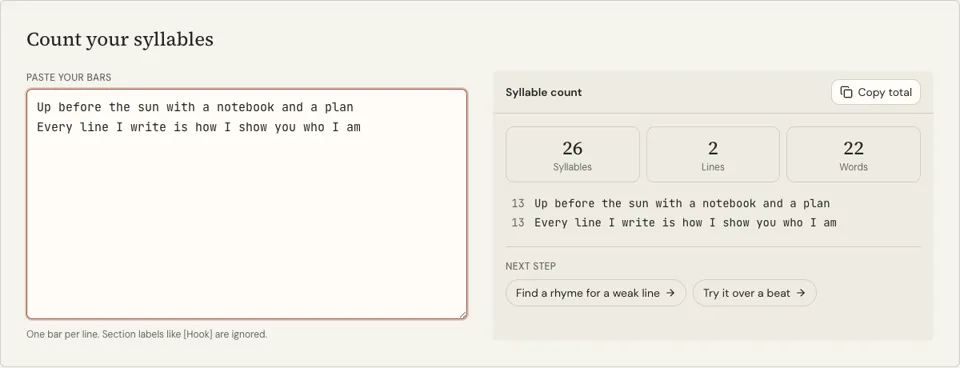
Paste your lines and see a syllable count beside each one, plus totals for syllables, lines and words. Counts update as you type. Free, no sign-up.
Rap Rhyme Generator
Type the last word of your bar and get rhymes grouped by syllable count in about a second, so you can pick one that lands on the same beat. Free, no sign-up.
Rap Lyrics Generator
Describe your song in a sentence, choose a style, mood and length, and a four-line hook plus a verse comes back in a few seconds. Free, with no sign-up and no credits.
Last updated November 12, 2026