Battle Rap Lyrics With Examples
Read four original battle verses, see how each sets up and lands its punch, and learn to write a 90-second round aimed at an opponent’s skill, habits and choices.
Guide·7 min read·With exercises
12 battle rap lyrics, clean enough to use
Original four-bar rounds aimed at skill, effort and choices, never at looks or background. Use them to practise delivery or as a template for your own. Tap to copy.
Openers
Skill and effort
Closers
Battle rap lyrics: how the bars are built
Battle rap lyrics are written to beat one named opponent in front of a crowd. The unit is the punchline: two to four bars of setup that lead to one line the room reacts to. A round is a chain of those, usually one to three minutes long, and a full battle is commonly three rounds each.
The strongest material is specific. It targets what the opponent actually does: recycled flows, missed shows, big talk with no releases. A line anyone could say to anyone gets silence. A line only true of the person across from you gets noise.
The examples here stay on skill, habits and choices. That is a rule on this site, and it is also sound strategy: crowds and judges reward the sharpest observation, and cheap shots at who someone is tend to lose the room.
Setup and punch: the two-part bar
A punchline needs a setup that points the listener one way so the last line can turn them. In the "Setup and flip" example below, three lines build a picture of a phone, and the fourth pays it off with the battery. Without the first three, the fourth is just a sentence.
Keep setups short. Two bars of setup to one bar of punch is a reliable ratio, and four bars is the limit before attention drifts. Put the key word of the punch at the very end of the line, then stop talking for a beat so the room can react. Write three setups for one punch and keep the shortest.
Find angles from what they actually do
An angle is the argument of your round: the one thing you are proving about your opponent. Research like a reporter. Watch their past rounds, read their posts and write down patterns. You want three angles, one per round, each backed by at least two facts.
These categories are fair game and give you plenty to work with.
- Skill: one flow, weak rhymes, stumbles, reused lines from earlier battles
- Habits: turning up late, reading from a phone, excuses after every loss
- Choices: promises not kept, tapes never released, copying another rapper’s style
- Contradictions: what they said last year against what they did this year
What stays out, and why it wins you rounds
Leave out slurs, anything about race, religion, gender, sexuality, disability or body, and anything that reads as a real threat. Leave out family members who never chose to be part of this. These are easy targets, which is exactly the problem: they show the crowd you had nothing specific.
Rooms respond to craft. A precise bar about someone’s recycled second round hits harder than an insult about their looks, and it holds up when the footage is shared later. Go through your draft and strike every line that would work against a stranger. What remains is your real material.
Rebuttals: answer one line, fast
A rebuttal is a short reply to something your opponent just said, delivered at the top of your next round. It proves you were listening and can think on your feet. Keep it to two or four bars. Pick one of their lines, repeat the claim in a few words, then turn it.
You can prepare the frame in advance: "He said X, from the man who Y." During their round, listen for the X. Practise by having a friend read you any four bars, then give yourself 30 seconds to write a two-bar reply.
Build a 90-second round
Without a beat, 90 seconds holds roughly 24 to 30 bars at a clear speaking pace. Open with your rebuttal, spend the middle on one angle with three or four punches that escalate, and save your strongest line for last. The final bar is what the room carries into the next round.
Delivery is half of it. Memorise fully, since reading kills eye contact. Mark the pauses after punches on your page and rehearse them. Record the round on your phone standing up, at performance volume, and time it. Cut bars until it fits with five seconds to spare.
Wordplay and schemes that suit a battle
Beyond the single punch, battlers use schemes: a run of four to eight bars built around one theme, where every line borrows vocabulary from the same field. A cooking scheme might say the opponent’s verses are reheated, underseasoned and served cold. The pleasure for the crowd is hearing how long you can extend the idea without forcing it. Stop the scheme at its strongest line, not when you run out of terms.
Name flips are another staple. Take the opponent’s stage name, find what it sounds like or contains, and turn it into the point of the bar. Keep these to one per round, because everyone they have ever battled has tried it. Whatever device you use, the test is the same: does the line still say something true about their rapping? Pick one field you know well, such as football, cooking or driving, list ten of its terms, and write a four-bar scheme about an opponent who recycles material. Aim for the fourth bar to be the hardest hit.
- Scheme: one theme carried across several bars
- Name flip: the opponent’s stage name turned into the punch
- Double meaning: one word that lands in two senses
- Callback: a return to your own earlier bar, or to theirs
What changes when your battle rap lyrics are specific
The crowd finishes the thought
When a bar refers to something the room already knows about your opponent, people connect it themselves a split second before the punch. That shared recognition is where the loudest reactions come from.
Your round cannot be flipped
Generic insults are easy to rebut because they fit you as well. A bar built on their own record, with a date or a detail in it, gives them nothing to turn around.
The footage ages well
Battles live on as clips. Lines about craft and choices still look sharp a year on, while lines that punched down are the ones people quote against you later.
How to practise writing battle rap lyrics today
- 01
List angles for five minutes
Pick a friend who agrees to be your practice opponent, or invent one. Write six true or agreed facts about their rapping habits and choices, then circle the two with the most detail.
- 02
Draft punches for eight minutes
Open the rap battle generator, enter who they are and what they did, and read the draft for structure. Then write four of your own two-bar setups with a one-bar punch.
- 03
Check and perform for five minutes
Paste your bars into the rhyme scheme analyzer to confirm each punch rhymes with its setup. Stand up, deliver all four with a one-beat pause after every punch, and record it.
Battle rap lyrics examples
Setup and flip
You said you’d freestyle, then you read it off your phone, Screen went dark and you were standing there alone, I don’t need a charger for the lines that I say, Your whole round died at four percent today
Angle: habits
You show up late and blame the train every time, The train’s on schedule, you’re behind on the rhyme, Three rounds booked and you prepared for one, I wrote for all three, so the maths is done
Rebuttal
He said I’m boring, that’s the line that he chose, From the man with one flow that he wears like clothes, Same four bars since the first of July, You don’t have a catalogue, you have a reply
Closer
Crowd came for bars and you gave them a speech, Talked about levels that you’re nowhere near to reach, I’ll leave you the tape so you can study the round, Press play, take notes, hear how finishing sounds
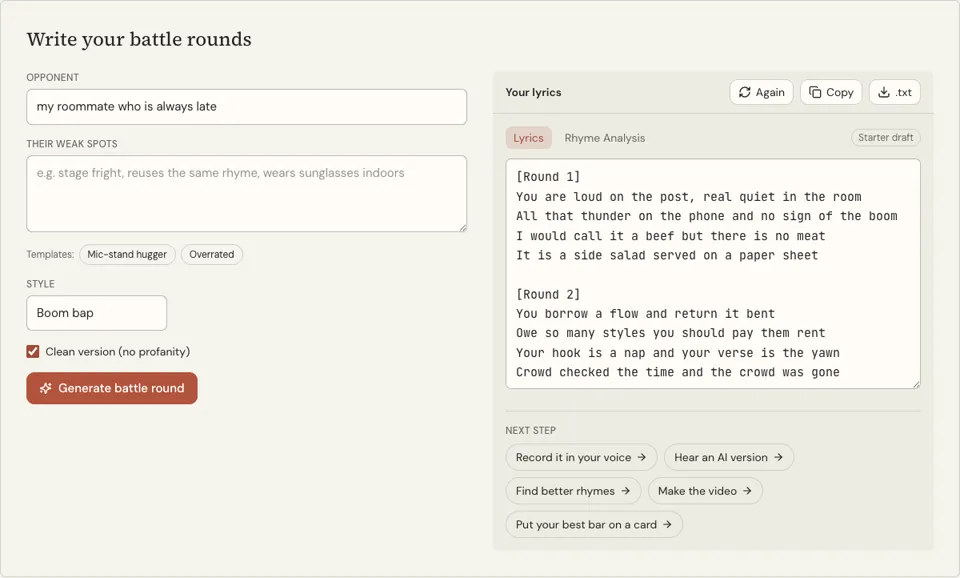
Try it: Rap Battle Generator
Battle rap lyrics FAQ
Are battle rap lyrics written or freestyled?
Both formats exist. Many organised leagues use prepared, memorised rounds performed without a beat, with short freestyled rebuttals at the start. Cypher and open-mic battles are often improvised over a beat. Ask the organiser which format applies before you prepare.
How many bars is a battle rap round?
It is usually set by time, not bars. Rounds of one to three minutes are common, and a 90-second round without a beat holds about 24 to 30 bars. Finishing early with strong material is better than being cut off mid-punch.
What makes a good battle rap punchline?
A short setup that leads the listener one way, a last line that turns it, and a detail that is true of this opponent only. Place the key word at the end of the bar and pause after it so the reaction has room.
Can I use the example battle bars on this page?
Yes, they are original and written for practice. They will work for learning structure and delivery. In a real battle they will fall flat unless you replace the details with facts about the person you are facing.
What should battle rap lyrics never include?
Slurs, attacks on protected traits such as race, religion, gender, sexuality or disability, real threats, and private details about people outside the battle. Beyond the harm, they signal a lack of material, and many events will disqualify you.
How do I practise battle rap alone?
Write a round against an invented opponent with a fact sheet you make up, memorise it, and perform it to a camera. Review the video for eye contact, pauses and stumbles. Then write the opponent’s reply to yourself to train rebuttals.
Related reading
Related tools
Rap Battle Generator
Name an opponent, list a few weak spots and get three rounds of four bars aimed at them, written in seconds. Free to use, and the jabs stay on habits and choices.
Rap Punchline Generator
Enter a word with more than one meaning, pick a style, and get a numbered set of two-line punchlines a few seconds later. Each one sets up, then flips. Free to use without an account.
Diss Track Lyrics
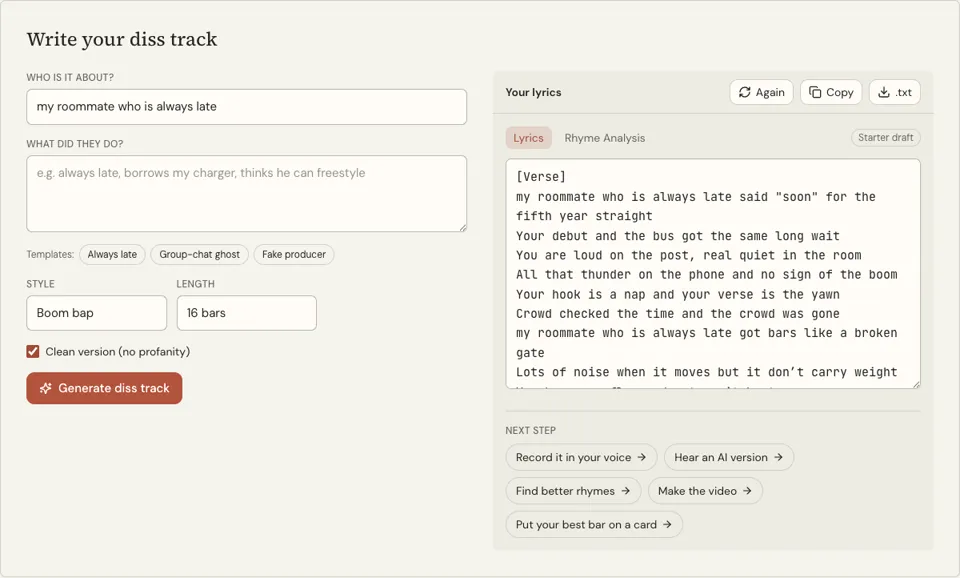
Read four original diss sections, learn the structure of a full track, and write your own verse and hook about what someone did, without slurs, threats or cheap shots.
Rhyme Scheme Analyzer
Paste a verse or poem and see its rhyme scheme as letters, one per line, with a syllable count beside each. Results update as you type. Free, no sign-up.
Last updated November 12, 2026