How to Rap Fast
Learn what fast rap is in beats and syllables, then follow a tempo ladder and four mouth drills that raise your speed without turning the words to mush.
Guide·6 min read·With exercises
How to rap fast without losing the words
Rapping fast means fitting more syllables into each beat while keeping every one of them even and audible. It is a rhythm skill before it is a speed skill. Fast rappers are not rushing: they are placing syllables on a finer grid, usually sixteenth notes or triplets, with the same precision a slower rapper uses on eighth notes.
The method is the one musicians use for any fast passage. Learn the line slowly and perfectly, then raise the tempo in small steps, and drop back the moment it smears. Add daily articulation drills for the tongue and lips, and plan where you breathe before you start.
Expect weeks, not days. The limit is rarely your lungs or your brain. It is the coordination of small mouth muscles, and those adapt gradually with short, frequent practice. Ten minutes a day does more than an hour once a week, and stopping when your mouth tires prevents sloppy habits.
Understand speed as subdivision
A beat can be split into two (eighth notes), three (triplets) or four (sixteenth notes). Sixteenths at 90 BPM give you 16 syllable slots per bar, which works out to 6 syllables a second. Triplets on a 140 BPM trap beat give 12 slots per bar and 7 syllables a second. Both sound fast, and neither needs a faster beat.
So the first step is hearing the grid. Clap sixteenths over a 90 BPM loop while saying "1 e and a, 2 e and a". Then say "tri-po-let" on every beat for the triplet feel. Two minutes of each, until your hands stay even without watching them.
Climb a tempo ladder
Pick four bars of fast material and set the loop to 70 BPM. Rap them until you get three clean passes in a row: every syllable heard, none late. Then raise the tempo by 5 BPM and repeat. When a pass smears, go down 5 and get three clean ones again before climbing.
Write down the top clean tempo each day. Most people gain a step or two per week on the same bars. Do not skip rungs. A line forced at full speed too early gets memorised with its mistakes built in, and those are slow to remove later.
Drill the mouth every day
Clarity at speed comes from crisp consonants. Do these for five minutes before you rap, slowly first, then faster, stopping when it blurs.
Exaggerate the lip and tongue movement far beyond normal speech. It feels silly and it is the point: big movements practised slowly become small accurate ones at speed.
- Repeat "puh-tuh-kuh" for 30 seconds, evenly, like a drum roll
- Say "tip of the tongue, top of the teeth" ten times without slurring
- Read your verse in a whisper, consonants only as loud as you can make them
- Read it again with a pencil between the teeth for one minute, then without
- Speak the verse on one pitch like a robot to check that every syllable is equal length
Write lines that can go fast
Some words are slow in the mouth. Clusters such as "strengths" or "sixths" need several tongue positions for one syllable. Fast lines prefer short vowels and single consonants that alternate between lips and tongue tip: "ticking", "better", "pack it", "middle".
Repetition helps too. Repeating a consonant or a three-syllable shape lets your mouth run a pattern instead of solving each word fresh. Write four bars where every beat holds the same shape, as in the triplet example below, then vary one beat per bar. Count the syllables so every bar has the same total.
Plan your air
A sixteenth-note bar leaves no room to breathe unless you make some. Cut one or two syllables at the end of every second bar and take a quick, silent breath through the mouth there. Mark those spots on the page with a slash and breathe at every one, even when you feel fine.
Stand up, keep your shoulders down and let the stomach move out as you inhale. Then test stamina: rap 8 fast bars, rest for 8, and repeat four times. When that is comfortable, go to 12 on and 4 off. Record the last round and check that the final bar is as clear as the first.
Switch speeds inside a verse
Fast rapping is most effective as contrast. A verse that moves from eighth notes into two bars of sixteenths, then drops back, makes the quick part sound quicker than it is. Plan these gear changes on the page: bracket the fast bars and write the syllable count beside them, so you know exactly where the shift starts and ends.
The hard part is the join. Coming out of a fast run, rappers tend to rush the next slow bar. Practise the transition alone: loop the last fast bar and the first slow bar twenty times until the change is clean in both directions. A good first target is a 16-bar verse with two fast bursts, at bars 7 to 8 and bars 15 to 16, where the ending burst closes the verse with energy. Mark those four bars in a verse you already know and rewrite only them as sixteenths.
- Bars 1 to 6: eighth notes, 10 to 12 syllables
- Bars 7 to 8: sixteenths, 15 to 16 syllables
- Bars 9 to 14: back to eighths, with one triplet bar
- Bars 15 to 16: sixteenths, ending on a held word
Warm up the jaw, lips and voice first
Speed work on a cold mouth produces tension, and tension is slow. Three minutes of warm-up before the articulation drills makes the first clean pass arrive sooner and protects your voice across a long session. Do it standing, with a glass of water nearby.
Start with the jaw. Press your fingertips into the muscle just in front of each ear and make small circles for 20 seconds while the mouth hangs open. Then blow air through closed, loose lips so they flap like a motorboat, 5 times for about 5 seconds each. Finish with humming: slide from a low note to a high one and back, 5 times, feeling the buzz in your lips and nose.
A tight jaw is a common cause of slurring that nobody checks. If your teeth are nearly closed when you rap, the syllables have no room. After the warm-up, say your four practice bars once at half speed, letting the jaw drop a finger's width on every stressed vowel.
- Jaw circles: 20 seconds
- Lip trills: 5 times, 5 seconds each
- Hum slides, low to high and back: 5 times
- Half-speed pass with an open jaw: once
Build breath capacity away from the beat
Marking breath points on the page solves the writing side. The body side is how much air one quick breath gives you and how slowly you spend it. Both improve with two short drills that need no music.
Lie on your back with a paperback on your stomach. Breathe in through the nose for 4 counts so the book rises, and out for 8 so it sinks, 10 times. The chest should hardly move. Then stand and do the hiss: take one quick breath and let it out on a steady "sss" while you time it. Twenty seconds is a normal start. Add 2 seconds a week until you reach 35 to 40.
Last, add effort. Walk briskly, or climb stairs, while reciting a verse you know by heart at speaking volume. When you can finish 8 bars on a brisk walk without the last words fading, the same 8 bars standing still will feel easy. Do this three times a week, and stop if you feel dizzy.
Read aloud against a timer
Reading prose quickly trains the link between eye, brain and mouth without rhyme or rhythm getting in the way. It also exposes the sound combinations you personally trip on, which are different for everyone.
Pick a paragraph of about 100 words from any book or news article. Read it aloud at a normal pace and time it. Most people take 35 to 40 seconds. Read it again and aim for 30, then 25. The rule is strict: every word complete, no skipped endings. Circle each word you stumbled on.
Those circled words are your personal drill list. Say each one 10 times slowly, then put it in a short sentence and say that 5 times. Use a new paragraph every day so you practise reading, not reciting. Five minutes is enough.
Make smaller movements and trade awkward words
At six syllables a second there is no time for big shapes. Quick rappers keep the tongue tip close to the ridge behind the top teeth, where t, d, n and l are made, and let the jaw move just enough for the vowels to stay distinct. Watch yourself in a mirror while rapping a fast bar. If your chin travels a long way on every syllable, halve the distance and listen to whether the words survive.
The other half is word choice during editing. A fast bar is not the place for a word you find hard. Shorten with contractions, drop a syllable that adds nothing, and replace a consonant cluster with a simpler word of the same meaning. The list shows one idea written twice, then some common trades.
Run this edit on your own bars: underline any word you missed twice in practice and replace it instead of fighting it. Then paste both versions into the syllable counter to confirm the bar kept its count.
- Before: I am practising these difficult structures constantly (14 syllables, several clusters)
- After: I been running every pattern till it's automatic (14 syllables, easy consonants)
- Contract: "going to" becomes "gonna", "want to" becomes "wanna", "them" becomes "'em"
- Swap: "strengths" for "power", "asked" for "said", "texts" for "notes"
Study fast verses the way a drummer would
Listening to quick rappers helps only if you listen for mechanics. The fastest tradition in rap is usually called chopper style. It grew in the American Midwest in the early 1990s and is associated with artists such as Twista and Tech N9ne. You do not need to copy anyone's voice or words to learn from it. You need the rhythm map.
Choose 4 bars of any fast verse and slow the playback to 0.75 speed, a setting most video players have. Tap along and write down only numbers: how many syllables fall in each beat, and where the breath is. A bar might read 4, 4, 3, rest. That grid is a rhythm, not a lyric.
Now write your own words to that grid on a different subject, and rap them over a drum loop in the rap beat maker at 80 BPM before climbing. Learning how to rap fast this way gives you patterns you would not have invented alone, with lyrics that are entirely yours. Map one new 4-bar grid a week.
Learn the bars by heart before you add speed
Reading and fast rapping compete for the same attention. While your eyes are finding the next word, your mouth has to wait for them. That is why a verse you can rap cleanly from memory at 85 BPM often falls apart at 75 when you read it from a screen. Memorise first, then climb.
Learn in chunks of one beat. Say the first beat’s syllables five times, add the second beat and say both five times, and continue until the bar is whole. Then chain bars the same way. Test yourself by starting from the middle: if you can begin at bar three without running up from bar one, the words are stored properly. Do this away from the beat, while walking or washing up. Ten minutes of this on two days running is usually enough for four bars.
Turn the volume down
Beginners tend to get louder as they get faster. Loud speech uses more air per syllable and tightens the neck, and both work against speed. Practise a fast bar at the level you would use to talk to someone across a small table. The same bar often comes out cleaner straight away.
When you record, stay about a hand’s width from the microphone and turn the input up instead of your voice. Aim slightly past the microphone, not straight into it, so that the bursts of air on p and b do not thump. Record one quiet take and one loud take of the same four bars and count which has more clear words.
A four-week plan with one test each week
Fifteen minutes a day is enough if the days are consistent. Use the same four bars for the first two weeks so that progress is easy to measure.
Every seventh day, record one pass at your top clean tempo and ask someone who has not seen the words to write down what they hear. Count the words they got right. That number matters more than the BPM. If your throat feels sore or your voice turns hoarse, stop for the day. Hoarseness means the sound is being forced, and rest fixes it faster than repetition.
- Week 1: memorise the four bars, find your top clean tempo and write it down
- Week 2: ladder work on those bars every day, with one full rest day
- Week 3: write four new bars in the other subdivision, triplets if you began with sixteenths
- Week 4: place both bursts inside a 16-bar verse and practise the joins
Three mistakes beginners make when trying to rap fast
Speeding up the beat instead of the grid
Jumping to a 170 BPM loop only makes you late. Speed comes from sixteenths or triplets over a moderate tempo. Master the subdivision at 70 to 90 BPM first and the faster beats follow.
Accepting mush
If a listener cannot make out the words, the speed counts for nothing. Record every session and transcribe ten seconds of it. Any word you cannot write down from the recording needs slowing down.
Rapping fast for a whole verse
Sixteen bars at top speed with no change tires the ear. Fast passages land harder next to slower ones. Use a burst of two to four bars, then open the rhythm up again.
How to practise rapping fast today
- 01
Warm the mouth up for four minutes
Do "puh-tuh-kuh" for 30 seconds, the tongue and teeth phrase ten times, then read the sixteenth-note example below slowly with exaggerated consonants, twice.
- 02
Check the count for three minutes
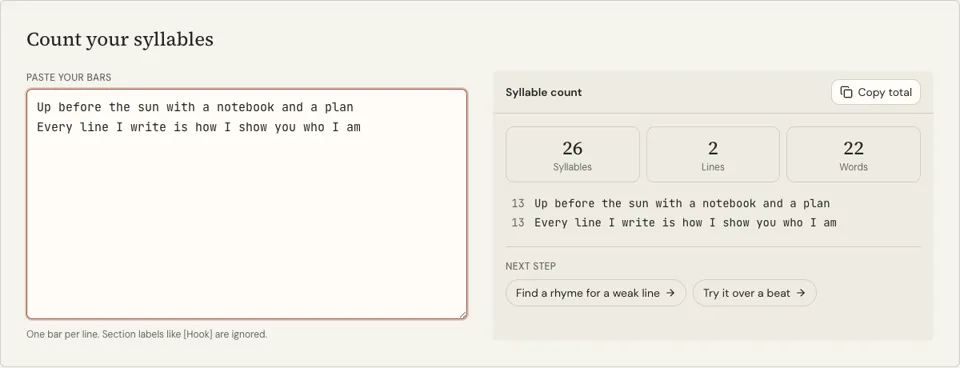
Paste your four fast bars into the syllable counter. Adjust words until each line has the same number of syllables, so the rhythm repeats cleanly from bar to bar.
- 03
Climb the ladder for ten minutes
In the rap beat maker, set the tempo to 70 BPM. Get three clean passes, add 5 BPM and repeat. Note your highest clean tempo and start 10 BPM below it tomorrow.
Fast rap example bars and drills
Sixteenth-note bars (15 syllables each)
Ticking like a metronome, I’m picking every little note, Never let a letter slip, I’m steady when the tempo grows, Tapping on the table top, I’m stacking up the syllables, Clip it at the consonant and get it back in time to go
Triplet bars (12 syllables, four groups of three)
Run with it, stay with it, never get late with it, Count on it, bounce on it, every beat pounce on it, Tap on it, snap on it, put a new cap on it, Breathe on the four, then I’m back at the door with it
Articulation warm-up (say each line five times)
Tip of the tongue, top of the teeth, tap it twice Big black boots kick back, big black boots kick back Digging deep, getting quick, keeping grip, staying crisp Say it slow, say it clean, say it quick, say it mean
Breath-mapped burst (/ = quick breath)
Every little syllable is sitting on a sixteenth, Getting to the middle of the bar and then I fix it / Leaving out a couple at the end to get some air in, Back on the one and I’m ready for the next ten /
Try it: Syllable Counter
How to rap fast FAQ
How do I rap faster without mumbling?
Practise the line slowly with exaggerated consonants, then raise the tempo 5 BPM at a time and only after three clean passes. Add daily articulation drills. If a recording of you cannot be transcribed, you have gone past your clean speed.
How many syllables per second is fast rap?
Sixteenth notes at 90 BPM are 6 syllables per second, and triplets at 140 BPM are 7. Those already sound quick to most listeners. Higher rates exist, but evenness and clarity impress more than a raw number.
How long does it take to learn to rap fast?
With ten to fifteen minutes of daily ladder practice, expect noticeable gains on a specific passage within two or three weeks. General speed across any lyrics builds over months, because the small muscles of the tongue and lips adapt slowly.
What BPM should I practise fast rap at?
Begin at 70 BPM with sixteenth notes, which is only about 4.7 syllables a second, and climb toward 90 to 100. For the triplet style, practise over 120 to 140 BPM beats while counting at half speed.
How do I breathe when rapping fast?
Build breaths into the writing. Leave a gap of one or two syllables at the end of every second bar and inhale quickly through the mouth there. Breathing low into the stomach refills faster than lifting the chest and shoulders.
Is fast rapping better than slow rapping?
No. Speed is one tool among many. A slow verse with strong writing beats a quick one nobody can follow. Use fast passages for contrast and excitement, and keep them short enough that every word still reaches the listener.
Why do rappers rap fast?
Mostly for contrast and to show skill. A quick passage raises the energy of a verse, shows control of rhythm and breath, and fits more words into the same bars. It also grew out of competitive scenes where technical ability was the point.
Do I need to warm up before rapping fast?
It helps. Three minutes of jaw circles, lip trills and humming loosens the muscles that shape consonants, so clean passes come sooner and the voice tires later. Skip it and the first ten minutes of practice become the warm-up, with sloppier repetitions.
Related reading
Related tools
Syllable Counter
Paste your lines and see a syllable count beside each one, plus totals for syllables, lines and words. Counts update as you type. Free, no sign-up.
Rap Beat Maker
Press Play and a boom bap loop starts at 90 BPM. Tap squares on the 16-step grid to change the kick, snare, hats, clap and 808, then write to it. Free, no sign-up.
Rap Flow Guide
After this guide you can count a bar, place syllables on or off the beat on purpose, and switch between four flow patterns inside one verse.
How to Rap
By the end you can count bars, land a rhyme on the fourth beat, breathe without losing the pocket and finish a 16-bar verse. Every section ends with a drill you can run today.
Last updated November 13, 2026