How to Become a Rapper
This guide lays out the real sequence: skill, name, songs, releases, stages and audience, with a number attached to each step. No promises of fame or income, only work you control.
Guide·7 min read·With exercises
How to become a rapper: the honest version
You become a rapper by writing verses regularly, recording them, releasing songs and performing them in front of people. There is no application and no gatekeeper for any of those four things. The day you finish and release a song under a name, you are a rapper. Whether it becomes a career is a separate, much longer question.
The order matters. Skill comes first, because nothing else works without songs worth hearing. Then a name and a consistent sound, then a small catalogue, then stages and an audience. People who start with logos and photo shoots usually stall before the third song.
Nobody can promise you listeners or money, and this page will not. What you can control is output: how many verses you write, how many songs you finish and how often you perform. Those numbers are the path. Track them weekly and the rest of this guide becomes a checklist.
Write 30 verses before you judge yourself
Your first verses will be weak. That is the cost of entry, and the only way through is volume. Set a target of thirty finished 16-bar verses, two a week for about four months. Number them. Somewhere around the fifteenth, your timing settles and you start hearing your own habits.
Rap every verse out loud over a beat and record it on your phone, even the bad ones. Keep the files in dated folders. Listening to verse three after writing verse twenty is the most convincing feedback you will ever get. Write number one tonight. Vary the task so you do not write the same verse thirty times: a story, a boast, a letter to someone, a verse with no "I" in it. Change tempo every few verses as well.
Pick a name and a lane
Choose a stage name you can say clearly, spell after one hearing and find free as a handle on the platforms you use. Search it on streaming services first. Sharing a name with an existing artist splits your releases and confuses anyone looking for you. Check the spelling does not invite a common typo, since people will search for you by ear.
A lane is the short answer to "what kind of rap do you make?" Tempo range, subject matter and tone. You are allowed to change it later, but three songs that sound related tell a listener who you are faster than three experiments. Describe your lane in one sentence and pin it above your desk.
Record and release three songs
A phone and earbuds are enough for demos. For releases, a modest USB microphone in a room full of soft furniture is a common next step. Record standing, a hand’s width from the mic, and do at least three takes of every verse. Listen for words that are hard to make out and re-record those lines before anything else.
Songs reach streaming services through a digital distributor: a service that delivers your audio and artwork to the stores. You upload the file, a square cover and the credits, and choose a date. If you did not make the beat, you need the producer’s permission or a licence first.
- Final audio exported as WAV
- Square cover art with your name and the title spelled correctly
- Songwriter and producer credits agreed in writing
- A release date at least two weeks out, so you have time to tell people
Get on a stage early
Open mics are where rappers learn to perform. Search for hip-hop nights, poetry slams and general open mics in your area, arrive early and sign the list. A typical slot is about five minutes, which is two short songs or one song and a verse.
Memorise everything. Bring your instrumental on your phone and on a spare drive, and tell the host the track name. Hold the microphone close and steady, look at faces and not the floor. Your first three sets will be nervous. Book them anyway, then book the fourth. Stay for the other acts and introduce yourself to the host afterwards. Open mic regulars are how you hear about showcases, cyphers and people looking for a feature.
Build an audience one person at a time
Post on a schedule you can keep: one clip a week of you rapping to camera does more than a burst of ten and then silence. Reply to everyone who comments. Swap verses with rappers at your level, since each collaboration introduces you to their listeners.
Keep a simple list of people who liked a song enough to message you. Fifty names you can tell about a release is a real start. Pick your weekly posting day now and put the first four dates in your calendar. Ask one honest listener for criticism on every song, and thank them when it stings. Praise from friends feels good and teaches little.
Treat time and money like an adult
Most rappers pay for their music with another job for years, and many always will. Decide what you can spend each month on beats, artwork and distribution and stay inside it. Be wary of anyone selling guaranteed streams, placements or fame for a fee.
Protect practice time the way you would a shift at work: fixed hours, written down. Three focused sessions a week for a year puts you ahead of most people who say they rap. Review your numbers every three months: verses written, songs released, shows played. If a number has not moved in three months, that is the area to change. Put the next review date in your calendar today.
Study verses the way a player studies game tape
Writing volume trains your hands. Listening trains your ear, and it needs the same structure. Three times a week, pick one verse by a rapper you admire and play it four times with a pen. First pass: count the bars. Second: mark where every breath falls. Third: letter the end rhymes down the margin. Fourth: write one sentence on what the verse is about and how it ends.
Choose from different decades and regions, not only this year's playlist. A slow 1990s verse teaches placement, a current trap verse teaches space and ad-libs, and a grime verse teaches speed at 140 BPM. The aim is to collect techniques, never lines. If a pattern impresses you, copy its rhythm with your own words in your next numbered verse and note where it came from.
- Bars in the verse, and where the beat changes
- Breath points in each group of four bars
- Rhyme letters, plus any rhyme inside the bar
- One technique to try this week
Six skills behind the title, with a drill for each
"Rapper" covers several separate skills, and most beginners are strong in one and untested in the rest. Rate yourself from 1 to 5 on each skill below, then give the lowest score one extra 20-minute session every week until it catches up.
Rate yourself again every month. The scores matter less than the direction. A writer who cannot remember a verse on stage and a performer with nothing new to say are stuck at the same point, for opposite reasons.
- Writing: one finished verse in a single sitting, phone in another room.
- Timing: rap a verse while clapping beats 2 and 4, without drifting.
- Breath: deliver 4 bars on one breath at 90 BPM, then 6.
- Memory: learn 16 bars in 30 minutes and recite them the next morning.
- Performance: film one take, standing, eyes on the lens.
- Finishing: turn a verse into a full song with a hook inside 7 days.
Keep going through the weeks you do not feel like it
Every rapper hits a stretch where the verses sound worse than last month's and nobody is listening. That stretch is where many people quit. Plan for it before it arrives by setting a minimum session: 10 minutes, 4 bars, recorded. On a bad day you do the minimum and stop. The habit survives, and the habit is the part that is hard to rebuild.
Give yourself permission to write a deliberately bad verse once a week. Removing the pressure to be good often produces the loosest lines of the month. Compare your work only with your own older recordings. Measuring a six-month catalogue against someone's tenth year tells you nothing useful.
Keep a paper calendar on the wall and mark each day you wrote. When you miss a day, one rule applies: never miss two in a row.
Work with a producer and an engineer
Sooner or later you will want beats made for you and a mix that sounds finished. Approach producers at your own level first. Send a short message with one 30-second clip of you rapping, the tempo range you like and what you are asking for. Agree the terms in writing before you record a word: how the credits read, who can release the song and whether money changes hands.
Studio time is charged by the hour, so arrive ready. Know the verses by heart, bring the lyrics printed in large type, the instrumental as a WAV and a reference song for the sound you want. Record the hook first while your voice is fresh. A prepared rapper can track a song in about two hours. An unprepared one spends that time rewriting bar 9.
Three mistakes people make when trying to become a rapper
Branding before bars
A logo, a photo shoot and a profile bio feel like progress and produce no music. Spend the first months almost entirely on writing and recording. Image is quick to add once there are songs to attach it to.
Waiting for perfect equipment
Putting off recording until you own a studio microphone costs you months of practice. Demos on a phone teach delivery and breath just as well, and they show you what gear you actually need.
Releasing once and stopping
One song rarely finds an audience. Listeners and platforms respond to a steady run of releases. Plan your first three songs together so the second is nearly finished when the first comes out.
How to practise becoming a rapper today
- 01
Warm up for four minutes
Load the Boom bap preset in the rap beat maker and leave it at 90 BPM. Rap any verse you know twice through, standing up, at the volume you would use on a stage.
- 02
Write verse one for ten minutes
Write 8 bars about why you want to do this. If you are stuck, generate a draft in the rap lyrics generator on the same topic and rewrite every line in your own words.
- 03
Record and file it for four minutes
Record the 8 bars over the loop on your phone in one take. Save it in a folder with today’s date and the number 1. Tomorrow you finish the other 8.
Plans and drills for becoming a rapper
The 30-verse log
Verse 1: date, beat tempo, topic, one thing to fix Verse 2: date, beat tempo, topic, one thing to fix Two verses a week, every week Re-listen to verse 1 after verse 10, 20 and 30
Five-minute open mic set
Say your name and one sentence, 15 seconds Song one, hook and one verse, 90 seconds Song two, full, 2 minutes 30 seconds Say your name again and thank the host
Release checklist for song one
Beat permission or licence saved WAV exported and checked on earbuds and a speaker Cover art checked for spelling Date set two weeks ahead and three clips filmed
A week you can repeat
Monday: write a verse, 45 minutes Wednesday: record and listen back, 45 minutes Friday: post one performance clip Sunday: write a verse, plan next week
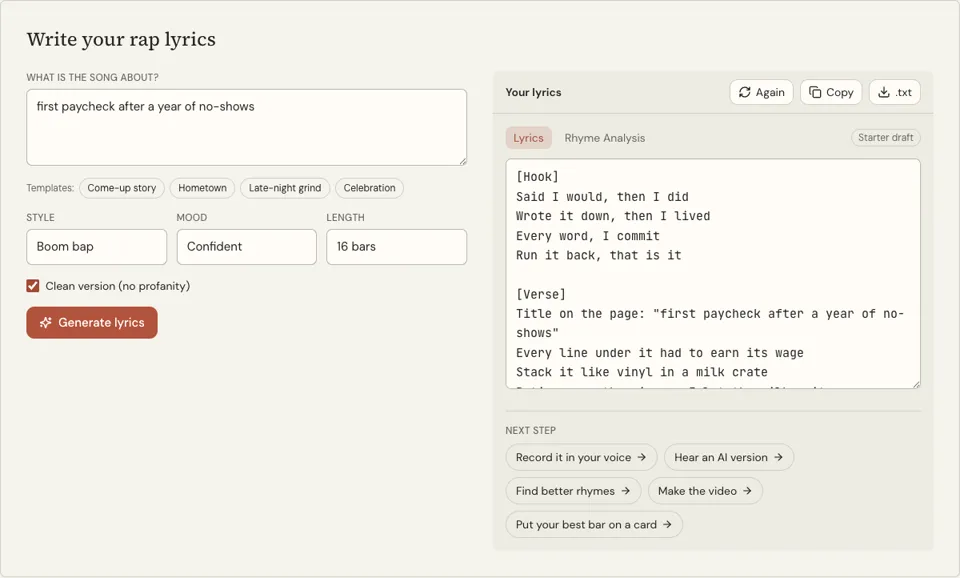
Try it: Rap Lyrics Generator
How to become a rapper FAQ
How do I become a rapper with no experience?
Start by learning to count bars and write a 16-bar verse over a slow beat. Write two verses a week, record each on your phone and listen back. After a few months, finish one full song and release it. Experience is simply finished work.
Do I need a record label to become a rapper?
No. You can record at home and release music to streaming services yourself through a digital distributor. Labels are one possible later step for a small number of artists, not a requirement for making and releasing rap.
How long does it take to become a rapper?
You can release a first song within a few months of serious practice. Becoming good takes years of regular writing and performing, and building an audience has no fixed timeline. Plan around habits you can sustain, not a deadline.
Can I make money as a rapper?
Some people do, through shows, streaming, merchandise and features, but nothing is guaranteed and most artists earn little from music for a long time. Keep another source of income, set a monthly music budget and treat any earnings as a bonus at first.
Am I too old or too young to start?
There is no age rule for writing and releasing music. Younger artists should involve a parent or guardian for accounts and shows. Older beginners often write with more to say. The work is the same either way: verses, songs, stages.
What equipment do I need at the beginning?
A phone, earbuds and a quiet room. That covers beats, writing, practice and demo recordings. A USB microphone and free recording software are a sensible upgrade once you have several songs you want to release properly.
Do I need to know music theory to become a rapper?
No formal theory is needed. You do need to count four beats in a bar, hear where the snare falls and keep to a tempo. Those three things can be learned in a week or two of counting along to instrumentals, and they cover most of what a verse requires.
Related reading
Related tools
Rap Lyrics Generator
Describe your song in a sentence, choose a style, mood and length, and a four-line hook plus a verse comes back in a few seconds. Free, with no sign-up and no credits.
Stage Name Generator
Enter your first name and see five stage names in about a second: a fully new alias, your own first name with a new surname, and a new first name with your initial. Free, no sign-up.
Start Rapping
Seven short sessions take you from never having rapped to a recorded 8-bar verse. Each day has one task, a time limit and a way to tell you did it right.
Make a Rap Song
Follow one song from a one-line idea to a finished file: a 64-bar map, a hook, two verses and a demo recorded in a single sitting.
Rapper Interview Questions
You will leave with a preparation routine, 25 questions grouped by theme, and three follow-up moves that turn short answers into stories.
Choose a Rap Name
You will go from a blank page to a shortlist of three rap names, then run five checks that tell you which one to keep.
Last updated November 13, 2026