Diss Track Lyrics With Examples
Read four original diss sections, learn the structure of a full track, and write your own verse and hook about what someone did, without slurs, threats or cheap shots.
Guide·6 min read·With exercises
12 diss track lyrics you can adapt
Original four-bar verses about habits and choices: the flaky friend, the copycat, the ex who moved on badly. No names, no threats, nothing about looks or background. Tap to copy and make it specific.
The fake friend
The copycat
The ex
Diss track lyrics: what they are and how they work
Diss track lyrics are a song-length argument against one person. Unlike a battle round, a diss has a beat, a hook and replay value, so it must work as music as well as a takedown. The usual shape is two 16-bar verses around an 8-bar hook, or one long verse if you want it to feel relentless.
A diss that lands does three things: states one clear claim early, backs it with details the listener can check, and stays composed. The examples below show an opening claim, a receipts verse, a hook and a closer that you can study and adapt.
Everything here aims at behaviour: what the person said, did or failed to do. That is the rule for Punchline’s tools, and it is the approach that convinces listeners who do not already agree with you. The same standard applies to anything you write with them or without them.
Choose one claim and say it in the first four bars
A diss with ten accusations proves none of them. Pick the single charge you can support, such as "you announce and never release" or "you took my hook", and make it the spine of the song. Everything else is evidence for that claim or it gets cut.
State it plainly in the opening four bars so a new listener knows what the track is about within ten seconds. The "Opening claim" example does this: by line two you know the charge. Write your own claim as one sentence of ten words or fewer before you write a single bar.
Bring receipts, not adjectives
Calling someone fake is an opinion. Naming the month they promised a tape and the season it is now is a receipt. Listeners side with the rapper who sounds like they kept notes. Collect dates, numbers, places and quotes, then build bars around them.
Stick to things that are true or that everyone hears as an obvious joke. Stating invented facts about a real person as if they were true can cause real trouble for you beyond music. Gather your material first.
- Dates: when they said it, when it was meant to happen, what day it is now
- Numbers: teasers posted, shows cancelled, bars reused
- Their own words: a short paraphrase of the promise, followed by the result
- Things you witnessed yourself, not rumours passed along by others
Write a hook the listener can repeat
The hook is what makes a diss travel. It should be 4 or 8 bars, simple enough to chant after one listen, and built on a phrase that sums up the claim. Repetition is your friend here. Notice how the hook example repeats one three-word phrase and changes only the lines between.
Test it by saying the hook to someone once and asking them to say it back. If they cannot, simplify. Then place it after each verse, so the structure runs verse, hook, verse, hook.
Stay calm on the page
Anger reads as losing. The dissing voice that persuades is amused, patient and precise, like someone reading out a list. Write your first draft as angry as you like, then go through and replace every shouted insult with a specific observation delivered flatly.
End the last verse by stepping back instead of escalating, as the "Calm closer" example does. Walking away sounding unbothered is the strongest final image you can leave. Read your closing four bars aloud in a normal speaking voice. If they only work when yelled, rewrite them.
Where the line is, and why it helps you
No slurs. Nothing about race, religion, gender, sexuality, disability, body or family members who are not involved. No threats, even as a figure of speech, because a recording strips out your tone and keeps your words. These limits are not about being polite.
They are about winning. Cheap shots hand your target the moral high ground and give listeners a reason to switch sides. A diss made of accurate observations leaves nothing to object to except the truth of it. Before recording, sleep on the lyrics once and ask whether you would stand by each bar in a year.
Fit the words to the beat you chose
A diss is judged as a song, so the beat matters. Hard, sparse drums leave room for the words and suit a cold tone. A bouncy, almost cheerful beat can make mockery sting more, because you sound like you are enjoying yourself. Avoid busy melodies that compete with the lyrics. The listener must catch every receipt on first play. Decide the mood before you choose the tempo, and let the tempo set how many words you write.
On a trap beat around 140 BPM, count in half time and keep bars to 10 to 13 syllables so each detail is clear. Clarity is the weapon here, more than speed. Leave the last beat of important bars almost empty: a short pause after a receipt works like a raised eyebrow. Add ad-libs sparingly, a laugh or a single repeated word, and only after your strongest lines. Rap your verse over two different loops, one slow and one fast, and record both. Choose the version where a friend can repeat the claim back to you after hearing it once.
- Slow and sparse: sounds cold and certain
- Mid-tempo bounce: sounds amused
- Fast and busy: sounds angry, and the words get lost
- Beat drops out for one bar: puts a spotlight on the line that follows
Three bar templates you can fill in
When the page is blank, a template gets the first four bars down. Each one below is a shape, not finished lyrics. Replace every detail with a receipt from your own notes, then reword the line until it sounds like you.
The promise flip states what they said, then what happened. The comparison sets your record next to theirs using numbers. The sign-off steps back and lets the evidence speak. Write one of each for the same target and keep the strongest.
- Promise flip: "You said [promise] by [date], it's [today] and we got [result]". Example: You said ten songs by spring, it's autumn and we got a thumbnail.
- Comparison: "I [did this, with a number] while you [did that, with a number]". Example: I wrote four verses on the night bus, you wrote one caption all week.
- Sign-off: "No reply needed, [the evidence] already answered". Example: No reply needed, your empty release page already answered.
Pick one tone and hold it
The same claim can be delivered several ways, and mixing them in one verse leaves the listener unsure how serious you are. Choose the tone before you write, based on your relationship with the target and where the track will be heard.
A friendly roast is for someone who is in on it and will laugh in the room. Sarcastic suits a rival who takes themselves very seriously. Cold is for a real grievance with real receipts. Whatever you pick, the material stays the same: things the person did, said or failed to finish. Here is one claim, always late to the session, in three tones.
- Friendly: Session starts at eight, he strolls in at ten, brought snacks for the room, so we let him back in
- Sarcastic: Love how you honour us, two hours behind, the beat aged a year but I'm sure you don't mind
- Cold: Eight on the booking, ten on the door, I paid for those hours, I won't pay for more
Answering a diss aimed at you
A response has a different job from a first strike. The listener has already heard the other side and is waiting to see whether you deal with it. Play the track once with a pen and list every claim made about you. Mark each one true, half true or false.
Answer the strongest claim first and directly. If it is true, own it in one bar and move on, since an admitted fault cannot be used against you twice. Skip the weakest claims completely: replying to everything makes you look rattled. Then turn to your own single claim and your own receipts. Keep the response shorter than the track it answers, and borrow their phrasing once at most.
- Bars 1 to 4: the claim you are answering, and your answer
- Bars 5 to 12: your claim about what they did, with three receipts
- Bars 13 to 16: step back and close
An 8-bar version for short video
Many people will meet a diss as a clip, not a full song. Eight bars on a 140 BPM beat counted in half time last about 27 seconds, which fits a short video with a moment to spare at each end. That is room for one claim, two receipts and a tag line, and nothing else.
Put the claim in bars 1 and 2, one receipt in bars 3 and 4, the second in bars 5 and 6, and a repeatable closing phrase in bars 7 and 8. Show the lyrics on screen as captions, because plenty of viewers watch with the sound low. Check the lines in the syllable counter first: 10 to 12 syllables per bar stays readable at that speed.
Three mistakes beginners make with diss track lyrics
Listing insults without a case
Sixteen bars of name-calling give the listener nothing to believe. One claim supported by three concrete details is more damaging than thirty adjectives, and far easier to remember afterwards.
Forgetting it is a song
A diss with no hook and no rhythm changes gets one curious listen. Give it a chantable chorus and a beat people enjoy, and it gets replayed by people who do not even know the target.
Releasing it the same night
Lyrics written in anger contain the lines you will regret. A one-day gap lets you cut anything untrue, anything that punches down and anything that makes you look more upset than them.
How to practise writing diss track lyrics today
- 01
Build the case in five minutes
Write your claim in one sentence, then list five receipts: dates, numbers and things you saw. Use a willing friend or an invented rival as the target while you are learning.
- 02
Draft with a tool for six minutes
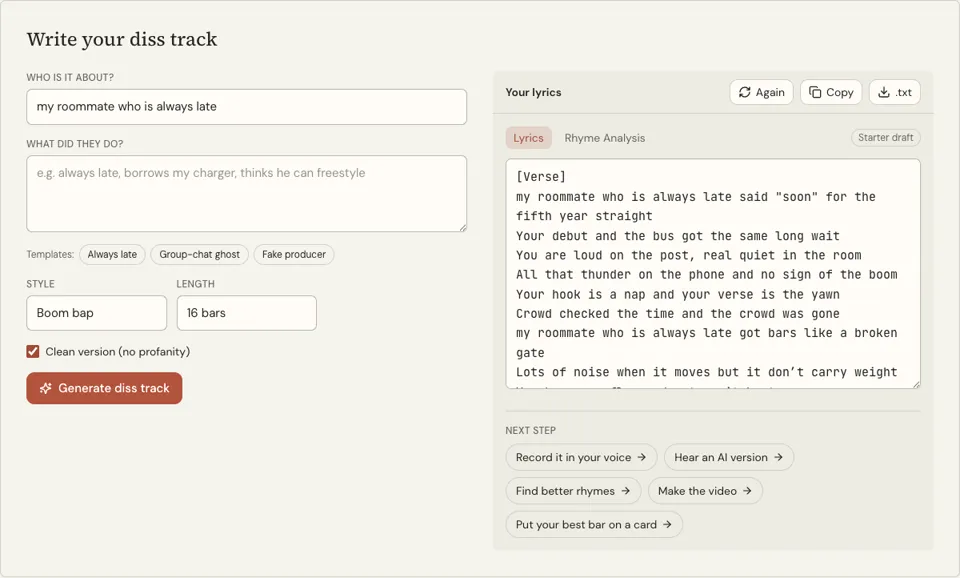
Open the diss track generator, fill in who it is about and what they did, and generate a draft. Edit it in place: swap its general lines for your own receipts.
- 03
Write the hook and test it for six minutes
Write a 4-bar hook around one repeated phrase. Play the Trap preset at 140 BPM in the rap beat maker, say the hook four times, then the verse, and record the take.
Diss track lyrics examples
Opening claim
You told the whole city that the tape drops in May, It’s winter now and there’s nothing to play, Twelve teasers posted and not one song, That’s not a rollout, that’s a ring light on
Receipts
Borrowed my hook and changed two words, Posted it on Friday like nobody heard, I’ve got the voice note, date in the file, Next time you copy, try to copy the style
Hook
Talk, talk, talk, but the page stays clean, Loud in the comments, quiet on the scene, Talk, talk, talk, where’s the sixteen? I’ll wait right here, you know where I’ve been
Calm closer
I’m not mad, I just wrote it all down, Every late session, every time you weren’t around, Keep the handle, keep the jacket, keep the pose, I’ll keep the songs and we’ll see which one grows
Try it: Diss Track Generator
Diss track lyrics FAQ
How do you write diss track lyrics?
Pick one claim about what the person did, collect specific details that support it, state the claim in the first four bars, and write a short repeatable hook. Keep the tone composed and aim at behaviour, not identity.
How long should a diss track be?
Two to three minutes is plenty: two 16-bar verses with an 8-bar hook after each, or a single 24 to 32 bar verse. If you run out of evidence before you run out of bars, the track is too long.
Can I use the example diss lyrics here?
Yes. They are original and written as models. Swap in your own details, because a diss only works when the listener recognises the facts. Using them unchanged against a real person would make little sense.
Can a diss track get me in trouble?
It can. Threats, harassment and false statements of fact about a real person can have consequences outside music, and platforms remove content that breaks their rules. Keep it truthful or clearly humorous, avoid threats entirely, and seek proper advice if unsure.
What is the difference between a diss track and a battle rap?
A battle is live, often without a beat, with both rappers present and taking turns. A diss track is a recorded song released to the public, with a beat and usually a hook. Battle bars need a room’s reaction. Diss lyrics need replay value.
Can I write a friendly diss for a friend?
Yes, and it is a good way to learn. Tease habits they would laugh at themselves, such as being late or losing their keys, and check they are happy before sharing it. The roast generator is built for that lighter tone.
Should I name the person in a diss track?
You rarely need to. If the receipts are accurate, the people involved will recognise the behaviour without a name. Never name a private person in a public release. For practice, write about an invented rival or a friend who has agreed to it.
Related reading
Related tools
Diss Track Generator
Name your target, list what they did, and get a diss verse with a two-line closer within seconds. It costs nothing and needs no account.
Roast Generator
Give a first name and a few true things about your friend, and a short rhyming roast is ready moments later. No charge, no sign-up, and nothing about how anyone looks.
Battle Rap Lyrics
Read four original battle verses, see how each sets up and lands its punch, and learn to write a 90-second round aimed at an opponent’s skill, habits and choices.
AI Rap Generator
Paste your lyrics, pick a style and get a full rap track with vocals and a beat in under a minute. Each track costs 20 credits with one free redo; an eligible verified account can hear its first track free, limited to one per browser.
Last updated November 13, 2026