How to Rap
By the end you can count bars, land a rhyme on the fourth beat, breathe without losing the pocket and finish a 16-bar verse. Every section ends with a drill you can run today.
Guide·7 min read·With exercises
How to rap: the short answer
Rapping is speaking in rhythm over a beat so that your stressed syllables fall on the drum hits and your rhymes arrive where the listener expects them. Almost all rap is in 4/4 time: four beats to a bar, with the snare on beats 2 and 4. Learn to count that and you have the grid every verse sits on.
The quickest route is this order: count the beat, put a rhyme on beat 4 of each bar, keep each bar to a syllable count you can say in one breath, then stack bars into a verse of 16. Voice, speed and wordplay come after the grid is automatic.
You do not need a studio or a natural gift. You need a loop at a steady tempo, a notes app and about fifteen minutes a day of saying words out loud on time. The five sections below take those steps one at a time.
Count the beat before you say a word
Put on a drum loop at 90 BPM and count "one, two, three, four" out loud with the kick and snare. The snare cracks on two and four. Each run of four is one bar. A standard verse is 16 of those bars and a hook is usually 4 or 8.
Now count bars instead of beats: "ONE two three four, TWO two three four" up to sixteen. At 90 BPM a bar lasts about 2.7 seconds, so a full verse is roughly 43 seconds. Do this for two minutes without rapping. If you lose the count, you would have lost it mid-verse as well.
Land the rhyme on beat four
The default home for a rhyme word is the fourth beat, on the second snare. That is where a listener’s ear waits for it. Write a line, say it over the loop and shift words until the last stressed syllable hits that snare. If it lands early, add a word at the front. If it lands late, cut one.
Start with couplets: bars 1 and 2 rhyme, bars 3 and 4 rhyme (AABB). It is the plainest scheme and it trains your timing faster than anything clever. Write four bars this way and loop them ten times before you write a fifth.
Fit the syllables to the bar
A bar has room for a limited number of syllables. At 85 to 95 BPM, 10 to 14 syllables per bar sits comfortably. Under 8 sounds sparse unless you mean it. Over 16 forces you to rush and swallow consonants. Count every line you write until your ear can tell without counting.
Four starter rhythms cover most beginner verses. Practise each one on a single line for a minute.
- Straight eighths: two syllables per beat, eight per bar, steady as a march
- Eighths with a pickup: start two syllables before beat one so the line leans forward
- Sixteenth burst: four quick syllables on beat three, then the rhyme alone on beat four
- Rest on one: stay silent for the first beat and squeeze the line into beats two to four
Breathe on purpose and hit your consonants
Running out of air is a writing problem as much as a lung problem. Mark a breath at the end of bar 2 and bar 4 of every four-bar block and leave a gap of half a beat there. Breathe low, into the stomach, with your shoulders still.
For clarity, read your verse for 60 seconds with a pencil held lightly between your teeth, then take it out and read again. Your tongue works harder against the obstacle, and the lines come out sharper afterwards. Rap at speaking volume or a little above. Whispering hides timing mistakes from you.
Write your first 16 in four blocks
Sixteen bars is four blocks of four. Give each block one job: block one says who you are, block two says where you are from or what you want, block three tells one short story, block four makes the closing claim. One subject per block keeps you from running dry at bar six.
Write the last word of each bar first, in rhyming pairs, then fill in the lines that lead to them. When all sixteen exist, rap the verse through and circle every bar where you stumble. Rewrite only those. Three passes of this turns a rough draft into a verse you can perform.
Rehearse until you can perform it
A verse is not finished until you can deliver it without the page. Learn it two bars at a time: say the first pair five times with your eyes closed, add the next pair, then join them. Sixteen bars usually settle after about twenty minutes spread across two days. Once the words are in memory, your attention is free to listen to the drums instead of reading. Rap it standing up, since posture changes how much air you have.
Then work on delivery. Use your normal speaking voice, slightly louder, and choose one word in each bar to lean on, usually the rhyme or the word that carries the meaning. Small changes in emphasis matter more than a new voice. Try the verse three ways: flat and steady, with extra energy on every fourth bar, and almost conversational. Record each version over the loop and keep the one that sounds most like you talking. Repeat that take daily for a week and compare the first recording with the seventh.
Three mistakes beginners make when learning how to rap
Writing on a silent page
Lines written without a beat read well and rap badly, because nothing told you where the stresses fall. Keep a loop running while you write, even quietly, so every bar is tested the moment it exists.
Cramming the bar
New writers treat syllables as proof of skill and pack 18 into a bar built for 12. The result is rushed and hard to hear. Cut small words until the line breathes, then add speed later on purpose.
Practising in your head
Thinking a verse and saying a verse use different muscles. Timing, breath and diction only improve out loud. Ten spoken repetitions of four bars teach more than an hour of silent reading.
How to practise rapping today
- 01
Count for five minutes
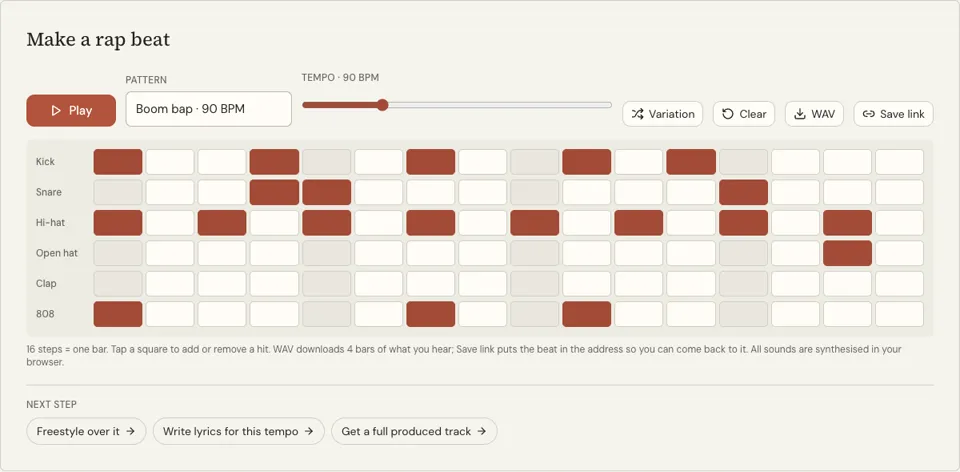
Open the rap beat maker, load the Boom bap preset at 90 BPM and press play. Count beats aloud for two minutes, then count bars up to sixteen, twice through, without rapping.
- 02
Write four bars in five minutes
Write an AABB block about your morning. Paste it into the syllable counter and trim or pad each line until every bar sits between 10 and 14 syllables.
- 03
Loop and record for eight minutes
Rap the four bars over the loop ten times in a row, breathing after bars 2 and 4. Record the last three passes on your phone and listen for rhymes that miss the snare.
Example bars and drills for learning to rap
AABB with the rhyme on beat four
Woke up early with the sun on the wall, Phone on silent so I missed every call, Pen on the paper and the loop on repeat, Four beats a bar and I land on my feet
Bar-counting drill (say it over the drums)
ONE two three four TWO two three four THREE two three four FOUR two three four, breathe
Internal rhyme inside the bar
Late night, bright light on a page gone white, Stay tight, say right what I came to write, No hype, slow type till the line sits clean, Then I lock every stop on the snare’s routine
Breath marks (/ = half-beat gap)
I keep it steady when the kick comes in, Count to the four and I begin again / Nothing in a hurry, every word has a place, Save a little air so I finish the race /
Try it: Rap Beat Maker
How to rap FAQ
Can anyone learn how to rap?
Anyone who can talk in time with a beat can learn the basics. Counting bars, placing rhymes and controlling breath are trainable skills. How far you take it depends on how often you practise out loud and how honestly you listen back to your recordings.
How long does it take to learn to rap?
With fifteen minutes of daily practice, most people can stay on beat for a written 16-bar verse within a few weeks. Sounding like yourself takes much longer, usually dozens of finished verses. Measure progress in verses completed, not in days.
What tempo should a beginner rap at?
Start between 85 and 95 BPM, the boom bap range. The beats are far enough apart that you can hear where each syllable lands. Trap tempos of 130 to 150 BPM are felt at half speed, so they are learnable next, once your counting is solid.
Do I need to freestyle to be able to rap?
No. Writing and freestyling are separate skills that feed each other. Many strong writers rarely improvise. Learn to write and perform a verse on beat first. Freestyle practice becomes much easier once the four-beat grid is automatic.
How many bars should my first verse be?
Aim for 16, the standard verse length, but build it as four blocks of four. If 16 feels like too much on day one, finish an 8-bar verse and perform it cleanly. A short verse you can deliver beats a long one you read.
Do I need equipment to start?
A phone is enough. You need something to play a loop, somewhere to type lines and a voice recorder to check yourself. A microphone and recording software only matter once you have verses worth keeping.
Related reading
Related tools
Rap Beat Maker
Press Play and a boom bap loop starts at 90 BPM. Tap squares on the 16-step grid to change the kick, snare, hats, clap and 808, then write to it. Free, no sign-up.
Syllable Counter
Paste your lines and see a syllable count beside each one, plus totals for syllables, lines and words. Counts update as you type. Free, no sign-up.
Start Rapping
Seven short sessions take you from never having rapped to a recorded 8-bar verse. Each day has one task, a time limit and a way to tell you did it right.
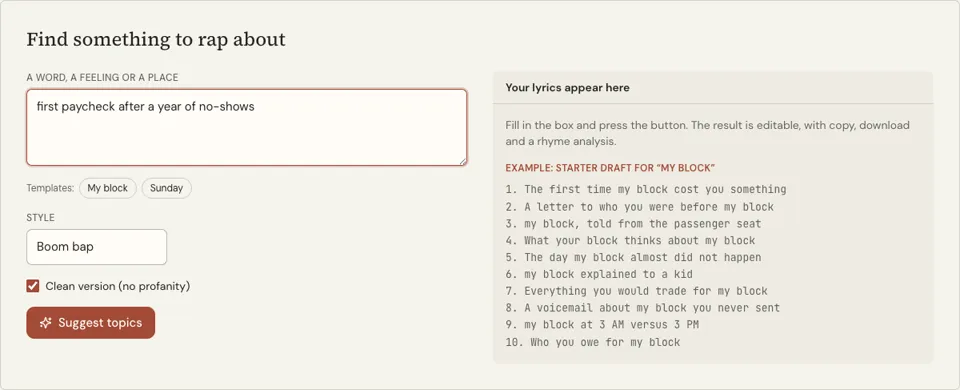
Write Rap Lyrics
Sharpen your writing at the level of the single bar: swap vague words for things a listener can see, rhyme inside the line, land a punchline and cut what is not needed.
Last updated November 12, 2026