How to Freestyle Rap
Follow the drills in order and you will be able to improvise for two minutes over a beat without stopping. Each drill has a duration, a tempo and a clear pass mark.
Guide·7 min read·With exercises
How to freestyle rap: start with one rule
To freestyle rap, put on a slow beat and keep talking in rhythm without stopping, even when the words make no sense and nothing rhymes. That single rule, never stop, is the whole first stage. Rhyme, wit and structure are layered on once your mouth trusts that the next word will come.
After that the skill is looking ahead. While you say one bar, you pick the word that will end the next bar, then build a line that walks to it. Freestyling is less about speed of thought than about choosing your landing spot early.
Expect to sound bad for the first few weeks. Everyone does, and the people who get good are the ones who kept doing short daily rounds anyway. The stages below are in order, and each has a pass mark so you know when to move on.
Stage one: sixty seconds without stopping
Set a loop to 80 or 85 BPM. Start a one-minute timer and talk on beat about what you did today. Rhyme is optional. Sense is optional. Silence is the only failure. If you blank, say "and then, and then" in rhythm until a word arrives.
Pass mark: three one-minute rounds in a row with no gap longer than one bar. Most people need a few days. Do not move on early, because every later technique assumes your mouth keeps moving while your mind works. Keep your eyes open and your body moving, a nod or a step on each beat, because a still body tends to produce a still mind. If one minute feels long, begin with thirty seconds and add ten each day.
Stage two: rhyme only the last word
Now add one requirement: the final word of bar two must rhyme with the final word of bar one. Everything else in the line can be filler. Use easy sounds first, such as "-ay" or "-ight", and stay on one sound for four or six bars before switching.
Staying on a sound is called holding a rhyme, and it is easier than changing every couplet because your brain keeps fishing in the same pond. Run two-minute rounds where you hold each sound for at least four bars. Pass mark: fewer than three missed rhymes per round. Write nothing down during these rounds. The aim is to train recall, and a pen switches your brain back to composing.
Stage three: choose the landing word first
Here is the trick experienced freestylers rely on. As bar one ends on "night", you already pick "light" for bar two, then improvise any sentence that finishes there. You are writing backwards in real time. The line can be plain, because a rhyme that lands on beat four makes plain lines sound intended.
Drill it without a beat first. Say a target word aloud, then speak a sentence that ends on it, ten times with ten words. Then repeat over the loop. You will feel the difference at once: less panic at the end of each bar. A useful extension is the two-word plan: before a four-bar block, choose both rhyme words for the two couplets, then go. Planning four bars at a time is as far ahead as most freestylers ever look.
Stage four: feed yourself subjects
Blanking is usually a subject problem. Give your brain something to talk about and the rhymes follow. Four sources never run out, and you should rotate through them inside one round.
Practise each source for one minute before mixing them. Then run a two-minute round where you switch source every four bars, in order, so changing subject becomes a reflex and not a rescue.
- What you see: objects, colours, people, the weather through the window
- What you did: today’s route, meals, messages, the last thing that annoyed you
- What you want: a plan for the weekend, a goal for the year, what you would buy
- What the beat does: name the kick, the tempo, the moment the hi-hats open up
Stage five: random words under a clock
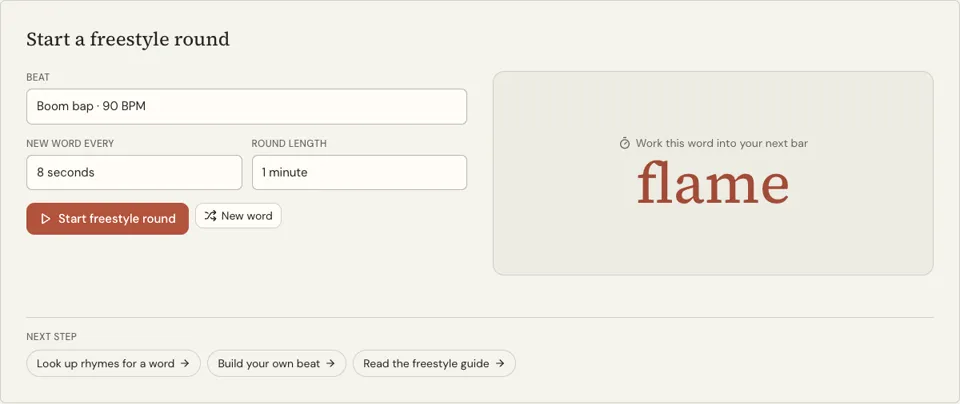
Word prompts force you off your comfortable rhymes. A new word appears and you must use it in a bar before the next one arrives. Begin with a long interval of 20 seconds per word, which gives you roughly seven bars at 85 BPM to work it in and rhyme it.
When you can do a two-minute round at 20 seconds, drop to 12, then 8, then 4. At 4 seconds you get barely more than one bar per word, which is hard and meant to be. Stay at an interval until you use at least four words out of five. If a word stumps you, say it, define it in plain speech on beat and move on. Using the word clumsily still counts. Skipping it does not.
Take it to other people
Practising alone builds the engine. A cypher, a circle of people taking turns over one beat, teaches timing, nerve and listening. Take 8 bars, end clearly and nod to the next person. Mention something the last rapper said and the circle will warm to you.
If there is no cypher near you, record a two-minute round every Sunday and keep the files. Comparing week one with week six is the clearest proof that the drills are working. Book your first recording for this week. Before any turn in a circle, listen to the tempo for a full four bars and breathe out slowly. Starting half a bar late is fine. Starting in a panic is what derails a verse.
Three mistakes beginners make when they freestyle rap
Starting on a fast beat
A 140 BPM trap loop leaves no thinking time between bars. Begin at 80 to 90 BPM, where each bar gives you almost three seconds, and raise the tempo only after two clean minutes at the slower one.
Chasing clever lines
Trying to be impressive makes you stop and search. Early on, a simple bar that lands in time is worth more than a punchline that arrives late. Wit shows up by itself once flow is steady.
Practising in long, rare sessions
One hour on a Saturday does less than ten minutes on six days. Improvising is recall under pressure, and recall is built by frequent short repetitions with rest between them.
How to practise freestyle rap today
- 01
Warm up for four minutes
Open the freestyle rap word generator and ignore the words for now. Use its drum loop for two 2-minute rounds of non-stop talking about your day. No rhymes needed, no pauses allowed.
- 02
Hold rhymes for six minutes
Run three 2-minute rounds where each pair of bars rhymes on the last word. Stay on one sound for at least four bars, and pick the landing word before each bar begins.
- 03
Add word prompts for six minutes
Set a new word every 20 seconds and do two 3-minute rounds, working each word into a bar. Count how many you used. Tomorrow, try to beat that number.
Freestyle drills with example bars
Non-stop talk (no rhyme needed)
I got up, made some toast, then I looked at my phone, And then I took the bus, and the bus was slow, And then, and then, I was thinking about lunch, Still talking on the beat, still going, still on
Holding one rhyme for four bars
I can do this every day, Got a couple things to say, If it’s work then I call it play, Move aside, I’m on my way
Landing-word drill (targets: light, door, slow, mine)
Flip the switch and the room fills up with light, Somebody’s knocking, go and check the door, Take the corner easy, take it slow, Pass the mic over here, this turn is mine
Subject rotation (see, did, want, beat)
Blue chair, cracked screen, rain on the glass, Missed my train this morning, had to run for the last, Want a quiet weekend and a plate piled high, Hear the kick knock twice while the hats tick by
Try it: Freestyle Word Trainer
How to freestyle rap FAQ
How do I start freestyle rapping with no experience?
Play a slow loop around 85 BPM and talk in rhythm for one minute without stopping. Do not worry about rhyme yet. When you can do three minutes of that across three rounds, start rhyming the last word of every second bar.
How long does it take to get good at freestyling?
With ten to fifteen minutes a day, many people can hold a simple two-minute freestyle within one to three months. Sounding sharp in front of others takes longer and depends on how much live practice you get. Daily short rounds matter more than talent.
How do freestyle rappers think of rhymes so fast?
They do not search during the bar. They know families of rhyming words by heart and choose the next end word while finishing the current line. The sentence is improvised, the landing spot is selected a few beats in advance.
Is it okay to use prepared lines in a freestyle?
A prepared opener or a reset line is normal and accepted. Reciting a whole written verse and presenting it as improvised is not, and listeners can usually tell because nothing in it refers to the moment.
What beat is good for freestyle practice?
A simple drum loop with a clear kick and snare between 80 and 95 BPM. Busy melodies distract you while you are learning. Move to faster or sparser beats once you can keep going for two minutes without a gap.
Why do I keep freezing?
Usually because you have run out of subject, not out of rhymes. Look around and describe an object, or switch to what you did today. Keep one reset line memorised so your mouth keeps the rhythm while you pick a new subject.
Related reading
Related tools
Freestyle Word Trainer
Press start and a drum loop plays while a new random word appears every few seconds. Work each word into a bar before the next one lands. Free, no sign-up.
Freestyle Beats
Press Play and a West Coast drum loop starts at 96 BPM and keeps going until you stop it. Set the tempo, switch the pattern and rap. Free, no sign-up.
Freestyle Rap Lyrics
Read four sets of original freestyle bars, learn why each one works off the top, and leave with a small bank of openers, resets and rhyme families you can use in your next cypher.
Rhyme Finder
Type a word and get its perfect rhymes in about a second, sorted by how many syllables each one has. Free, no account, English only.
Last updated November 12, 2026