Build a pulse with your hand
A beat is a steady pulse with sounds on top. You can supply the pulse yourself: tap a table four times at an even speed, count “one, two, three, four” and repeat. One full cycle is a bar. Say each line across one cycle. If a line will not fit in four taps, it will be too long on most beats as well.
Choose a speed and keep it for the whole verse. A tap about once a second is slow and spacious. If you have a metronome app, set it near 90 BPM, a middle tempo that suits a lot of rap, and write everything at that setting. Changing speed halfway is the most common reason a verse written in silence falls apart later.
Size each bar with syllables
Without drums telling you a line is crowded, the syllable count becomes your ruler. Draft a line, paste it into the Syllable Counter and read the number beside it. At a middle tempo, many writers aim for 10 to 14 syllables per bar. A bar of 18 will usually rush, and a bar of 6 leaves a gap the beat has to fill.
Keep neighbouring lines within two syllables of each other unless you want a change of pace on purpose. One short line before a punchline works as a pause. Three short lines in a row sound like you ran out of words.
Mark the stresses so the verse travels
Lyrics written in silence often look fine and then stumble on a beat because the wrong words land on the pulse. Say each line with your taps and write the syllables that fall on a tap in capitals. Those should be words that carry meaning, not “the”, “and” or “to”. Here are two original bars marked that way:
- I KEEP the old reCEIPTS in a SHOEbox by the DOOR (13 syllables)
- I COUNT them every SUNday, spread aCROSS the FLOOR (12 syllables)
- The tapped syllables are verbs, objects and the rhyme. Move these bars onto almost any beat and those words still meet the drums.
Write the verse in four-bar blocks
A 16-bar verse is easier to build without a beat if you treat it as four blocks of four bars. Give each block one job: set the scene, add a detail, turn it, land it. Rhyme the line endings inside each block, AABB or ABAB, and save the line you most want remembered for bar 16.
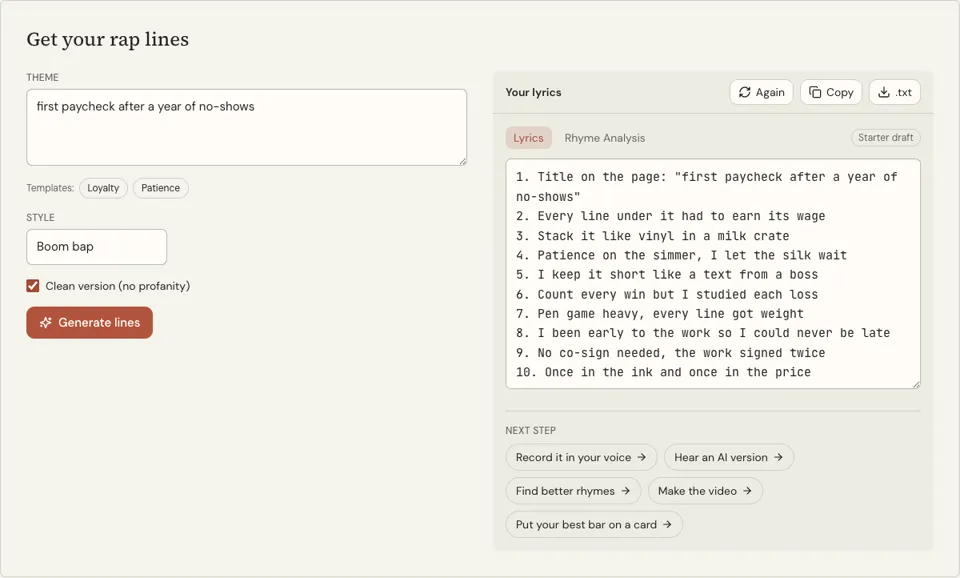
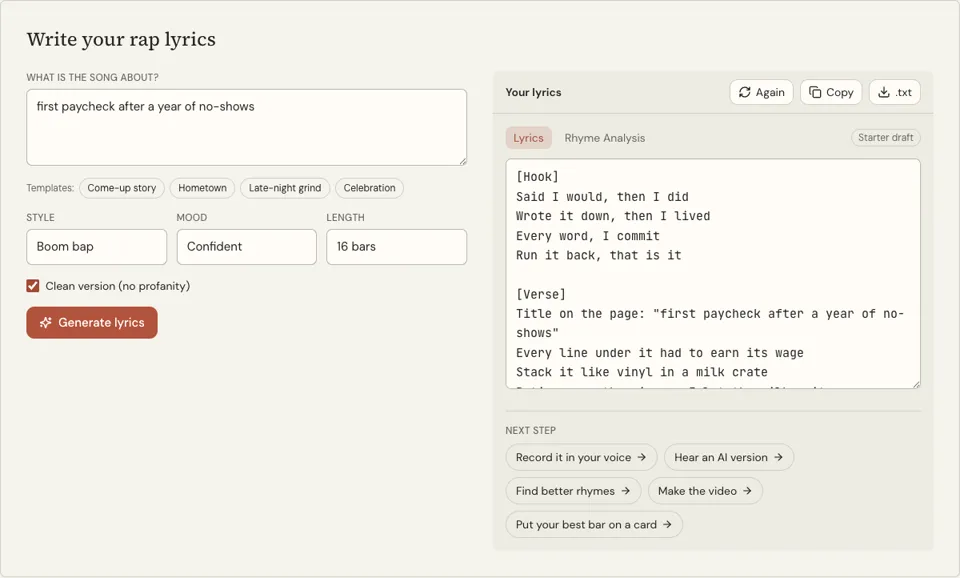
If you are stuck for a first line, the Rap Lyrics Generator writes a four-line hook and a verse of 8, 16 or 24 bars from one sentence, free and without sign-up. Use the draft to see how an idea spreads across bars, then rewrite every line in your own words. The Write Rap Lyrics guide goes further on specific detail, internal rhyme and cutting filler at the level of a single bar.
Mistakes and their fixes
Each of these shows up as soon as the verse meets real drums. Catching them on the page saves a rewrite.
- Writing in paragraphs. Fix: one line per bar and one bar per row, so every line can be counted.
- Drifting tempo. Fix: write the whole verse at one tapping speed, even if it starts to feel slow.
- Lines that only work at one speed. Fix: say the verse at a slow tap and a quick tap, and rewrite any bar that survives only one.
- Rhymes that land in the middle of the bar by accident. Fix: move the rhyme word towards the fourth tap.
- No room to breathe. Fix: leave one bar in every four a little short.
Test it the day a beat arrives
That is how to write rap lyrics without a beat; the last step happens once you have one. Rap the verse once without changing anything and record it on your phone. Mark the bars that rush or drag, then trim or pad only those. A verse written to a steady tap usually needs small edits, not a rewrite.
Then learn it so you can perform it without the page. The Memorize Rap Lyrics guide shows you how to chunk a 16-bar verse into four-bar blocks, chain them together and test yourself over a loop, which fits a verse that was already written in blocks.