How to Memorize Lyrics for Rap
You will have a method for getting a 16-bar verse off the page and into memory: chunk it, chain it, test it over the beat and review on a schedule.
Guide·6 min read·With exercises
How to memorize lyrics: chunk, chain, test, space
To memorize lyrics, break the verse into four-bar chunks, learn one chunk at a time by saying it aloud until you can do it without looking, join each new chunk to the ones before it, and then test yourself from memory over the beat. Review later the same day, the next day and two days after.
The step that does the work is the test. Reading a verse twenty times feels productive but builds recognition, not recall. Covering the page and trying to say the line, even when you fail, is what fixes it in memory.
Rap is easier to memorise than plain text because rhyme and rhythm give you cues. Use them: each rhyme word pulls up the next, and the beat tells you how long each line lasts. That is why a verse often sticks faster than a paragraph of the same length.
Understand it before you drill it
Meaning is the strongest memory aid. Read the verse once slowly and write a three or four-word summary beside each group of four bars: "morning, kitchen", "the argument", "bus ride", "decision". Those four notes are your map.
If you wrote the verse, this takes a minute. If you are learning someone else’s part for a show or a feature, look up any word or reference you do not understand. Then say the four summaries aloud from memory before learning a single line.
Picture each block as a scene in a place you know well, such as rooms of your home, one block per room. Walking through the rooms in your mind gives you the order of the verse even when a single line escapes you.
Chunk and chain
Work in blocks of four bars. Say bar 1 aloud while reading, then without looking. Add bar 2 and say both. Continue to bar 4. When the first block is solid, learn bars 5 to 8 the same way, then say bars 1 to 8 together.
The joins between blocks are where memory fails, so practise them directly: say the last line of one block and the first line of the next as a pair, five times. A 16-bar verse has three joins. Drill each one.
Say the lines at full performance volume, not under your breath. The movement of your mouth and the sound of your own voice are extra cues, and whispered practice leaves them out.
- Bars 1 to 4 alone, three clean passes
- Bars 5 to 8 alone, then 1 to 8
- Bars 9 to 12 alone, then 1 to 12
- Bars 13 to 16 alone, then the full verse
Use rhymes and first letters as cues
Write only the rhyme words down the side of a card, one per bar. Try to rebuild each line from its last word. Because you know the rhyme is coming, the rest of the line tends to follow.
If that is too hard at first, write the first letter of every word in the bar: "S a t h t" for "Six a.m., the heater ticks". The letters prompt without giving the words away. Move from full text to first letters to rhyme words only, then to a blank card.
Gestures help as well. Attach a small hand movement to the key word of each bar, pointing, counting on fingers, a push away. On stage the movement often brings the word back before you consciously remember it.
Test over the beat, standing up
Memory depends on context. A verse learned sitting silently can vanish when the beat starts and you are on your feet. As soon as you can say the verse without the page, switch to rapping it at full voice over the instrumental or a drum loop at the same tempo.
When you blank, do not stop the beat. Mumble the rhythm through the gap and come back in on the next line you know, then check the page afterwards. Recovering in time is a performance skill by itself, and it shows you exactly which lines need more work.
Start slower if the song is fast. Run the verse at about 80 per cent of the tempo until it is clean, then at full speed. Rushing through errors at tempo only rehearses the errors.
Space the reviews
One long session fades fast. Short reviews spread across days hold. After your first session, run the verse again a few hours later, once before sleep, the next morning and two days after that. Each review takes under three minutes.
Sleep does part of the job, so learning in the evening and testing in the morning works well. Set phone reminders for the reviews now, before you start learning.
- Same day: once after a break of a few hours, once before bed
- Day 2: morning, from memory, with the beat
- Day 4: full performance, recorded
- Weekly after that, or the day before any show
Make it survive pressure
Before a show or recording, rehearse under mild stress. Rap the verse while walking, while doing the dishes, at a faster tempo, and to one other person. Start from bar 9 without the run-up. If it holds through distraction, it will hold on stage.
Record one full take on your phone and listen for lines where you slowed or swallowed words. Those are the ones still half learned.
For a full set, memorise the order of songs and the first line of each as their own list. The first line is the hardest to find under lights, and once it is out the rest tends to follow.
Three mistakes people make memorizing lyrics
Rereading instead of recalling
Looking at the page feels safe, and that is the problem. Memory strengthens when you struggle to retrieve a line. Cover the text early and accept the mistakes.
Always starting from bar 1
If every run begins at the top, the first four bars get fifty repetitions and the last four get ten. Begin some passes at bar 9 or 13 so the ending is as solid as the opening.
Learning it without the beat
Words learned as text come out with the wrong timing. Add the instrumental as early as you can, so rhythm and lyrics are stored together and each recalls the other.
How to memorize lyrics today
- 01
Map and cue (5 minutes)
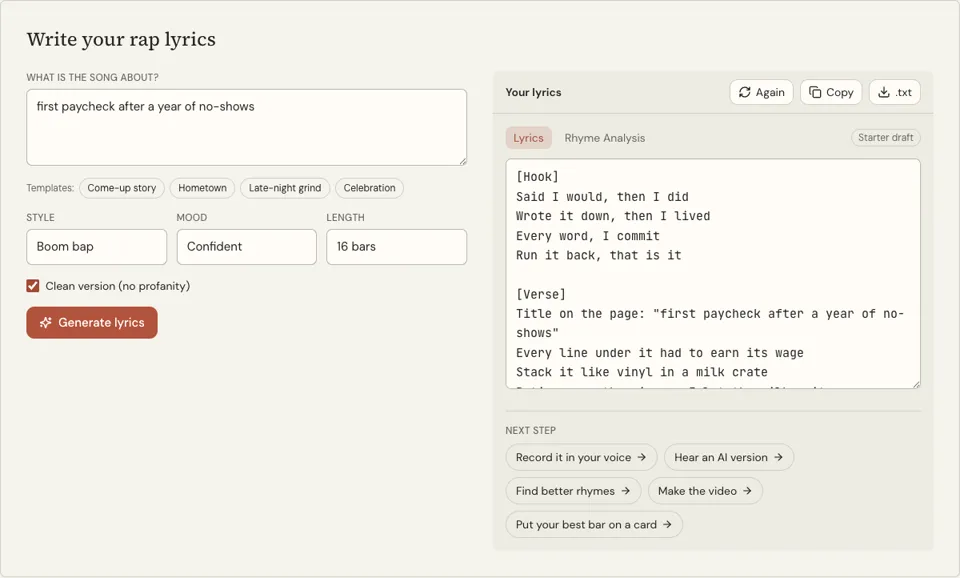
Choose a 16-bar verse. Paste it into the rhyme scheme analyzer to see the end-rhyme letters, then write the four block summaries and the 16 rhyme words on a card.
- 02
Chunk and chain (10 minutes)
Learn bars 1 to 4, then 5 to 8, joining as you go, saying every line aloud. Drill the join between bar 4 and bar 5 five times. Use the card only when stuck.
- 03
Test with a loop (5 minutes)
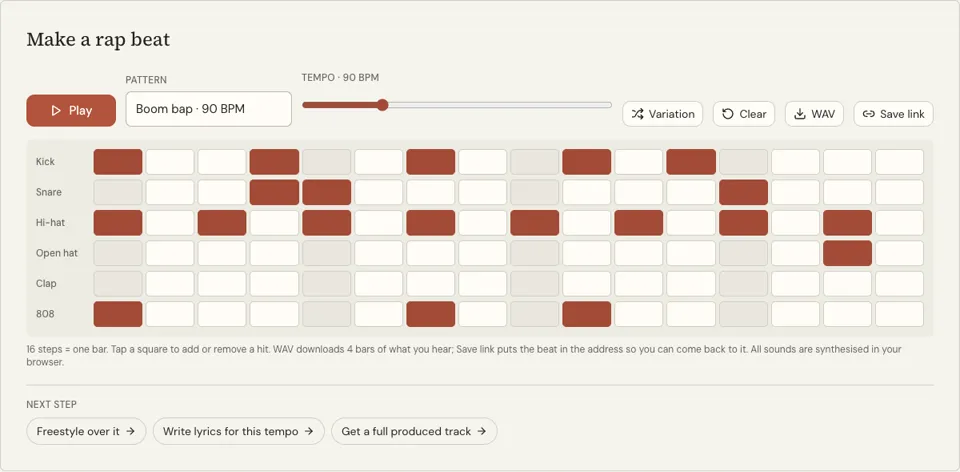
Play a preset in the rap beat maker at your song’s tempo and rap the eight bars standing up, three times, without the page. Set reminders for tonight and tomorrow morning.
Lyric memorizing examples: cue cards for four bars
Full text
Streetlight flickers on the corner where we stood Promised we would leave as soon as anybody could You went north for work, I stayed for the sound Now I say your name whenever I am back around
First letters
S f o t c w w s P w w l a s a a c Y w n f w, I s f t s N I s y n w I a b a
Rhyme words only
stood could sound around
Block summary map for 16 bars
Bars 1 to 4: the corner, the promise Bars 5 to 8: the phone call Bars 9 to 12: first show without you Bars 13 to 16: coming back
Try it: Rap Beat Maker
How to memorize lyrics FAQ
What is the fastest way to memorize lyrics?
Learn in four-bar chunks, say each aloud without looking as soon as possible, and chain the chunks together. Then test over the beat. Active recall with short spaced reviews is faster than rereading the page many times.
How long does it take to memorize a 16-bar verse?
A first pass often takes 20 to 30 minutes of focused work. It will not be reliable yet. Three or four short reviews over the next two days are what make it stay.
Why do I forget lyrics on stage?
Usually because the verse was learned in a calm setting and never tested under pressure. Rehearse standing, at full volume, with the beat, in front of someone, and practise recovering after a deliberate blank.
Is it easier to memorize lyrics I wrote myself?
Yes, because you already know the meaning and chose the rhymes. You still need to drill them. Many rappers find that freshly written verses feel memorised until the beat starts.
Does writing lyrics by hand help?
For many people it does. Writing a verse out from memory is a recall test, and the slower pace makes you notice each word. Check it against the original and mark the lines you missed.
Should I memorize before recording?
It helps. Reading from a phone tends to flatten delivery, because part of your attention is on the screen. Knowing the verse lets you concentrate on tone, timing and energy for each take.
Related reading
Related tools
Rap Beat Maker
Press Play and a boom bap loop starts at 90 BPM. Tap squares on the 16-step grid to change the kick, snare, hats, clap and 808, then write to it. Free, no sign-up.
Rhyme Scheme Analyzer
Paste a verse or poem and see its rhyme scheme as letters, one per line, with a syllable count beside each. Results update as you type. Free, no sign-up.
Find Your Rap Voice
You will have a repeatable test for finding the pitch, energy and tone that suit you, plus breath and diction drills to make that voice hold up for 16 bars.
How to Rap
By the end you can count bars, land a rhyme on the fourth beat, breathe without losing the pocket and finish a 16-bar verse. Every section ends with a drill you can run today.
Last updated November 12, 2026