How to Write Rap Lyrics
Sharpen your writing at the level of the single bar: swap vague words for things a listener can see, rhyme inside the line, land a punchline and cut what is not needed.
Guide·6 min read·With exercises
How to write rap lyrics people remember
To write rap lyrics, start from a specific thing you have seen or done, put it into lines of 10 to 14 syllables that fit a four-beat bar, rhyme the ends and some of the middles, and revise out loud until nothing trips your tongue. Strong lyrics are mostly specific nouns and active verbs arranged so the stressed words hit the drums.
Most weak bars fail the same way: they are general. "I work hard every day" could be anyone. "Two buses and a night shift, home when the birds start" is one person. Detail is what makes a listener believe you, and belief is what makes a punchline or an emotional line land.
This guide stays at line level. For shaping a whole track, see the guide on how to write a rap song. Here you are polishing individual bars. Each technique below comes with a short drill you can run on a verse you already have.
Trade general words for things you can see
Go through a draft and underline every abstract word: struggle, success, pain, haters, grind. For each, ask what it looked like on one particular day. "Struggle" becomes a declined card at the till. "Success" becomes your mother’s rent paid in March. Put the picture in the bar and delete the label.
A useful test is whether a camera could film the line. Aim for at least one filmable image every two bars. Write a list of ten objects from your own week, with brand, colour or place attached, and use three of them in your next four bars.
Rhyme in more than one place
End rhyme holds a verse together. Internal rhyme makes it move. Place a word in the middle of the bar, usually on beat two, that rhymes with the word on beat four, or echo the previous bar’s end rhyme early in the next line.
Mix rhyme types so the pattern does not become a nursery rhyme. Near rhymes such as "home" and "stone" sound natural and widen your choices. Take a plain AABB block and add one internal rhyme to each bar without changing the end words.
- End rhyme: the last stressed syllables of two bars match
- Internal rhyme: a mid-bar word matches the end word
- Near rhyme: vowels match and consonants differ
- Multi: two or more syllables in a row match
Put the important words on the beats
In speech we stress the words that carry meaning. In a bar, beats one to four are the strong positions. When the meaning words sit on those beats, a line sounds natural and forceful. When "the" or "of" lands on a beat, it sounds like the rapper is fighting the drums.
Say a line over a loop and clap the four beats. Note which word each clap falls on. If two of the four are small connecting words, reorder the sentence or swap a word until nouns and verbs take those spots. Do this for four bars and compare recordings of the old and new versions.
Build punchlines with a setup and a flip
A punchline is a line whose last few words change the meaning of what came before. The setup leads the listener to expect one thing, and the flip delivers another, often through a word with two senses or a comparison that turns.
Work backwards. Find the flip first: a word with a double meaning, such as "bars", "notes", "sharp" or "record". Then write a setup line that points to the first meaning, so the second arrives as a surprise. Keep the flip word at the very end. Write three setup lines for one flip and choose the shortest.
Cut until it is tight
Filler words pad a bar to reach the rhyme: "yeah", "like", "you know", "I’m saying", stacked "and"s. Read each line and remove any word whose absence changes nothing. If the bar is now short, add a detail, not another filler.
Watch for stock phrases as well, the ones you have heard in a hundred songs. Replace each with your own way of saying it, even if it is plainer. Last, rap the verse three times at full voice and fix whatever catches your tongue. Count how many words you cut. On a first draft of 16 bars, ten to twenty is normal.
Use comparisons only you would make
Similes and metaphors are everywhere in rap, and the common ones have gone flat: cold as ice, sharp as a knife, hot like fire. A comparison earns its place when it is exact and a little unexpected. Listeners enjoy the small jolt of an image they have not heard before. Draw from what you know that others do not: your job, your sport, your grandmother’s kitchen, the game you play too much.
A simple method is to finish the sentence "it was like" five times for the same feeling, discarding the first two answers because they are the ones everybody gives. The third or fourth is usually yours. Keep the comparison short, ideally in the second half of the bar, and do not explain it. If it needs explaining, it is the wrong image. One fresh comparison every four bars is enough. More than that and the verse becomes a list. Take one emotion from your draft, write five "like" endings for it and put the fourth into a bar.
- Flat: quiet as a mouse
- Exact: quiet as a group chat after a bad joke
- Flat: tired like a dog
- Exact: tired like the last bus driver on a Sunday
Where to find something to write about
A blank page is usually a topic problem, not a talent problem. Bars come easier when the subject is small. "My life" gives you nothing to hold. "The morning I missed the interview" gives you a bus stop, a time on a phone screen and a feeling. Narrow the topic until it fits in one room or one hour.
Keep a running note on your phone and add one line a day: something overheard, a price, a street name, a sentence someone said that stuck. After a month you have thirty starting points that belong to nobody else. When you sit down to write, pick one and ask three questions: where was I, what could I see, what did I want.
- A job you had, told through one shift
- An object you kept longer than you should have
- The last argument you lost, from the other person's side
- A place that has closed, described from memory
- Something you are good at that nobody asked about
One bar through four drafts
Revision is easier to copy when you can watch it happen. Start with a flat line: "I was broke but I kept on working hard". It scans, and it gives a listener nothing to picture. Draft two swaps the labels for a scene: "Counted coins for the bus, walked the last two stops". Now there is a person in it.
Draft three adds sound. "Counted coins for the bus, cut the last two stops" repeats the hard C three times and puts the short U of "bus" and "cut" side by side. Draft four fits the bar to the beat by placing the meaning words on the counts: "COUNT-ed coins for the BUS, cut the LAST two STOPS". That is 11 syllables with four clear stresses.
The idea never changed between drafts. Only the choices did: picture, then sound, then placement. Run your own weakest bar through the same three passes, in that order.
Sound beyond rhyme: alliteration, assonance and run-on lines
Rhyme is one way to make words echo. Alliteration repeats a starting consonant: "battered boots by the back door". Assonance repeats a vowel in words that do not fully rhyme: "late trains, grey days, same face" all carry the long A. Both make a bar feel written without forcing an end rhyme, which helps when the obvious rhyme word would bend your meaning.
A run-on line lets a sentence spill across the bar line instead of stopping with the rhyme. "I told my brother I would call him when the / money came, and then it came and I forgot" ends bar one mid-thought, so the listener leans into bar two. One run-on in every eight bars is plenty. More than that and the rhymes stop working as landmarks.
Mark a verse with three colours, one each for alliteration, assonance and run-ons. A verse with none of the three is leaning on end rhyme alone.
Three timed drills for a daily habit
Short daily drills beat one long weekly session, because each skill needs repetition more than it needs hours. Set a timer and stop when it rings, finished or not. Rotate the three drills below across the week, and keep everything in one notebook so you can lift lines later.
Once a week, read back through the notebook and copy the two strongest lines onto a separate page. That page is where you go when a verse needs an opening.
- Word chain, 5 minutes: write one word, then the first word it suggests, for 20 links. Circle the three oddest pairs and put one in a bar.
- Other eyes, 10 minutes: write 4 bars about your street as a delivery driver, a child or a stray cat would see it.
- Object study, 10 minutes: put one object on the table and write 8 bars that never name it.
Give sixteen bars a shape
A verse with strong lines can still drift if nothing changes between the first bar and the last. Before drafting, split the sixteen bars into four blocks of four and give each block a job. The first shows where you are. The second brings in the problem or the other person. The third is the turn, where something is decided, admitted or lost. The fourth lands on a single image or a line that answers the opening.
Write one plain sentence for each block, then draft the blocks in any order. Many writers start with the third, since the turn is the reason the verse exists, and build toward it. When the draft is done, read only bars 1 and 16 aloud, one after the other. If they could be swapped without anyone noticing, the verse has not moved. Rewrite the last block until it could only come at the end.
Three mistakes beginners make when they write rap lyrics
Rhyme first, meaning second
Choosing words only because they rhyme produces bars that sound fine and say nothing. Decide what the line means in plain speech, then find the rhyme that carries that meaning, or pick a different end word.
Telling instead of showing
Announcing that you are hungry, real or different convinces no one. One concrete scene, a time, a place, an object, does the persuading for you and gives the listener something to picture.
Never revising
First drafts carry filler, awkward stresses and borrowed phrases. Writers who improve are the ones who rework a verse two or three times aloud. The draft is raw material, not the finished piece.
How to practise writing rap lyrics today
- 01
Gather detail for four minutes
List ten specific things from your week: places, objects, prices, times. Choose three that belong to one moment and say in one sentence what happened there.
- 02
Draft and study for six minutes
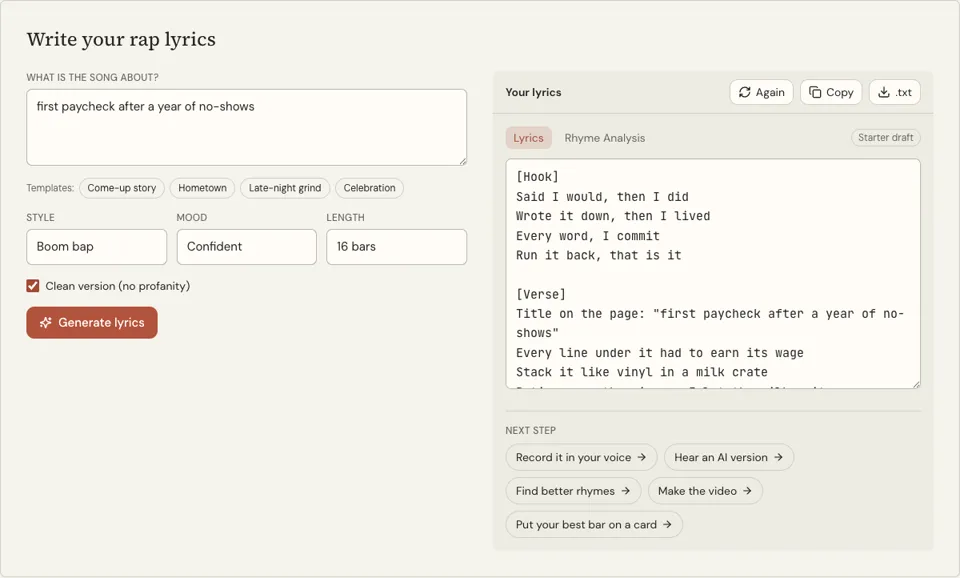
Write four bars from those details. Then set the rap lyrics generator to Length 8 on the same topic and open its Rhyme analysis tab to see the scheme letters and syllable counts.
- 03
Revise for seven minutes
Add one internal rhyme per bar, cut every filler word, and run your four bars through the syllable counter to keep each between 10 and 14. Rap the result three times and record it.
Example bars for writing rap lyrics
General to specific
Before: I work so hard, I struggle every day After: Two buses to the night shift, home when the birds start Before: Money was tight when I was growing up After: Mum cut the toothpaste tube to get the last out
Internal rhyme on beats two and four
Packed my bag in the dark and I ran for the gate, Missed the first train, then the next one was late, Got a seat by the door with my head on the glass, Watched the whole town wake as the stations went past
Setup and flip (double meaning: "notes")
Teacher said I never paid attention in class, Always in the back with a pen and a pad, Now I’m at the bank with a smile on my face, Turns out I was taking notes all along
Filler cut
Before: Yeah, you know I’m like really on my way up, like After: Third floor now, still taking the stairs Before: And I’m saying that I’m never gonna stop, yeah After: Same pen since the winter, ink still wet
Try it: Rap Lyrics Generator
How to write rap lyrics FAQ
How do I write good rap lyrics as a beginner?
Write about one specific moment using objects, places and times a listener can picture. Keep bars to 10 to 14 syllables, rhyme the last word of each pair, and say every line aloud over a beat. Then cut filler and rewrite the bars that stumble.
How many syllables should a rap line have?
At 85 to 95 BPM, 10 to 14 syllables per bar is a comfortable range. Fewer gives space, more gives urgency. Consistency matters: neighbouring bars with similar counts are easier to deliver on beat.
What is a punchline in rap?
A line whose ending reframes what came before, through wordplay, a double meaning or an unexpected comparison. It needs a setup that creates an expectation. The key word goes last, followed by a short pause so it registers.
What is internal rhyme?
Rhyme that happens inside a bar instead of only at its end. A word in the middle of the line matches the last word, or matches a word in the next line. It adds rhythm and makes a verse sound more intricate without extra syllables.
How do I stop my lyrics sounding corny?
Corny lines are usually borrowed phrases or forced rhymes. Replace stock expressions with your own plain description, choose meaning before rhyme, and prefer a true small detail over a big claim. Reading the verse to a friend exposes weak lines fast.
Should I write lyrics with or without a beat?
With one. A looping beat tells you at once whether a line fits the bar and where its stresses fall. If you have an idea away from a beat, note it down, then test and reshape it over a loop later.
How long does it take to write a 16-bar verse?
A first draft can take 20 to 40 minutes once you have a topic. Revision takes longer: plan two or three further passes on different days. Speed comes with practice, and a slow verse full of specific detail is worth more than a quick one made of filler.
Related reading
Related tools
Rap Lyrics Generator
Describe your song in a sentence, choose a style, mood and length, and a four-line hook plus a verse comes back in a few seconds. Free, with no sign-up and no credits.
Rhyme Finder
Type a word and get its perfect rhymes in about a second, sorted by how many syllables each one has. Free, no account, English only.
Multisyllabic Rhymes
Understand what makes a multisyllabic rhyme, build your own from any phrase in four steps, and write four bars that chain a three-syllable rhyme from start to finish.
Rap Punchline Generator
Enter a word with more than one meaning, pick a style, and get a numbered set of two-line punchlines a few seconds later. Each one sets up, then flips. Free to use without an account.
AI Ghostwriter
Write a short brief, who you are, what happened, how the verse should feel, and get a first-person verse plus three alternative opening lines in seconds. Free, with no sign-up.
Last updated November 13, 2026