What the count tells a songwriter
Every line of a song has to fit a fixed slot of time: one bar of a rap verse, or one phrase of a melody. The syllable count is a quick measure of how much you are asking your mouth to fit into that slot. When two lines share a slot, such as line one of verse one and line one of verse two, their counts should sit close together.
The number does not tell you where the stresses fall, and stress decides how a line feels. Eleven syllables with the strong words on the beat can feel easier than nine that fight it. Treat a syllable counter for songs as a way to find suspects quickly, then let your voice decide which ones are guilty.
Count a whole song in five minutes
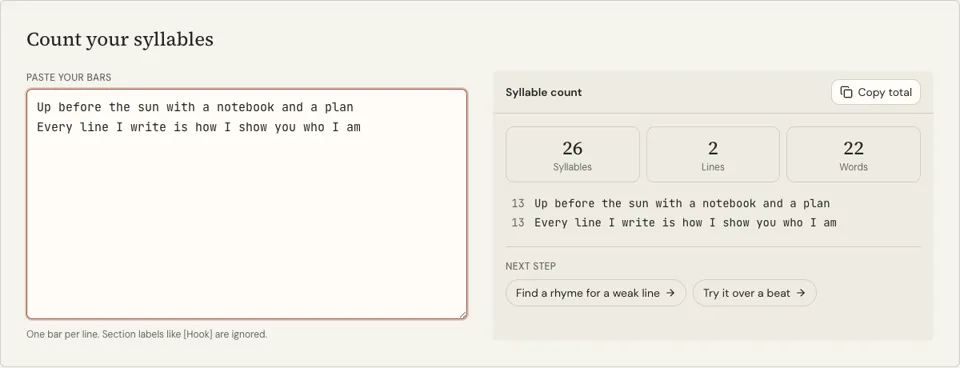
The Syllable Counter takes a full lyric sheet: paste the song and read a count in front of every line, plus totals for syllables, lines and words. Keep labels such as [Verse 1] and [Hook] on their own rows in square brackets. They are skipped, so the numbers stay clean and you do not have to strip the sheet first.
- Paste the lyric with one line per row.
- Compare verse one with verse two line by line: line 1 with line 1, line 2 with line 2.
- Mark any pair that differs by more than two syllables.
- Rap or sing each marked line over the beat or the melody and note where it rushes or drags.
- Edit in the box, watch the number change, then read the whole song aloud once more.
Working ranges for each part of a song
These are starting points, not laws. In rap at a moderate tempo, many writers keep verse bars between 10 and 14 syllables. Slower beats leave room for more words, and double-time passages hold far more. The How to Rap Fast guide is where you practise packing extra syllables onto a finer grid without slurring them.
Hooks usually run shorter than verse lines because a short line is easier for a listener to repeat. If your hook bars count the same as your densest verse bars, the hook will probably feel like more verse. For how many lines each section should have, the Bars in a Verse guide explains 16-bar verses and 8-bar hooks and shows you how to count them on a beat.
- Rap verse bar at a middle tempo: 10 to 14 syllables.
- Hook line: often 6 to 10 syllables.
- A 16-bar verse at 12 per bar: about 190 syllables.
- Partner lines across verses: within two of each other.
A worked example
Here is a verse-one couplet and the verse-two couplet that has to sit on the same part of the beat. The numbers are what the counter shows for each line.
- Verse 1, line 1: I fold the night shift into a paper plane (11)
- Verse 1, line 2: and throw it from the window down the empty lane (12)
- Verse 2, line 1: My mother counts the coins out on the kitchen table (13)
- Verse 2, line 2: and every single coin is for the rent and cable (13)
- Revised verse 2, line 1: Mom counts the coins out on the kitchen table (11)
- Revised verse 2, line 2: and every coin is for the rent and the cable (12)
Mistakes that throw the numbers off
In the example, the first draft of verse two ran one and two syllables long, so it would have rushed on bars that verse one fills comfortably. Cutting “My mother” to “Mom” and “every single coin” to “every coin” fixed both without losing the picture or the rhyme. Most count problems come from a handful of habits like these.
- Digits instead of words. Write numbers the way you say them, so the count matches your delivery.
- Spelling you do not sing. If you say “gonna”, write gonna; if you sing “going to”, write that.
- Ad-libs left in the line. Take them out while you count, since a backing voice does not use the lead’s breath.
- Trusting the count on names and slang. The counter estimates from spelling, so an unusual name or a borrowed word can be off by one. Clap those yourself.
- Matching numbers but not stress. If two lines tie and still feel different, check which syllables land on the beat.
Check the rhyme in the same pass
Once the counts line up, paste the same verse into the Rhyme Scheme Analyzer. It gives every line ending a letter, so the example above reads AABB, and it prints a syllable count beside each line, which lets you check rhyme and length in one view. Any letter that shows up a single time is a line still waiting for a rhyme.
Both tools run in your browser as you type, with no sign-up and no button to press. Finish by recording one take on your phone over the beat. The recording catches stress problems that no counter can see, and it is the version your listener will actually hear.