How Many Bars in a Verse?
You will know the standard lengths for a verse, hook, intro and bridge, be able to count bars on any beat, and choose the right verse length for a song.
Guide·6 min read·With exercises
How many bars in a verse: 16 is the standard
A standard rap verse has 16 bars. A bar is four beats in 4/4 time, so a verse is 64 beats, and in most lyric sheets one written line equals one bar. When someone asks for "a sixteen", they mean one verse.
It is a convention, not a law. Verses of 8 and 12 bars are common on songs under three minutes, on tracks with several guests and in the last verse of a song. Storytelling records sometimes run 24 or 32 bars.
The hook is usually 8 bars, sometimes 4. A typical song has two or three verses with the hook between them, which lands between two and a half and four minutes at most tempos. The sections below show how to count all of this on a real beat.
How to count a bar
Put on any rap instrumental and count "1, 2, 3, 4" with the pulse. The snare or clap normally hits on 2 and 4. Each time you get back to 1, a new bar starts. Count bars by replacing the 1 with the bar number: "1, 2, 3, 4; 2, 2, 3, 4; 3, 2, 3, 4".
Beats are usually arranged in groups of four and eight bars. You can hear it: a drum fill, a dropped kick or a new sound tends to arrive at bar 5, 9 or 13. Count along with one full verse of a song you know and tap the table each time a four-bar group ends.
If you lose the 1, listen for the kick. In most rap beats the heaviest kick drum lands on beat 1 of each bar, and a melody loop usually restarts there too.
How long 16 bars last at each tempo
The length of a bar in seconds is 240 divided by the BPM. Multiply by 16 for a verse. Fast beats in trap and drill are often counted at half speed, so a 140 BPM beat can feel like 70, and the verse lasts longer than the raw number suggests.
- 78 BPM (lo-fi): one bar is about 3.1 seconds, 16 bars about 49 seconds.
- 90 BPM (boom bap): one bar is about 2.7 seconds, 16 bars about 43 seconds.
- 96 BPM (West Coast bounce): one bar is 2.5 seconds, 16 bars 40 seconds.
- 140 BPM counted in full: 16 bars take about 27 seconds. Counted in half time at 70, they take about 55.
Standard lengths for every section
Sections are nearly always multiples of four bars, because that is how producers build beats. Knowing the usual sizes lets you write to a beat you have not heard in full.
These are habits, and producers break them for effect, for example by cutting a hook to six bars so the next verse arrives early. When a section feels oddly short or long, count it; you will usually find it is two or four bars off the norm.
- Intro: 4 or 8 bars, often instrumental or with ad-libs.
- Verse: 16 bars, with 8 and 12 as common shorter forms.
- Hook: 8 bars, or 4 bars said twice.
- Bridge or breakdown: 4 or 8 bars, used once, usually before the last hook.
- Outro: 4 to 8 bars, often the beat riding out.
Common song layouts
The classic layout is intro, verse, hook, verse, hook, verse, hook: three sixteens and three eights, 72 bars plus the intro. At 90 BPM that is a little over three minutes.
The shorter modern layout opens with the hook, then runs verse, hook, verse, hook with 12-bar verses. That is 56 bars and comes in around two and a half minutes. Pick a layout before you write, and write the bar counts on a line at the top of your page: 4, 16, 8, 16, 8, 16, 8.
Leave a bar of space where sections meet. Many rappers stop on beat 3 of bar 16 and let the beat play alone into the hook, which makes the entry of the hook hit harder.
When to use 8, 12, 24 or 32 bars
Choose the length that fits what you have to say. Padding a 12-bar idea to 16 gives you four weak lines; cutting a story to fit 16 can remove the ending.
- 8 bars: a guest spot, a third verse, or a song with a long sung hook.
- 12 bars: short songs and fast tempos where 16 lines of dense words would tire the ear.
- 16 bars: the default. Use it unless you have a reason not to.
- 24 or 32 bars: storytelling, a showcase with no hook, or an opening verse on a mixtape track.
Written lines versus bars
One line per bar is the habit, but it is only a habit. A long line can run across the bar line, and some writers split one bar into two short lines on the page. What counts is the music: a 16-bar verse fills 64 beats however you lay it out.
To check a verse you have written, play the beat, start on bar 1 and tap once per bar while rapping. If you finish on tap 15 or 17, find the line that is too short or too long.
A pickup is the usual reason for confusion: a few syllables said just before beat 1 that belong to the next line. They sit at the end of the previous bar and do not add a bar to the verse.
Split the 16 into four groups of four
Sixteen bars are easier to write as four small blocks than as one long run. Beats change every four bars, and listeners take in a verse the same way: they expect something to resolve at bars 4, 8, 12 and 16. Give each block one job and a payoff in its last bar, whether that is a punchline, the end of a sentence or a turn in the story.
Here is one block with the payoff in bar 4: "Alarm at five, the flat still dark / Shoes by the door where I left them to dry / Bus pass, notebook, half a cold tea / Same seat every day, new verse every ride". Three bars set up and the fourth completes the idea. Draw a line under every fourth bar on your page and check that the bar above it finishes something.
- Bars 1 to 4: set the scene and state the subject.
- Bars 5 to 8: add detail or raise the stakes.
- Bars 9 to 12: change something, such as the flow, the rhyme sound or the point of view.
- Bars 13 to 16: deliver the strongest line and close the thought.
How many words fit in 16 bars
A bar at a mid tempo holds 10 to 14 syllables comfortably, so a 16-bar verse carries roughly 160 to 220 syllables. Everyday English runs at about one and a half syllables per word, which puts a typical verse near 110 to 150 words. That is shorter than most people guess: less than one page of a notebook.
Use the number as a budget. A 12-bar verse is about 80 to 110 words and an 8-bar verse about 55 to 75. If your draft of a sixteen runs to 250 words, it will not fit without double time. If it is 70 words, the bars will have long gaps. Paste the draft into the syllable counter, read the total and divide by the number of bars you planned. A result between 10 and 14 suits 85 to 95 BPM.
Why the second half sags, and how to fix it
Most verses are written top to bottom, so bars 1 to 8 get the fresh ideas and bars 9 to 16 get what is left. Listeners notice. The usual signs are rhymes that reuse words from earlier, lines that restate bar 3 in different terms and a last bar that simply stops.
Write the ending first. Decide what bar 16 says, draft bars 13 to 15 to lead into it, and only then go back to bar 1. Plan one change at bar 9 so the second half sounds different from the first. If the verse still runs out of material at bar 12, that is your answer on length: end it there.
- Bar 16 written before bar 1
- A switch of flow or rhyme sound at bar 9
- No rhyme word used twice
- Strongest line placed in bars 13 to 16, not bar 2
Memorise and record in four-bar blocks
The four-bar habit helps after the writing too. To memorise a sixteen, learn bars 1 to 4 until you can say them twice without the page, add bars 5 to 8, then run all eight. Repeat for the second half and join the two. Four short blocks stick faster than sixteen lines read over and over.
When recording, you do not have to deliver all 16 bars in one take. Many rappers record in sections of four or eight bars and overlap the takes slightly, which keeps the voice strong to the end. Plan the joins at the block boundaries, where a breath falls anyway. On stage there are no joins, so make sure you can also perform the whole verse straight through before you book a set.
Three mistakes people make counting bars in a verse
Counting lines on paper only
Sixteen lines in a notebook are not always sixteen bars. A line that takes a bar and a half pushes everything after it off the grid. Count against the beat, not the page.
Counting fast beats at double the bars
On a 140 BPM beat felt in half time, counting every fast pulse gives you 32 bars where the producer hears 16. Follow the snare: in half time it lands once per bar, on beat 3.
Forcing every verse to 16
Filling space to reach a number produces the lines people skip. If the idea is complete at 12 bars, stop there and let the hook arrive early.
How to practise counting bars in a verse today
- 01
Count 16 bars on a loop (5 minutes)
Open the rap beat maker and play the Boom bap preset at 90 BPM. The 16 steps on screen are one bar. Count the loop 16 times aloud, tapping at bars 5, 9 and 13.
- 02
Fit four lines to four bars (6 minutes)
Write four lines and rap them over the loop, one per pass. Each line must end before the pattern restarts. Shorten any line that spills over.
- 03
Check the page against the beat (5 minutes)
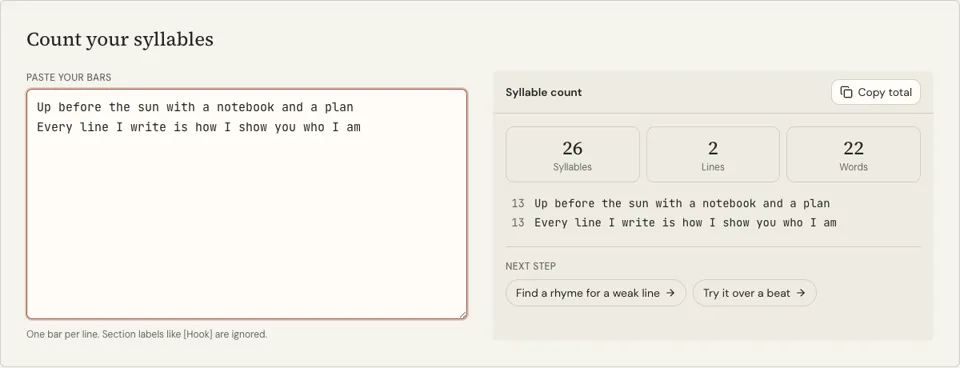
Paste a verse you have already written into the syllable counter and read the line count. Then rap it over the loop, tapping once per bar, and compare the two numbers.
Bar counts in a verse and a song, laid out
Classic three-verse song (76 bars)
Intro: 4 Verse 1: 16 Hook: 8 Verse 2: 16 Hook: 8 Verse 3: 16 Hook: 8
Short hook-first song (56 bars)
Hook: 8 Verse 1: 12 Hook: 8 Verse 2: 12 Hook: 8 Outro: 8
One bar on the page (beats marked)
[1] Late for the [2] bus with a [3] verse in my [4] hand
Counting four bars aloud
ONE, two, three, four TWO, two, three, four THREE, two, three, four FOUR, two, three, four
Try it: Syllable Counter
How many bars in a verse FAQ
How many bars are in a rap verse?
Sixteen is the standard length. You will also hear 8 and 12-bar verses on shorter songs and 24 or 32 bars on storytelling tracks. The right length is the one your idea fills without padding.
How many lines is 16 bars?
Usually 16 lines, because rappers tend to write one line per bar. If your lines are short half-bars it will be 32 lines on the page. Count against the beat to be sure.
How long is 16 bars in seconds?
Divide 3,840 by the BPM. At 90 BPM, 16 bars last about 43 seconds; at 100 BPM, about 38 seconds. For fast beats counted in half time, use half the BPM in the sum.
How many bars is a hook?
Eight bars is most common, often built as a four-bar phrase said twice. Some songs use a four-bar hook to keep things moving. It normally appears after each verse.
What is a bar in rap?
A bar is one measure of music: four beats in 4/4 time. In conversation, "bars" also means lyrics in general, so "she has bars" is praise for the writing, not a count.
How many verses should a rap song have?
Two or three. Three 16-bar verses with hooks make a song of three to four minutes. Many current songs use two verses, or two and a short third, and finish under three minutes.
How many words are in a 16-bar verse?
Roughly 110 to 150 words at a mid tempo, based on 10 to 14 syllables per bar. Dense double-time verses can pass 200 words, and slow, spacious ones can sit under 100. Counting syllables per bar is a more reliable check than counting words.
Related reading
Related tools
Syllable Counter
Paste your lines and see a syllable count beside each one, plus totals for syllables, lines and words. Counts update as you type. Free, no sign-up.
Rap Beat Maker
Press Play and a boom bap loop starts at 90 BPM. Tap squares on the 16-step grid to change the kick, snare, hats, clap and 808, then write to it. Free, no sign-up.
Write a Rap Verse
You will be able to plan and finish a 16-bar verse in one sitting: one subject, four blocks of four bars, and an ending that sets up the hook.
Write a Rap Song
Learn the writing decisions behind a complete song: what it says, what it is called, how the hook and verses differ, and how to edit until every bar earns its place.
Last updated November 13, 2026