Rap Rhyme Scheme Guide
By the end you can label any verse with letters, write the three core schemes on demand, and add internal rhymes and multis without losing the meaning.
Guide·7 min read·With exercises
What a rap rhyme scheme is
A rap rhyme scheme is the pattern of rhyming sounds across the lines of a verse. You mark it with letters: every line that ends in the same sound gets the same letter. Two rhyming lines followed by two more is AABB. Alternating lines is ABAB. One sound held for four lines is AAAA.
Rap adds two layers that poetry classes rarely cover. Internal rhyme puts matching sounds inside the line, not only at the end. Multisyllabic rhyme, or multis, matches two or more syllables at once, so "paper stacks" answers "later tracks". Both layers sit on top of the end-rhyme pattern, they do not replace it.
Start with couplets (AABB). They are the easiest to write and to follow. Then extend one sound into a chain of four or more lines, and only then add rhymes inside the bar. Each step below has a drill that takes about five minutes.
How to letter a verse
Take the last stressed vowel sound of each line and everything after it. "Late" and "weight" share the "ayt" sound, so they get the same letter. The first sound in the verse is A, the next new sound is B, and so on.
Rhyme is about sound, not spelling. "Rough" and "cuff" rhyme; "rough" and "though" do not. Near rhymes, where the vowel matches and the consonant is close, count in rap: "time" and "line" usually share a letter. Letter the last verse you wrote by hand before reading on, so you know your current habits.
Write the letters in the right-hand margin, one per line, and read down the column. Patterns jump out: a column of AABBCCDD means you only write couplets, and a column where no letter repeats after two lines means your rhymes are scattered. Circle any letter that appears once. A lone letter is an unrhymed line, which is fine once in a verse and distracting three times.
The three end-rhyme schemes
Almost every verse is built from these, often changing every four bars.
Each one changes how long the listener waits for the answering sound, and that wait is what you are controlling. A short wait feels punchy. A long wait builds tension. Write four lines in each scheme on the same subject to hear the difference.
- AABB (couplets): lines rhyme in pairs. Each pair is a small setup and payoff, which suits punchlines.
- ABAB (alternating): lines 1 and 3 rhyme, lines 2 and 4 rhyme. The answer is delayed, so it suits storytelling.
- AAAA (chain): one sound for four, eight or more lines. It builds pressure and shows skill, but the meaning can drift if you chase the sound.
- ABBA (enclosed): the outer lines rhyme around an inner pair. Rare in rap, useful as a four-bar change of pace.
Internal rhyme: sounds inside the bar
An internal rhyme is any rhyme that does not sit at the end of the line. The most common placement is beat 2 answering beat 4, so the bar rhymes with itself. Another is carrying the end sound of one line into the first half of the next.
Internal rhymes make a verse sound dense without adding syllables. Take a plain couplet and find one word before the midpoint of each line that you can swap for a word matching the end sound. Change one word per line, no more, and read it aloud to check the sentence still sounds like speech.
A third placement is the stacked rhyme: two or three rhyming words back to back near the end of the bar, such as "cold, bold, sold". It hits hard and should be used sparingly, perhaps once in eight bars, because it stops the sentence moving forward.
Multis: rhyme more than one syllable
A single rhyme matches one syllable: "cold" and "gold". A multi matches the vowel pattern of two, three or four syllables: "cold weather" and "gold feather", or looser, "old leather". Only the vowels have to line up; the consonants can differ.
To write one, pick a short phrase that matters to the verse, write its vowel sounds in order, and list phrases with the same vowels. Aim for six candidates and keep the two that say something. Spend five minutes on one phrase from your notebook now.
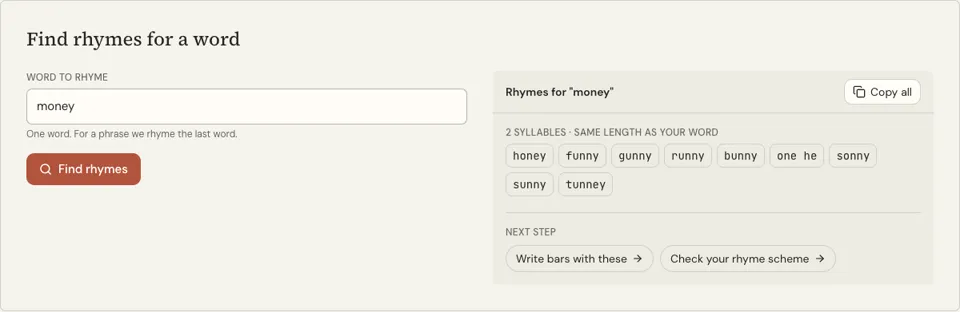
Rhyme dictionaries help here. A multisyllabic rhyme tool groups results by syllable count, so you can look for three-syllable answers to a three-syllable phrase instead of scrolling through single words.
- Two-syllable multi: "late shift" / "great gift" / "weight lift".
- Three-syllable multi: "city lights" / "pretty nights" / "fifty flights".
- Split multi: one long word answered by two short ones, "calculate" / "pass the plate".
Change the scheme to mark sections
Listeners feel a scheme change as a new paragraph. A common 16-bar plan is four bars of couplets to set the scene, four bars alternating, then an eight-bar chain on one sound that builds to the last line.
The rule that keeps this from sounding random: change the scheme at bar 5, 9 or 13, never in the middle of a four-bar group. Write the letters down the margin first, AABB ABAB CCCC CCCC, and fill in lines to match.
Delivery has to follow the scheme. Lean on the rhyming syllables a little, with more volume or a longer vowel, so the pattern is audible. A scheme that exists only on paper does nothing for a listener. Record the verse and check whether you can hear every letter without reading along.
Schemes with unrhymed lines: XAXA and AAXA
Not every line has to rhyme. In scheme notation an X marks a line whose ending answers nothing. XAXA rhymes only lines 2 and 4 and leaves 1 and 3 free. It sounds close to speech, because you can say exactly what you mean in the X lines and save the rhyme for the reply. The four lines below follow that pattern, with "stop" and "off" as a near rhyme.
AAXA does the opposite job. Three lines share a sound and the third breaks away, so the ear is surprised, then relieved when line 4 returns. Put your most important sentence in the X line. It stands out because it is the only one that does not chime.
- Left the house with the charger still plugged in (X)
- Phone at nine percent when I reached the stop (A)
- Asked a stranger which way to the venue (X)
- Got there as the opening act came off (A)
Six-line patterns: AABCCB and ABCABC
Four-line blocks are the habit, but a thought sometimes needs six. AABCCB is two couplets, each followed by a tail line, and the two tails rhyme with each other. The B sound is held back for three lines, which makes its return feel like a payoff. The example below uses short lines so the wait stays audible.
ABCABC stretches the wait further: three unrelated endings, then the same three sounds again in order. Nothing rhymes for three lines, so keep lines to 6 to 8 syllables, or the listener forgets sound A before it comes back. In a 16-bar verse, a six-line block followed by a couplet makes 8 bars, which keeps you lined up with the beat.
- Cold hands on the morning shift (A)
- Boxes that I couldn't lift (A)
- Boss said give it time (B)
- Six months and my back got strong (C)
- Every shift felt half as long (C)
- Now that floor is mine (B)
Move the rhyme off the end of the bar
A scheme says which lines rhyme. It does not say where in the bar the rhyme falls. By default the rhyme word lands on beat 4. Shift it to beat 3 and you gain a beat of space after it, which you can leave empty or fill with a short tail that does not rhyme.
Here the rhyme sits on beat 3 with a tail on beat 4: "Had the whole plan on a PAGE, right there / Wrote it at a young AGE, no doubt". The letters are still AA, but the ear gets the rhyme early and the tail rounds off the bar. Alternate bars that rhyme on 4 with bars that rhyme on 3, and a plain couplet stops sounding like a march.
When you letter a verse, write the beat number above each rhyme word. If every one says 4, move two of them.
Fixes for a scheme that sounds flat
When a lettered verse looks correct and still sounds dull, the cause is usually one of four things. Each has a fix you can apply in a single rewrite.
Use the rhyme finder to collect six candidates for the sound you are stuck on, and take the one that fits the meaning, not the first one listed. For a weekly workout, write the same four-line idea in AABB, XAXA and AAXA, 10 minutes each, and record all three. Hearing them back to back teaches more than reading about them.
- Every rhyme is one syllable: upgrade one pair in four to a two-syllable match.
- One sound for the whole verse: start a new letter at bar 9.
- Every rhyme word is a noun: end two lines on a verb so the sentences change shape.
- Rhymes too far apart to hear: in ABAB at slow tempos, echo the A sound once inside line 2.
Three mistakes people make with rhyme schemes
Choosing the rhyme before the thought
If the rhyme word arrives first, the line gets bent to reach it. Write what you mean in plain words, then look for a rhyme that fits the meaning, even a near rhyme.
Only rhyming the last word
End rhyme alone sounds like a greeting card after eight bars. One internal rhyme per couplet, placed on beat 2, is enough to make the same lines sound written by a rapper.
Holding a chain too long
A twelve-line run on one sound is impressive for six lines. After that the words start serving the sound. Stop the chain while the lines still make sense and start a fresh letter.
How to practise rap rhyme schemes today
- 01
Write four bars in AABB (5 minutes)
Pick one small subject, such as your morning. Write two couplets with 8 to 12 syllables per line. Say them aloud once to check each rhyme lands on the last stress.
- 02
Rewrite the same bars as ABAB (5 minutes)
Keep the subject and the two rhyme sounds, but reorder and reword so lines 1 and 3 rhyme and lines 2 and 4 rhyme. Notice how the story now waits a line.
- 03
Check and extend (7 minutes)
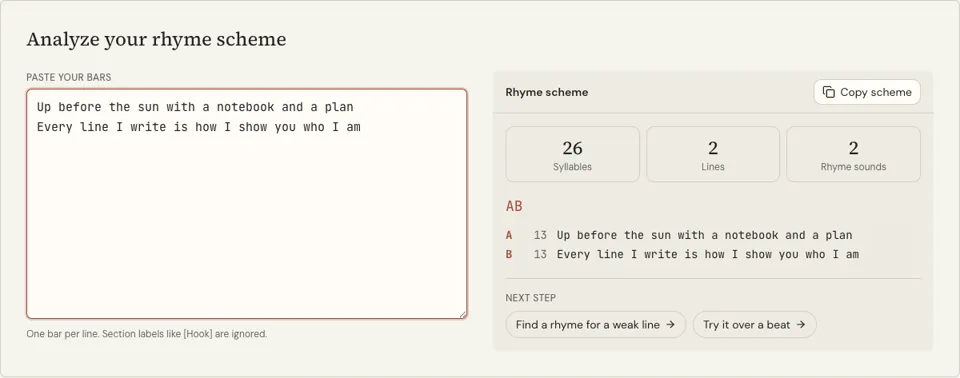
Paste both versions into the rhyme scheme analyzer and confirm the letters read AABB and ABAB. Then add four lines on one sound and check they all show the same letter.
Rap rhyme scheme examples, marked with letters
AABB couplets
Rent was due and the fridge was bare (A) Mama said wait, so I learned to share (A) Two jobs deep and the bus runs late (B) Still found time to carry the weight (B)
ABAB alternating
Streetlight hums on a quiet block (A) I fill this page by the kitchen door (B) My pen keeps time with the ticking clock (A) One more line, then I write one more (B)
AAAA chain with two-syllable multis
I move patient (A) No vacation (A) Slow foundation (A) Whole rotation (A)
Internal rhyme (matching sounds in capitals)
Kept the FLAME low, SAME road, PLAIN clothes Made a NAME though, CAME slow, they KNOW
Try it: Rhyme Scheme Analyzer
Rap rhyme scheme FAQ
What is the most common rhyme scheme in rap?
Couplets, written AABB, are the most common: two lines that rhyme, then two more on a new sound. Many modern verses stretch this into chains where one sound runs for four or eight lines before changing.
What is a multisyllabic rhyme?
It is a rhyme that matches two or more syllables in a row, such as "window pane" with "been through pain". The vowel sounds line up across the whole phrase, which sounds richer than matching one final syllable.
Do rap lyrics have to rhyme perfectly?
No. Near rhymes, also called slant rhymes, are standard in rap. If the vowel sound matches and the delivery leans on it, listeners hear a rhyme. "Home" and "alone" or "stuck" and "love" both work.
How do I identify the rhyme scheme of a verse?
Write the verse one bar per line. Give the first line’s ending sound the letter A, then give each new ending sound the next letter. Lines that share a sound share a letter. Read the letters down the page.
What is the difference between internal and end rhyme?
End rhyme sits on the last stressed word of a line. Internal rhyme sits anywhere earlier, often in the middle of the bar. Most strong verses use both: an end-rhyme pattern for structure and internal rhymes for texture.
Can a tool work out my rhyme scheme?
The rhyme scheme analyzer on Punchline letters the end rhymes of pasted bars and counts syllables per line, free and in your browser. It estimates from spelling, so check unusual spellings by ear.
How many rhyme sounds should a 16-bar verse have?
Between four and eight is common. Eight sounds means strict couplets. Four means each sound runs for a four-bar group. Fewer than three can make the verse feel like one long chain, and more than eight leaves at least one line without a partner.
Related reading
Related tools
Rhyme Scheme Analyzer
Paste a verse or poem and see its rhyme scheme as letters, one per line, with a syllable count beside each. Results update as you type. Free, no sign-up.
Multisyllabic Rhyme Generator
Type a word or short phrase and get rhymes of two or more syllables in about a second, with the lengths closest to yours listed first. Free, no sign-up.
Multisyllabic Rhymes
Understand what makes a multisyllabic rhyme, build your own from any phrase in four steps, and write four bars that chain a three-syllable rhyme from start to finish.
Rap Flow Guide
After this guide you can count a bar, place syllables on or off the beat on purpose, and switch between four flow patterns inside one verse.
Last updated November 13, 2026