Hip Hop Slang Glossary
You will be able to follow any conversation about writing, recording or releasing rap, with 99 terms defined in plain words and grouped by where you will hear them.
Guide·11 min read·99 terms
Hip hop slang, defined in plain sentences
Hip hop slang, in the sense this glossary covers, is the working vocabulary of rap: the words writers, producers and fans use for parts of a song, ways of delivering it, kinds of beat and kinds of release. If you know these 99 terms you can read a studio conversation or a review without stopping.
The list is grouped into six themes: song parts, delivery, writing, live and competitive rap, production, and styles and releases. Each entry is one sentence. Where a word has a second everyday meaning in the culture, the entry says so.
This is craft language, not a dictionary of street slang, which changes by city and by year. Meanings here are the ones in common use among people who make the music. If a word you heard is missing, it is probably local or new.
Parts of a song
These words name the pieces a track is built from. Play a song you know and point out each one as it goes by.
A verse of the standard length is also called a "sixteen", and the bridge is a one-off section that breaks the verse and hook pattern.
- Bar: one measure of four beats, usually one written line; "bars" also means strong lyrics in general.
- Verse: the main rapped section, 16 bars by convention.
- Hook: the repeated, memorable section between verses, usually 8 bars.
- Ad-lib: a short word or sound added behind the main vocal to fill gaps and add energy.
- Feature: a guest appearance by another artist, written "feat." in a title.
- Snippet: a short preview clip of an unreleased song.
Delivery
Delivery words describe how the lines are performed, apart from what they say. Record four bars and try to describe your own take with them.
A rapper described as "riding the beat" has all of these working together.
- Flow: the rhythm of the syllables against the beat.
- Cadence: the rise, fall and stress of the voice within a flow.
- Pocket: the spot in the beat where a flow locks in with the drums.
- Double time: rapping twice as many syllables per beat as the basic pulse.
- Mumble: a slurred, melodic delivery where tone matters more than clear words; often used as criticism.
- Breath control: managing air so long lines stay even to the last word.
Writing
Writers use these terms when they take a verse apart. Find one of each in your last 16 bars.
Two more you will meet often: a "scheme" can also mean an extended run of related wordplay, and a "quotable" is a line good enough to repeat.
- Punchline: a line built to land hard through a joke, a boast or a double meaning.
- Multi: a multisyllabic rhyme, matching two or more syllables at once.
- Scheme: the pattern of rhymes across a set of lines, marked with letters.
- Wordplay: using a word’s sound or second meaning to say two things at once.
- Written: a verse composed and edited in advance, as opposed to improvised.
- Ghostwriter: someone who writes lyrics another artist performs, usually without public credit.
Live and competitive rap
Rap grew up in rooms where people took turns. These are the words from that side of the culture; visit a local open mic and you will hear all of them.
A "rebuttal" is a line in a battle that answers what the opponent just said, and "spitting" simply means rapping.
- Freestyle: improvised rapping; also, historically, a written verse on no fixed subject.
- Off the dome: made up on the spot, straight from the head.
- Cypher: a circle of rappers taking turns over a beat or a beatbox.
- Battle: a contest in which two rappers trade verses aimed at each other.
- Diss: a line or whole track that insults a named rival.
- Co-sign: public approval from an established artist that lends a newcomer credibility.
Production
Producers have their own shorthand. Open a drum machine and match each word to something you can see or hear.
The person who makes the beat is the producer, and their short audio signature at the start of a track is a "tag".
- Beat: the instrumental; also a single pulse of the music.
- Loop: a short section of music that repeats.
- Sample: a piece of an existing recording reused in a new beat, which needs permission to release.
- 808: a deep, long bass drum sound that doubles as the bass line.
- BPM: beats per minute, the tempo of the track.
- Type beat: an instrumental labelled by the style it resembles so rappers can search for that sound.
- Crate digging: searching through old records for sounds to sample.
Styles and releases
Two more words sit over all of these: underground means music made and shared outside the major industry, and mainstream means music with wide commercial reach. Sort the last five projects you played into the terms below.
- Boom bap: a drum-led style at about 85 to 95 BPM, named after the sound of its kick and snare.
- Trap: a style from the American South with fast hi-hats, heavy 808s and half-time drums.
- Drill: a dark, hard style with sliding bass and off-beat snares.
- Single: one song released by itself.
- EP: a short project, usually four to six tracks.
- Mixtape: a looser full-length project, often released quickly.
- Drop: to release music, or the moment in a beat when the drums come in.
Money words
Money has more nicknames in rap than any other subject. Some were common American slang long before the music existed, such as the food words bread and dough. Others came from how cash is handled: notes held in rubber bands, or piled in stacks.
Several of these words also carry a number. A stack, a rack and a band each usually mean one thousand dollars, so "ten bands" is ten thousand. Write one sentence of your own with each term below so the amounts stick.
- Bread: money in general, especially what you live on. "I’m working doubles this week because I need the bread."
- Dough: the same idea as bread, with an older feel. "The show paid decent dough for twenty minutes on stage."
- Paper: cash, often with a sense of earning it properly. "She quit the group chat drama and went back to chasing paper."
- Cheese: money, usually when it is being spent or shown. "He put all his cheese into a new microphone."
- Guap: a large amount of money. "That sync deal was real guap for an unsigned artist."
- Benjamins: hundred-dollar bills, after the portrait of Benjamin Franklin on them. "The promoter paid in Benjamins, counted out on the table."
- Stack: one thousand dollars. "The video cost two stacks, and most of it went on the location."
- Rack: also one thousand dollars. "He saved five racks before he booked studio time."
- Band: one thousand dollars, from the rubber band around the notes. "Merch brought in three bands on the first night."
- Bag: a large payment or a paid opportunity; to "secure the bag" is to land it. "She secured the bag with a brand deal for her tour."
Praise and approval
Feedback in a studio or a comment section is often a single word. Knowing the shades between them tells you what the listener liked: the writing, the beat or the whole record.
Most praise words describe heat, cold or force. Play three songs you rate and choose a different word from this list for each one, then say why that word fits.
- Fire: very good; the all-purpose compliment. "That second verse is fire."
- Heat: strong new music, often unreleased. "He played us some heat from the next tape."
- Hard: forceful and convincing, said of a beat or a delivery. "The drums on this go hard."
- Cold: impressively sharp or ruthless, usually about a line. "The last bar was cold."
- Dope: good, with an old-school flavour. "Dope cover, who shot it?"
- Slaps: sounds great loud, especially the drums and bass. "This one slaps in the car."
- Banger: a high-energy song built for a crowd. "Open the set with the banger."
- GOAT: greatest of all time. "Ask ten fans for their GOAT and you get ten names."
- Fresh: new and stylish. "Fresh flow, nobody raps it that way."
Places and people
Rap is tied to where it is made, so place words appear in almost every verse. These are understood across regions, though each city has local versions of its own.
To "put on for" somewhere means to represent it with pride. List the words you would use for your own area and check that a stranger would understand them.
- The block: the street or few streets someone grew up on. "Everybody on the block heard the song before it came out."
- The hood: a person’s home neighbourhood. "He shot the video in the hood he was raised in."
- The crib: someone’s home. "We wrote the hook at my crib."
- The city: a rapper’s home town, whatever its size. "She does it for the city."
- The spot: a regular meeting place. "Meet at the spot at eight, then we head to the venue."
- Day one: a friend or supporter from the very beginning. "My day ones were at the first open mic."
- OG: a respected older figure. "An OG from the local scene gave him advice on contracts."
Studio talk
The production section above covers the sounds. These are the words for the session itself, the ones an engineer will use without explaining.
On your next recording day, write down every term you hear that you could not define. Note that "stack" has a second meaning here, unrelated to money.
- The stu: the studio. "I’m in the stu until midnight."
- The booth: the small room or corner where vocals are recorded. "Get in the booth, the beat is loaded."
- Take: one recorded attempt. "Take four had the energy."
- Punch in: recording a line or two over part of a take instead of redoing the whole verse. "Punch me in at bar nine."
- Stack: the same line recorded several times and layered for thickness. "Stack the hook three times."
- Rough: an unfinished mix for checking the song. "Send me the rough tonight."
- Bounce: to export the session as one audio file. "Bounce it so I can hear it in the car."
- Stems: separate files for vocals, drums, bass and so on. "The mixer asked for stems, not the full beat."
- Reference: a finished song used as a target for the sound. "Our reference has much drier vocals."
- Placement: a beat or verse that lands on another artist’s release. "Her first placement was a hook."
Using slang in your own bars
Knowing a word and using it well are different skills. The common mistake is loading a verse with terms from another city or decade, which sounds borrowed. Use the hip hop slang you would say in conversation, and one or two terms per four bars at most.
Slang also dates quickly. A money word that felt current five years ago can make a new song sound old. Before you record, read the verse aloud to someone your age from your area. If they smile at a word for the wrong reason, swap it for the plain version.
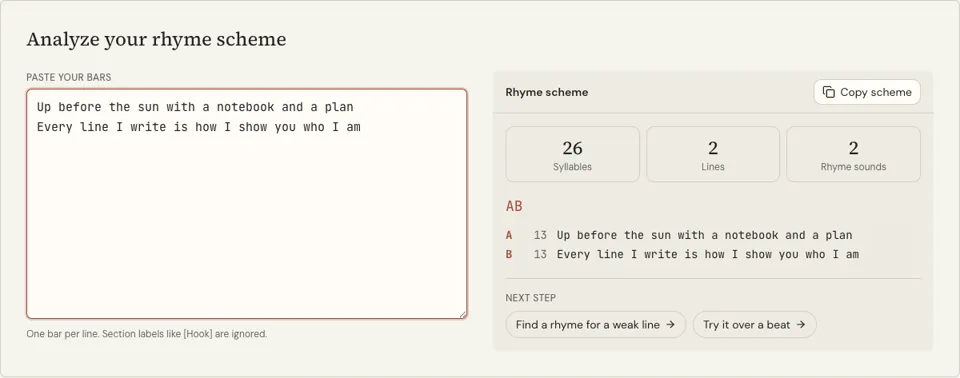
Variety helps rhyme. Bread, paper, bands and bag all mean money but end in different sounds, so pick the one that fits the scheme. Paste the finished verse into the rhyme scheme analyzer to check that the swap kept your pattern.
Clothes and appearance
Style has been part of hip hop since its first parties, so verses are full of words for what someone is wearing. Describe your own outfit today using two of the terms below.
- Drip: an outfit and accessories worn with confidence. “The drip in that video was all thrifted.”
- Fit: short for outfit. “She planned the fit for the cover shoot a week ahead.”
- Kicks: trainers or sneakers. “He kept the kicks in the box until show day.”
- Ice: jewellery, especially with diamonds. “No ice on him, only a watch from his dad.”
- Whip: a car. “We listened to the mix in the whip before sending notes.”
- Fitted: a cap made in exact sizes with no strap at the back. “A fitted pulled low hides your eyes on camera.”
Reputation and standing
Rap keeps score in public, and these words say who is rising and who is not. Several are blunt, so use them about music, not about people. Pick a record you think deserves more attention and describe it with one term.
- Props: credit or respect that is due. “Props to the engineer for saving that vocal.”
- Clout: influence and attention, online above all. “He wanted the feature for the song, not the clout.”
- Flex: to show off, or the thing shown. “Selling out a small room is still a flex.”
- Come up: the rise from little to something. “The tape tells the story of her come up.”
- Grind: steady daily work toward a goal. “The grind this month is one verse a day.”
- Slept on: ignored when it deserved notice. “That EP was slept on when it came out.”
- Fell off: lost quality or audience. “Fans argue about whether he fell off after the second album.”
- Wack: weak or unconvincing. “The hook was strong and the verse was wack.”
- Classic: a record still rated years later. “People called it a classic before the year was out.”
Quick replies and agreement
These short words fill comment sections and group chats. They move in and out of fashion quickly, so listen to how people around you use them. Reply to the next three messages about music using one of these.
- No cap: I am not exaggerating. “No cap, that is your strongest verse.”
- Cap: a lie or an exaggeration. “Ten songs in one night? That’s cap.”
- Bet: agreed, or all right. “Studio at six? Bet.”
- Facts: I agree completely. “The beat carries that song. Facts.”
- Lowkey: quietly, or somewhat. “I lowkey prefer the demo.”
- Say less: understood, no need to explain. “You need a hook by Friday? Say less.”
- Vibe: the mood of a song or a room. “The vibe changed when the bass came in.”
- Lit: lively and exciting. “The open mic was lit by the second act.”
What changes when you know hip hop slang
Feedback starts to make sense
When someone says your second verse is "out of the pocket" or "needs a switch at bar nine", you know which part to fix, instead of nodding and guessing.
You can ask for what you want
Telling a producer "boom bap, around 90, sparse hats, room for a sung hook" gets you closer on the first try than "something chill", and saves both of you an afternoon.
You listen differently
Once you can name a multi, an ad-lib or a half-time snare, you start hearing them in every song, and each one becomes something you can borrow as a technique.
How to practise hip hop slang today
- 01
Label a song (6 minutes)
Play one rap song with the lyrics open. Write the bar count of each verse and hook, and mark one ad-lib, one punchline and one multi. Say which style and rough BPM it is.
- 02
See the writing terms on your own bars (6 minutes)
Paste a verse into the rhyme scheme analyzer. The letters show your scheme and the numbers show syllables per line. Describe the verse in one sentence using three glossary words.
- 03
Hear the production terms (5 minutes)
Open the rap beat maker, switch between the Boom bap, Trap and Drill presets and listen for the 808, the loop and the tempo change. Say each term aloud as you hear it.
Hip hop slang used in sentences
Song parts
She wrote a sixteen-bar verse and an eight-bar hook, then recorded ad-libs on a second track. The feature only raps for eight bars, but the snippet they posted was his part.
Delivery
His flow sits right in the pocket on the first verse, then he goes double time for the last four bars. Her cadence drops at the end of every line, which makes it sound like a threat.
Writing and competing
That punchline works because the multi sets it up two bars earlier. He is sharper with writtens than off the dome, so he stayed out of the cypher.
Production and releases
The beat is a four-bar loop at 142 BPM with a sliding 808, closer to drill than trap. They dropped two singles before the EP and saved the sample-heavy tracks for a mixtape.
Try it: Rhyme Scheme Analyzer
Hip hop slang FAQ
What does "bars" mean in hip hop?
Literally, a bar is one measure of music, four beats long. In conversation, "bars" means well-written lyrics, so saying a rapper "has bars" praises the writing, wordplay and punchlines.
What is the difference between a mixtape, an EP and an album?
An EP is short, usually four to six tracks. An album is a full planned project. A mixtape is full-length but looser, often released quickly to show range. The lines between them are blurry today.
What does "freestyle" really mean?
Today it mostly means improvised rapping, made up on the spot. An older meaning is a written verse with no set subject. When someone specifies "off the dome", they mean truly improvised.
What is a type beat?
A type beat is an instrumental a producer labels with the style or sound it resembles, so rappers searching for that sound can find it. It is a way of describing a beat, not a claim of involvement.
What does "in the pocket" mean?
It means the rapper’s rhythm is locked tightly to the drums, so the stressed syllables and the snare feel like one instrument. Being out of the pocket means drifting ahead of or behind the beat.
Is hip hop slang the same everywhere?
Craft terms like bar, hook and flow are understood wherever rap is made. Street slang varies by city, country and year. Learn the craft words first and pick up local slang by listening.
What is the difference between racks, bands and stacks?
In everyday use, none. Each normally means one thousand dollars, so five racks, five bands and five stacks are all five thousand. The words come from how cash is bundled and piled. Which one a rapper picks is mostly down to region, era and what rhymes.
What does "secure the bag" mean?
It means to land a payment or an opportunity that pays, such as a booking, a deal or a sale. "The bag" is the money or the chance itself. The phrase is also used more loosely for getting any result you worked for.
Related reading
Related tools
Rhyme Scheme Analyzer
Paste a verse or poem and see its rhyme scheme as letters, one per line, with a syllable count beside each. Results update as you type. Free, no sign-up.
Rap Beat Maker
Press Play and a boom bap loop starts at 90 BPM. Tap squares on the 16-step grid to change the kick, snare, hats, clap and 808, then write to it. Free, no sign-up.
How to Rap
By the end you can count bars, land a rhyme on the fourth beat, breathe without losing the pocket and finish a 16-bar verse. Every section ends with a drill you can run today.
Rap Flow Guide
After this guide you can count a bar, place syllables on or off the beat on purpose, and switch between four flow patterns inside one verse.
Last updated November 13, 2026