How to Make a Rap Song
Follow one song from a one-line idea to a finished file: a 64-bar map, a hook, two verses and a demo recorded in a single sitting.
Guide·6 min read·With exercises
How to make a rap song, start to finish
To make a rap song, choose an idea and a beat, write an 8-bar hook, write two 16-bar verses, record them over the beat and arrange the parts in order: intro, hook, verse, hook, verse, hook, outro. That layout is 64 bars, a little under three minutes at 90 BPM.
Working in that sequence keeps you from the most common trap, which is a notebook of unconnected verses and no songs. The hook defines what the track is about, so writing it first gives both verses a target. It also means you always know how much is left to write.
A first song can be made in a weekend: Saturday for the map, hook and verses, Sunday for recording and fixes. It will not be your strongest work. Finishing it teaches you things that ten unfinished drafts never will. Keep the scope small and the deadline short.
Draw the song map
Before writing, lay the track out in bars on paper. The standard form is below. At 90 BPM each bar is about 2.7 seconds, so the whole map runs close to 2 minutes 50 seconds.
Count the sections of your beat against this. If the producer arranged it differently, follow the beat and adjust the numbers. Copy the map into your notes with empty lines under each heading. An intro can be as simple as the beat with one spoken line, and an outro can be the hook repeated while the drums drop out. Keep both short, since listeners decide quickly whether to stay.
- Intro: 4 bars
- Hook: 8 bars
- Verse one: 16 bars
- Hook: 8 bars
- Verse two: 16 bars
- Hook and outro: 8 bars plus 4
Match the beat to the idea
State the song in one line: "leaving my old job", "my city at 3 a.m.", "a thank-you to my grandmother". Then pick a beat whose mood fits. Slow and warm for reflection, hard drums for confidence, minor keys for tension. A mismatch between words and music is hard to fix later.
Loop the beat for five minutes and mumble rhythms without words. The patterns your voice falls into are the natural flow for that beat. Record the mumbling on your phone. You will fit real words to those rhythms next. Note the tempo too. A beat near 90 BPM gives you room for detail, while a 140 BPM trap beat counted in half time suits shorter phrases with more space.
Write the hook first
A hook is 4 bars repeated or 8 bars straight, with fewer words and more space than a verse. Build it around a title phrase of two to five words that says the idea, and put that phrase at the start or the end of the lines where it is easy to catch.
Aim for 6 to 10 syllables per bar so it can be sung or chanted. Say it eight times in a row over the beat. If you are bored by the fifth, change it. If you catch yourself humming it an hour later, keep it. Leave a gap at the end of at least two of the bars. Space is what lets a hook breathe, and it gives you room for ad-libs later.
Give each verse its own job
Two verses that say the same thing make a song feel long. Split the idea: verse one sets the scene and the problem, verse two shows what changed or what you will do. For a story, verse one is before and verse two is after.
Write in four-bar blocks and end the last block of each verse on a line that points at the hook, so the chorus arrives as an answer. Vary the rhythm at bar 9 of each verse, with a pause or a faster run, to keep the second half fresh. Then read both verses back to back and cut any repeated point. Use a different opening rhythm for verse two, starting before or after beat one, so the listener hears straight away that the song has moved on.
Record the demo in one sitting
Rehearse the song top to bottom three times before pressing record. Then capture it section by section: hook first while your voice is fresh, then verse one, then verse two. Do three takes of each and move on. Chasing a perfect take at this stage wastes the session. Keep the phone or microphone in the same position for every section so the takes match when you put them in order.
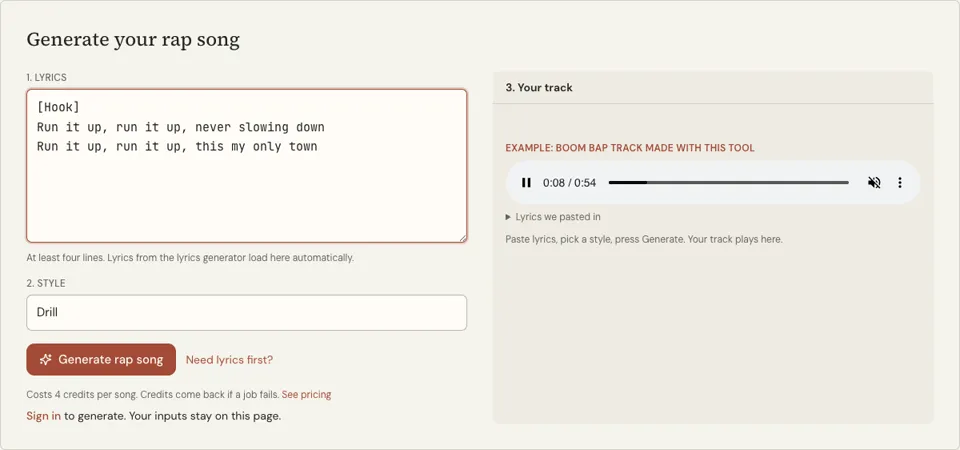
If you want to hear your lyrics as a full produced track before recording yourself, the AI rap generator turns pasted lyrics of at least four lines into a song with an MP3 download in under a minute, for 20 credits. Either way, end the day with something you can play start to finish.
Finish it
Listen the next morning, once, with a pen. Write down the three weakest moments: a clumsy bar, a late entry, a hook word that is hard to hear. Fix those three and nothing else. Then name the file with the title and the date and call it done.
Play it to two people without explaining it and watch where their attention goes. Their reaction to the hook tells you more than their words. Start the map for song two the same week. Keep the lyric sheet with the file. You will need the words again for captions and for performing it.
What changes when you make a rap song in this order
Verses stay on topic
With the hook written first, every bar in the verses can be tested against it. Lines that do not serve the chorus stand out and get cut, which is why finished songs feel focused.
You know when you are done
A 64-bar map has a fixed number of empty lines. When they are filled and recorded, the song exists. Without a map, writers keep adding bars and never reach an ending.
Recording gets quicker
Going in with rehearsed sections and a three-take limit turns a vague evening into about an hour of work. You leave with a complete demo and a short list of fixes.
How to practise making a rap song today
- 01
Map and idea in four minutes
Write your one-line idea and copy the 64-bar map under it. Open the rap beat maker, choose the preset that suits the mood and note the tempo beside the map.
- 02
Hook in eight minutes
Write a 4-bar hook around a title phrase. For alternatives, enter the same idea in the rap hook generator and compare, then keep whichever version you can still recite a minute later.
- 03
First four bars in six minutes
Write the opening four bars of verse one so they set the scene. Rap the four bars straight into the hook over the loop, three times, and record the third pass.
Worked examples for making a rap song
Song map filled in (idea: leaving the old job)
Intro, 4 bars: beat and one spoken line Hook, 8 bars: "Clocked out for good" Verse one, 16 bars: the last shift Verse two, 16 bars: the first free morning
Four-bar hook around a title phrase
Clocked out for good, left the badge on the desk, Clocked out for good, got my name off the vest, Clocked out for good, now the morning is mine, Clocked out for good, and I’m right on time
Verse one, opening four bars (sets the scene)
Six a.m. alarm for the two thousandth time, Same grey lanyard and the same slow line, Manager talking but I’m watching the door, Counted every tile on that break room floor
Last two bars of a verse, pointing at the hook
Handed in the keys with a smile on my face, One more signature and I’m out of this place
Try it: AI Rap Generator
How to make a rap song FAQ
How do you make a rap song step by step?
Pick an idea and a beat, map the song in bars, write an 8-bar hook, write two 16-bar verses, rehearse, record each section in three takes, arrange them as hook, verse, hook, verse, hook, and fix the three weakest spots the next day.
How long should a rap song be?
Two and a half to three and a half minutes suits most songs. The standard 64-bar layout with two verses and three hooks lasts just under three minutes at 90 BPM. Shorter is fine if the idea is complete.
Should I write the hook or the verse first?
Hook first is the more reliable order for beginners, because it fixes the subject and the mood before you spend 32 bars on verses. If a verse arrives first, find its strongest phrase and try building the hook from that.
Can I make a rap song without recording equipment?
Yes, for a demo. A phone voice recorder with the beat in earbuds is enough to capture a full song. You can also paste your lyrics into the AI rap generator, which returns a produced track as an MP3 for 20 credits.
How many verses does a rap song have?
Usually two or three verses of 16 bars each, separated by the hook. Two verses keep a song under three minutes. A third verse is worth adding only when it brings a new angle and not a repeat of the first two.
Related reading
Related tools
AI Rap Generator
Paste your lyrics, pick a style and get a full rap track with vocals and a beat in under a minute. Each track costs 20 credits with one free redo; an eligible verified account can hear its first track free, limited to one per browser.
Rap Hook Generator
Enter the subject of your song and receive three different four-line hooks, labelled A, B and C, a few seconds after you press the button. Free and open to everyone.
Write a Rap Song
Learn the writing decisions behind a complete song: what it says, what it is called, how the hook and verses differ, and how to edit until every bar earns its place.
Rap Beat Maker
Press Play and a boom bap loop starts at 90 BPM. Tap squares on the 16-step grid to change the kick, snare, hats, clap and 808, then write to it. Free, no sign-up.
Last updated November 12, 2026