How to Start Rapping
Seven short sessions take you from never having rapped to a recorded 8-bar verse. Each day has one task, a time limit and a way to tell you did it right.
Guide·5 min read·With exercises
How to start rapping from zero
Start rapping by doing three small things in order: count along to a slow beat until you can feel four beats in a bar, write two lines that rhyme and fit that count, and say them out loud over the beat. That is the entire first step, and it takes about fifteen minutes.
You do not need a rap name, a microphone or a finished song to begin. Those come later. The first week is about getting your voice onto a beat and getting used to hearing it, which is the part most people put off.
The plan below is seven sessions of fifteen minutes. Do one a day. By the end you will have an 8-bar verse recorded on your phone and a habit you can keep. Nothing in it needs talent, only a quiet corner and a little patience.
Day one: get your kit together and count
Your kit is a phone, earbuds and a notes app. Find a simple drum loop at about 90 BPM. Sit down, press play and nod on every beat. Count "one, two, three, four" aloud and notice that the sharp snare sound lands on two and four.
Stay with it for ten minutes. In the last five, clap only on two and four while still counting. This feels too easy to matter. It is the foundation, and people who skip it drift off beat for months. You have done it right if you can hold the count while thinking about something else. Try the same count on two or three other slow instrumentals, so you learn to find beat one by ear and not by habit.
Days two and three: talk on the beat
On day two, speak ordinary sentences in time. Describe your room, one short sentence per bar, starting each on beat one and finishing by beat four. No rhymes yet. You are learning how many words fit between the drums. Short sentences fit one bar. Long ones spill over, and feeling that spill is the lesson.
On day three, do the same and make the last word of each sentence land exactly on the fourth beat. Shift words around until it does. Record one minute and listen. If the final words line up with the snare, you are rapping in time, even without a single rhyme.
Days four and five: write four bars
Now add rhyme. Pick a subject you can see from where you sit. Choose two pairs of rhyming words first, then write a line that ends on each. Four lines, two rhymes: that is an AABB block, the basic unit of a verse.
Keep each line between 9 and 12 syllables so it fits without rushing. On day five, write a second block on the same subject. Say all eight lines over the loop at least ten times. Change any word that makes you trip. Do not worry about being clever. Clear, in time and finished is the goal for this week.
- Pick a subject in the room
- Write down two rhyming pairs
- Build one line toward each rhyme word
- Say it over the beat and adjust
Day six: perform it, do not read it
Today the words stay the same and the delivery changes. Stand up. Learn the eight bars by heart, two at a time: say bars one and two five times without looking, then three and four, then join them. Memorised lines free your attention for timing and tone.
Speak from the chest at the volume you would use across a room. Take a quick breath after bar two, bar four and bar six. Decide which word in each line matters most and lean on it slightly. Run the full eight bars five times in a row without stopping. If you forget a line, keep the rhythm going with a hum and rejoin at the next bar. Recovering without stopping is a skill you will use for as long as you rap.
Day seven: record and listen
Play the loop through one earbud and open your phone’s voice recorder. Hold the phone a hand’s width from your mouth, a little to the side. Record three takes of your eight bars. Pick the one where the rhymes hit the snare most cleanly and save it with the date.
Hearing your recorded voice is uncomfortable for nearly everyone at first. Listen twice anyway and write down one thing to keep and one thing to change. If you feel brave, send it to one person you trust. Then decide when tomorrow’s session happens. Keep all three takes for now. In a month they will show you how far your timing has come.
After the first week
Keep the fifteen minutes. A workable pattern is five minutes of counting or freestyle warm-up, five of writing and five of rapping aloud. Each week, extend your verse by four bars until you reach sixteen, then start a new one. When a verse is done, perform it for a week before writing the next, because delivery improves on material you already know.
Add one new skill at a time: internal rhyme, a faster rhythm, a hook. Trying everything at once is how beginners stall. Pick a name whenever one feels right, since there is no rush. Set a reminder on your phone for the same time each day. Missing a day is normal. Missing two in a row is how habits end, so restart the next day with a shorter session.
Three mistakes people make when they start rapping
Waiting to feel ready
There is no moment when a beginner feels prepared. The people who start are the ones who accept sounding rough for a few weeks. Fifteen minutes today is worth more than a perfect plan for next month.
Copying a voice
Imitating an accent or tone that is not yours takes effort that should go into timing, and listeners can hear the strain. Use the voice you talk in. Style grows out of your own speech patterns over time.
Avoiding the recorder
Without recordings you cannot hear what a listener hears. Mistakes in timing are obvious on playback and invisible while rapping. One short recording a week is the cheapest coaching available.
How to start rapping today in 15 minutes
- 01
Count for five minutes
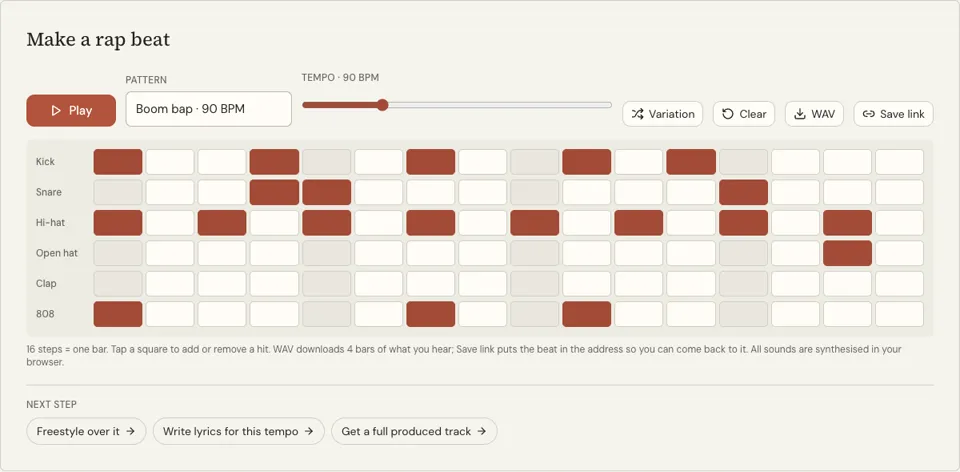
Open the rap beat maker and press play on the Boom bap preset at 90 BPM. Nod and count to four aloud, then clap on two and four only, until it feels automatic.
- 02
Write two lines in five minutes
Choose a word for something in the room and look it up in the rap rhyme generator. Click a rhyme you like, then write two lines that end on those two words.
- 03
Say them for five minutes
Rap the two lines over the loop twenty times, landing each end word on the fourth beat. Record the final three on your phone and keep the file. That is day one done.
Starter drills and bars for new rappers
Talking on the beat (one sentence per bar)
There’s a bed by the wall and a desk by the door, There’s a pile of clean washing I left on the chair, There’s a light on outside and a car going by, There’s a beat in my ears and I’m counting to four
First AABB block (pairs: cold / old, street / feet)
Window’s open and the room’s gone cold, Same grey hoodie and it’s three years old, I can hear the buses going down the street, Tapping out the rhythm with my own two feet
Fill-in template for your own four bars
I’m sitting in my ___ with a ___ in my hand, Looking at the ___ and I ___ where I stand, Every single ___ I’m a little more ___, Give me one more ___ and I’m ready to ___
The seven days at a glance
Days 1 to 3: count, talk in time, land on beat four Days 4 to 5: write two AABB blocks Day 6: memorise and perform standing up Day 7: record three takes, keep one
Try it: Rap Beat Maker
How to start rapping FAQ
How do I start rapping as a complete beginner?
Play a slow drum loop, count four beats to a bar, and speak simple sentences in time. Then write two rhyming lines and say them over the loop. Repeat daily for fifteen minutes and extend the verse by a few bars each week.
What do I need to start rapping?
A phone with earbuds covers everything in the first weeks: a loop to rap over, a notes app for lyrics and a voice recorder for checking yourself. No microphone, software or paid beats are needed to begin learning.
What should my first rap be about?
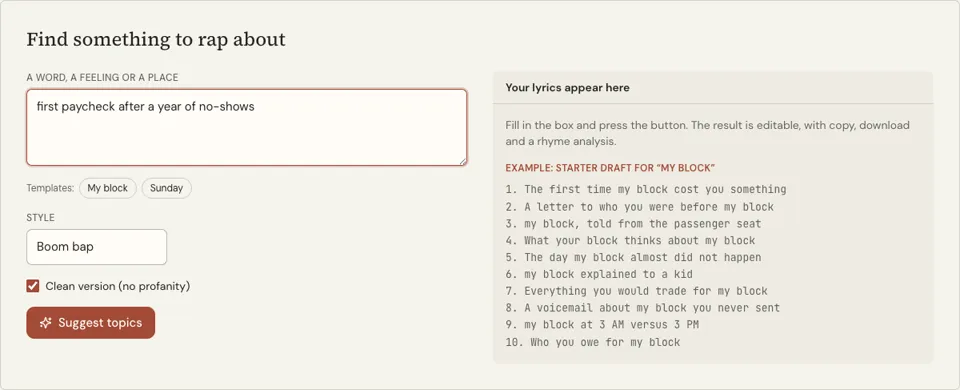
Something in front of you or something that happened today. Simple, true subjects are easier to write and sound more convincing than big themes. Your room, your commute or your breakfast is a perfectly good first topic.
How often should I practise?
Short and daily works well. Fifteen minutes every day builds timing faster than a long session once a week, because rhythm is learned through frequent repetition. Pick a fixed time so you do not have to decide each day.
I hate how my voice sounds on recordings. Is that normal?
Yes. Almost everyone dislikes their recorded voice at first, because it sounds different from what you hear inside your own head. The discomfort fades after a dozen or so recordings, and by then you will be listening for timing instead.
When should I choose a rap name?
Whenever you like, but it is not needed to practise. Many people choose one after a few weeks, once they know what they sound like. When you are ready, a name generator can give you patterns to react to.
Related reading
Related tools
Rap Beat Maker
Press Play and a boom bap loop starts at 90 BPM. Tap squares on the 16-step grid to change the kick, snare, hats, clap and 808, then write to it. Free, no sign-up.
Rap Rhyme Generator
Type the last word of your bar and get rhymes grouped by syllable count in about a second, so you can pick one that lands on the same beat. Free, no sign-up.
How to Rap
By the end you can count bars, land a rhyme on the fourth beat, breathe without losing the pocket and finish a 16-bar verse. Every section ends with a drill you can run today.
Become a Rapper
This guide lays out the real sequence: skill, name, songs, releases, stages and audience, with a number attached to each step. No promises of fame or income, only work you control.
Last updated November 12, 2026