How to Write a Hook
After this guide you can turn a song idea in any genre into a four or eight-bar hook with a title phrase, a simple rhythm or melody and one line that changes.
Guide·7 min read·With exercises
How to write a hook: the short answer
To write a hook, sum up the song in one short phrase, set that phrase to a rhythm or melody simple enough to repeat after two listens, and say it more than once. In most pop, R&B, rock and rap songs the hook is the chorus: four or eight bars that come back after every verse.
A hook does three jobs. It carries the title, so people know what to search for. It is the easiest part to remember, so it uses fewer words and more repetition than a verse. And it states the main feeling of the song, which the verses then explain.
Sung or chanted, the method is the same: title phrase first, simple shape, repeat, change one line. The second half of this guide covers what is different when the hook is rapped. Each section ends with a short task, so you can write as you read.
What a hook is, and how long it runs
A hook is any part of a song built to stick. Usually it means the chorus lyric and its tune, but a guitar riff, a bass line or a shouted word can be a hook too. Songs often have more than one: a main vocal hook and a smaller instrumental one.
In 4/4 time, where a bar is four beats, most vocal hooks last eight bars, often a four-bar phrase sung twice. That is roughly 15 to 25 seconds at common tempos. Pick three songs you know well, count the bars of each chorus and write down how many times the title is said.
Placement varies by genre. Many pop and rap songs now open with the hook so a new listener hears it within seconds, while older structures save it until after the first verse. Either works; decide before you arrange.
Find the title phrase
A hook is built around two to five words that hold the whole idea. Write one sentence saying what the song is about, as if texting a friend, then underline the words that would still make sense printed on a shirt. That is your title phrase.
Strong title phrases are concrete and easy to say: a place, an action, something a person said. "Never home" does more than "my absence". Put the phrase in the first or last line of the hook, where attention is highest. Write five candidates for your current song and say each aloud four times; keep the one that does not wear out.
Repeat, with one change
Repetition is the point of a hook, yet eight identical bars can go flat. The standard answer is to state four bars, repeat them, and alter only the last line the second time. The new line can answer the first, raise the stakes or twist the meaning.
Keep the rhyme sound of the altered line the same as the one it replaces, so the swap sounds planned. Write your four bars, copy them underneath, and rewrite bar 8 only.
Inside the four bars, repetition works at a smaller scale too: starting two lines with the same word, or ending them with the same word, makes them easier to recall.
Melody or chant
For a sung hook, stay within a narrow range of four or five notes, move mostly by step, and let the highest note fall on the main word of the title. Long held vowels are easier to sing along with than quick consonants, so choose open sounds like "oh", "ay" and "ah" for the peak.
A chanted hook has no tune to lean on, so rhythm carries it. Speak the line on "da" sounds over the beat until you find a pattern you could clap, then fit the words to it. Record a voice memo, wait an hour and try to perform it from memory. If you cannot, simplify.
Whichever you choose, give the hook a second voice. A doubled take, a harmony a third above or a group shout on the title makes the section sound bigger than the verse without adding a single word.
Rap hooks: fewer syllables, more space
A rap verse may carry 10 to 14 syllables in a bar. A rap hook should carry 4 to 8, with at least one silent beat in every bar. The gaps let a crowd join in and leave room for ad-libs and a doubled vocal. Land the stressed word of the title on beat 1 or beat 3.
Pick one of these shapes before writing lines. Each fills four bars and can be repeated to make eight.
- Statement and echo: the title in bars 1 and 3, a short answering line in bars 2 and 4.
- Build and land: three bars of setup, then the title alone in bar 4.
- Call and response: a question or command in each bar, answered by a one or two-word reply the crowd can shout.
- Chant: one short line four times, with the last word changed on the fourth.
Connect the hook to the verses
Write the hook before the verses when you can. It fixes the subject, and every verse line can then be judged by one question: does it lead back to the hook? The final bar of each verse should hand over to the first words of the hook, in meaning or in rhyme.
Make the hook sound different from what surrounds it. Change at least one of these as it arrives: pitch, syllable count, rhythm or the number of voices. Read your last verse line and first hook line as a pair and adjust until one sets up the other.
Three mistakes people make when they write a hook
Writing another verse
A hook packed with clever lines and 14 syllables a bar is a verse in the wrong place. Nobody can repeat it. Move those lines to a verse and keep the hook plain.
Hiding the title
If the title phrase shows up once, in the middle of bar 3, listeners will not know what the song is called. Say it at least twice per hook, on strong beats.
A hook unrelated to the verses
When the hook celebrates and the verses grieve, the track feels like two songs stitched together. Check that both are about the same thing, seen from the same side.
How to practise writing a hook today
- 01
Get raw material (5 minutes)
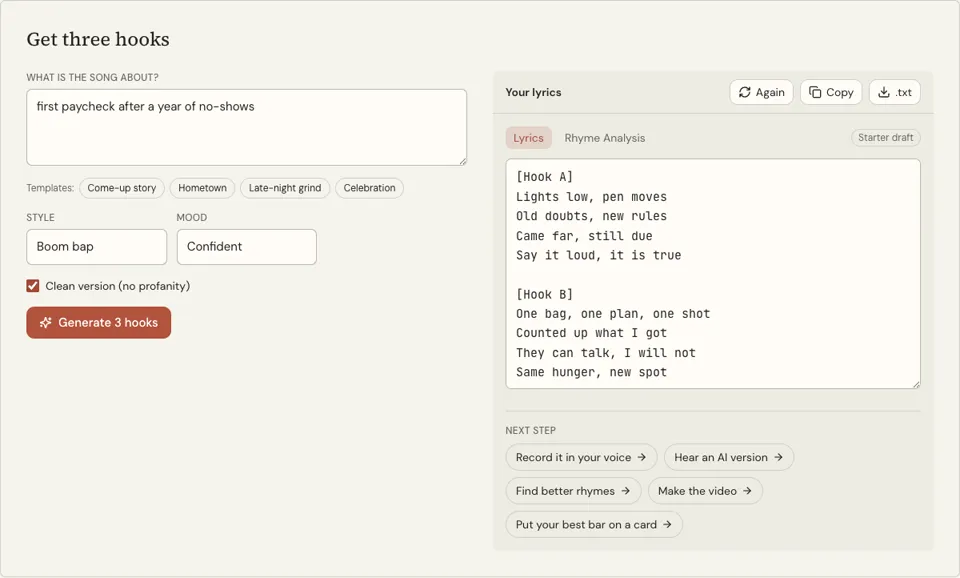
Open the rap hook generator, type your song topic, pick a style and generate. Press Again twice. Do not keep a whole hook: collect the phrases that sound like something you would say.
- 02
Write four bars by hand (8 minutes)
Choose one title phrase and one of the four shapes. Write four bars of 4 to 8 syllables each, then copy them and change the last line to make eight.
- 03
Test it on a loop (5 minutes)
Play a preset in the rap beat maker at the tempo of your song and perform the hook four times through. If you trip in the same place twice, cut a word there.
Hook examples in four bars
Statement and echo
Never home, never home Phone on silent, on the road Never home, never home Tell my mama that I’m close
Build and land
Counted every hour that the night shift took Every early bus, every dirty look Saved it all up, wrote it in a book Now look
Call and response
Who stayed up? (We did) Who paid up? (We did) Who got told no and made it up? (We did) Say it one more time (We did)
Sung hook with long vowels, one change in the last line
Oh, I’m on my way Hold the door, I’m on my way Oh, I’m on my way First time: Save a seat, I’m on my way Second time: Leave the light, I’m home to stay
Try it: Rap Hook Generator
How to write a hook FAQ
What is a hook in a song?
A hook is the part designed to be remembered: usually the chorus lyric and melody, sometimes a riff or a chanted phrase. It repeats several times and normally contains the title of the song.
How long should a hook be?
Most hooks are eight bars, often written as four bars repeated. Some are a single four-bar phrase, especially on fast or short songs. In seconds, that is usually between 10 and 25.
Is a hook the same thing as a chorus?
The chorus is a section of the song. A hook is any catchy element, wherever it sits. In practice the chorus usually holds the main hook, so many writers, especially in rap, use the two words for the same thing.
Do I need the hook before I write verses?
Writing the hook first is easier for most people, because it fixes the subject and the mood. If a verse arrives first, read it for the line that sums it up and build the hook from that.
Does a rap hook have to be sung?
No. Plenty of rap hooks are rapped or chanted. Singing helps the section stand apart from the verses, but a rhythm change, fewer syllables and a doubled vocal do the same job.
Is the rap hook generator free?
Yes. The rap hook generator on Punchline is a free text tool with no sign-up. You type a topic, pick a style, and can edit the result in place, copy it or download it as a .txt file.
Related reading
Related tools
Rap Hook Generator
Enter the subject of your song and receive three different four-line hooks, labelled A, B and C, a few seconds after you press the button. Free and open to everyone.
Song Title Generator
Press Generate and five song titles appear in about a second: two-word singles, an interlude and a time-stamped late-night cut. Free, with no account and nothing to install.
Write a Rap Verse
You will be able to plan and finish a 16-bar verse in one sitting: one subject, four blocks of four bars, and an ending that sets up the hook.
Write a Rap Song
Learn the writing decisions behind a complete song: what it says, what it is called, how the hook and verses differ, and how to edit until every bar earns its place.
Last updated November 12, 2026