Multisyllabic Rhyme Explained
Understand what makes a multisyllabic rhyme, build your own from any phrase in four steps, and write four bars that chain a three-syllable rhyme from start to finish.
Guide·6 min read·With exercises
What a multisyllabic rhyme is
A multisyllabic rhyme, or multi, is a rhyme that matches two or more syllables in a row, not only the last one. "City lights" and "pretty nights" rhyme on three syllables: the vowel sounds run i, ee, eye in both. The match is in the vowels and the stress pattern. The consonants around them are free to change.
Multis can be single long words or, more often in rap, short phrases. Because phrases can be assembled from common words, you have far more options than a rhyming dictionary of single words suggests. That is why multis are the main tool behind verses that sound dense and musical.
They are a technique, not a requirement. One well-placed three-syllable rhyme per couplet is plenty to change how a verse sounds, and meaning still comes first. Used well, they add music to a line. Used carelessly, they turn a verse into a string of sounds with nothing to say.
Hear rhyme as vowel sounds
Single-syllable rhyme trains you to match endings: cat, hat. Multis ask you to listen to the vowel in every syllable. Say "paper plane" slowly: AY, er, AY. Any phrase with that vowel sequence and the same stresses will rhyme with it: "later train", "safer lane", "major pain".
Notice that spelling is no guide. "Major" and "paper" look different and share the same two vowels. Practise by taking five two-word phrases from a book, saying each slowly and writing the vowel sounds in capitals. This takes about five minutes and retunes your ear quickly.
Build a multi in four steps
You can construct a multisyllabic rhyme for almost any phrase with a short routine. Work on paper the first twenty times. After that it starts happening in your head.
Run the routine on "kitchen table" now and aim for six matches before reading the example further down.
- Choose the anchor phrase, two to four syllables, that ends your first bar
- Write its vowel sounds in order and underline the stressed ones
- For each syllable, list words with that vowel: start with the last syllable, since it is the hardest to match
- Combine words from your lists into phrases that make sense, and say each beside the anchor to test it
Keep the stress pattern the same
Matching vowels is half of it. The stressed syllables must fall in the same positions, or the rhyme sounds off even when the sounds agree. "CI-ty LIGHTS" is strong, weak, strong. "Pretty NIGHTS" fits. "Committee" has the right vowels in the wrong places and will not sit.
Check by tapping the table on each stressed syllable while saying both phrases. The taps should line up. Then place the phrase so its final stressed syllable lands on beat four. Tap through your six "kitchen table" matches and cross out any whose stresses disagree.
Place and chain them
The simplest placement is at the end of consecutive bars, as in the three-syllable example below. Hold one multi for four bars and the verse immediately sounds more deliberate. Longer chains of six or eight bars are possible when the sound has many matches.
You can also put multis inside the bar. Two matching phrases in the first half and a third at the end gives an internal chain that drives the rhythm. A common pattern is a match on beat two and another on beat four. Write a four-bar block with end multis, then add one internal echo to bars two and four.
Do not let the rhyme write the verse
The risk with multis is nonsense: lines that exist only because the sounds fit. Listeners notice. Write the meaning of the bar first in plain words, then look for a multi that says the same thing. If none exists, change the anchor phrase, not the meaning.
Near matches are welcome. "Cold hands" and "no chance" share vowels and differ in consonants, and in performance they rhyme. Being a little loose opens up many more honest options. Take one bar from an old verse, find three multis for its last phrase and keep only those that still say something true.
Train your ear with a daily chain
Multis become automatic through volume. A daily chain drill takes five minutes: choose one anchor phrase and write as many matches as you can before the timer ends, without judging them. Say each match aloud beside the anchor as you write it, because the ear catches mismatches the eye lets through. Ten is a decent first score and twenty is common after a few weeks. Keep every list in one notebook, grouped by vowel pattern, so you build a personal stock to draw on.
Then turn lists into bars. Take the four matches that could plausibly belong to one subject and write a block around them, adjusting the lines until each makes sense. Some anchors are generous and some are stingy. Phrases ending in long vowels such as AY, EE and OH have many partners, while endings with unusual consonant clusters have few. When an anchor gives you fewer than five matches in two minutes, swap it for a phrase with the same meaning and a friendlier ending. Run one chain today on "morning train" and write a four-bar block from your four strongest matches.
- Generous endings: -ay, -ee, -oh, -ight, -ation
- Stingy endings: -ngth, -lf, -mpt, and most words ending in -ange
- Fix for a stingy anchor: reword the phrase, keep the meaning
The names you will meet: double, triple, compound, mosaic
Different books and forums use different words for the same thing, which confuses beginners. In poetry textbooks, a rhyme on one stressed final syllable (day, stay) is called single or masculine rhyme. A two-syllable match with the stress on the first (motion, ocean) is a double or feminine rhyme. Three syllables (happily, snappily) make a triple rhyme. All doubles and triples are multis.
Two more terms describe how the rhyme is built. A mosaic rhyme matches one longer word against several short ones: "minute" with "in it", or "tomorrow" with "to borrow". Compound rhyme is the term many rap writers use for phrase against phrase, such as "corner store" and "order more". Polysyllabic rhyme is another name for the whole family.
One near relative is not a multi. Syllabic rhyme matches only an unstressed final syllable: "hammer" and "river" share the "er" and nothing else. It is weak alone, though useful as a loose echo. Cover the right-hand side of the list and name the type of each pair to test yourself.
- remember, December: double
- carefully, prayerfully: triple
- poet, know it: mosaic
- morning shift, warning lit: compound
- finish, vanish: syllabic
Multis are older than rap
Rhyming several syllables was not invented in hip-hop. English comic and satirical verse has used it for centuries, because a long rhyme draws attention to itself and often gets a laugh. Lord Byron's long poem Don Juan, published between 1819 and 1824, is known for mosaic rhymes that stretch across two or three words. Limericks and stage patter songs lean on the same trick.
What rap changed was the purpose and the quantity. From the late 1980s, writers such as Rakim ran multis through serious verses, inside the bar as well as at the end, so the technique became a mark of craft instead of a joke. A modern verse may hold a single vowel pattern for eight bars or more, which is rare in page poetry.
The practical lesson is about tone. In a light or boastful bar, an obviously clever long rhyme works as a punchline, and you can let the listener notice it. In a serious bar the same rhyme can sound like showing off, so use near matches and bury one half of the pair mid-line. Write one playful couplet and one serious couplet on the same three-syllable pattern and compare how each feels.
One-word multis and phrase multis
A multi can live inside a single word. Many common English endings give you ready-made doubles and triples: -ation, -ility, -ising, -ential. "Education" and "dedication" match four syllables with no effort. These are easy to find, because the rhyme finder groups its results by syllable count, so you can go straight to the three and four-syllable matches for your end word.
The weakness of one-word multis is that everybody finds the same ones, and a run of long formal words can make a verse read like a form. Phrase multis sound more like speech. The strongest writing mixes them, answering a long word with a phrase of short ones.
In the four bars in the list, "motivation" is answered twice by phrases built from everyday words and once by a single word. Take one four-syllable word ending in -ation or -ility and write your own block that answers it the same way.
- Woke up short on motivation,
- Six days straight and no vacation,
- Same three songs on slow rotation,
- Still I owe it dedication
Map the multis in a finished verse
Analysing rhyme on paper is the fastest way to see how dense a verse really is, and it works on your own drafts as well as on verses you admire. You need the lyrics and two or three coloured pens.
Read the verse aloud and underline every group of two or more syllables whose vowels repeat somewhere else. Give each vowel pattern its own colour. Then count how many syllables in each bar are coloured, and how many bars a colour lasts. In the block in the list, one pattern, a long OH followed by a weak syllable, appears at least twice in every bar: sofa and over, closer and colder, folder and shoulder, then chosen, only and older.
Counted up, that is 9 two-syllable matches across 4 bars, with 4 coloured syllables in an 11-syllable opening bar. Run the same count on 8 bars of your own. If you find fewer than 2 coloured syllables a bar and want a denser sound, add one internal echo per bar. If nearly every syllable is coloured, check that the lines still say something.
- Slept on a sofa till the lease was over,
- Winter got closer and the flat got colder,
- Carried that folder with a chip on my shoulder,
- Nothing was chosen, I was only getting older
Four mistakes that make multis sound forced
Once writers discover long rhymes, the same faults show up in their verses. Each one in the list has a simple fix.
A quick test covers all four. Read the verse to someone as if it were a spoken message, with no beat and no rap delivery. Every place where you have to explain a word, or where they smile at the wrong moment, is a forced rhyme. Mark those lines, apply the matching fix and read it to them again.
- Bending pronunciation: stressing a word wrongly to force a match. Fix: say the line in your speaking voice, and if you would never pronounce it that way in conversation, change the word.
- Repeating the last word: "did it", "hid it" and "with it" reuse the same final word, so the ear hears a one-syllable rhyme plus a repeat. Fix: allow one such group per verse and end the others on different words.
- Padding to reach the pattern: adding "yeah", "though" or "man" to supply a missing syllable. Fix: find a phrase that has the syllable built in.
- Holding one sound too long: twelve bars on a single pattern tires the ear and strains the meaning. Fix: change the pattern every four bars, at the point where the idea changes.
What changes when you use multisyllabic rhyme
Bars sound connected
A three-syllable match ties a larger part of each line together than a single end sound does. The ear hears a repeating melody of vowels, which makes plain sentences sound composed.
You escape the obvious word
With single rhymes, "night" pulls in "light" and "fight" every time. Phrase-level rhyme has many more combinations, so your lines stop ending on the same words every other rapper reaches for.
Your flow gets a rhythm for free
Repeating a stress pattern at the end of each bar creates a rhythmic figure the listener anticipates. That anticipation is a large part of what people mean when they say a verse flows.
How to practise multisyllabic rhyme today
- 01
Map vowels for four minutes
Pick three anchor phrases of three syllables each. Say them slowly, write the vowel sounds in capitals and underline the stresses. Tap each one on the table.
- 02
Collect matches for six minutes
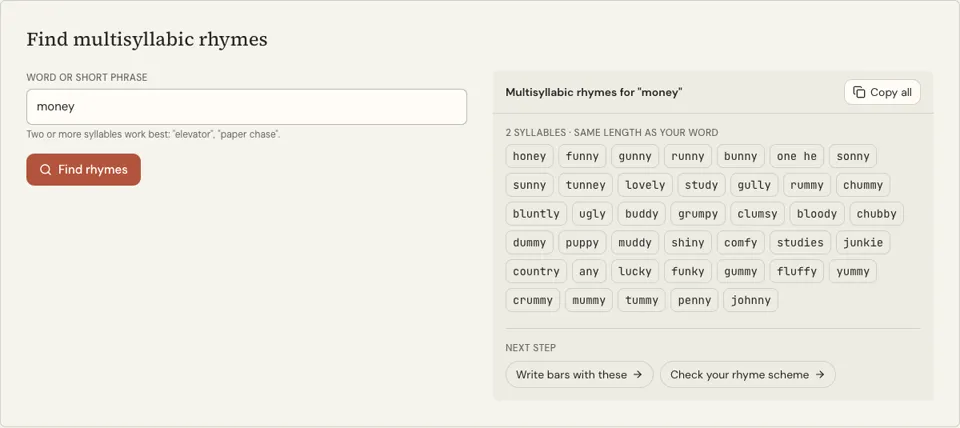
Open the multisyllabic rhyme generator and look up the last word of each anchor. Click results to copy them, then build phrases by adding words in front that match the earlier vowels.
- 03
Write and check for seven minutes
Write four bars that end on one chain. Paste them into the rhyme scheme analyzer: all four lines should get the same letter. Rap them at 90 BPM and listen for the stresses.
Multisyllabic rhyme examples
Three-syllable chain at the end of each bar
Rooftop view of all the city lights, Summer on the corner, those were pretty nights, Grew up quick around some gritty fights, Now I take the stairs up fifty flights
Four-syllable chain (kitchen table)
Wrote my first verse at the kitchen table, Homemade tape with a written label, Cousin on the beat, yeah, the kid is able, Speaker hanging on by a twisted cable
Internal multis inside the bar
Cold morning, slow yawning, phone warning me I’m late, No stalling, go calling every door along the gate, Bright evening, light leaving, I write even when I’m beat, Still breathing, still keeping every line upon the sheet
Vowel map drill
Anchor: paper plane Vowels: AY, er, AY Matches: later train, safer lane, major pain, labour day Bar: Folded all my worries in a paper plane
Try it: Multisyllabic Rhyme Generator
Multisyllabic rhyme FAQ
What is a multisyllabic rhyme?
It is a rhyme in which two or more consecutive syllables match in vowel sound and stress, such as "city lights" and "pretty nights". It can be a single long word or a phrase. In rap it is often shortened to "multi".
What is an example of a multisyllabic rhyme?
"Paper plane" with "later train" and "major pain" is a three-syllable example: each has the vowel sounds AY, er, AY. "Kitchen table" with "written label" matches four syllables. Both work because vowels and stresses line up.
Do multisyllabic rhymes have to match exactly?
No. The vowel sounds and the stress pattern need to match. Consonants can differ, which is why "cold hands" and "no chance" work when rapped. These looser matches are often called slant or near multis and are very common.
How do I find multisyllabic rhymes?
Write the vowel sounds of your phrase, then list words for each sound and combine them. A rhyme tool speeds up the last syllable: look up the final word, pick matches grouped by syllable count, then add words in front to match the rest.
How many syllables should a multi have?
Two or three is the practical range for most bars. Four is impressive and harder to keep meaningful. Longer than that tends to force the wording. Start with two-syllable matches and move up once they feel natural.
Will the rhyme scheme analyzer detect multis?
It letters the end-rhyme sound of each line, so a chain of multis shows as the same letter repeated. It estimates from spelling and does not score how many syllables match, so your ear makes the final call.
What is the difference between a compound rhyme and a multisyllabic rhyme?
They overlap. Multisyllabic rhyme is the general term for any match of two or more syllables. Compound rhyme usually means the version built from several words, such as "corner store" and "order more". Mosaic rhyme is a phrase matched against a single longer word.
Are multis only used in rap?
No. Double and triple rhymes appear in English poetry, comic verse, limericks and musical theatre going back centuries. Rap uses them far more densely and in serious writing, often several per bar, which is why the technique is now most associated with hip-hop.
Related reading
Related tools
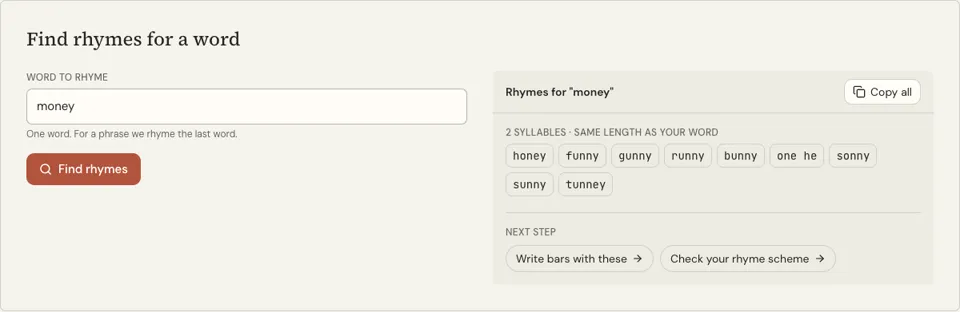
Multisyllabic Rhyme Generator
Type a word or short phrase and get rhymes of two or more syllables in about a second, with the lengths closest to yours listed first. Free, no sign-up.
Rhyme Scheme Analyzer
Paste a verse or poem and see its rhyme scheme as letters, one per line, with a syllable count beside each. Results update as you type. Free, no sign-up.
Rap Rhyme Schemes
By the end you can label any verse with letters, write the three core schemes on demand, and add internal rhymes and multis without losing the meaning.
Slant Rhyme Generator
Type a word and get its slant rhymes in about a second: words with the same vowel sound and a different ending, grouped by syllable count. Free, no sign-up.
Last updated November 13, 2026