Rap Flow, Explained
After this guide you can count a bar, place syllables on or off the beat on purpose, and switch between four flow patterns inside one verse.
Guide·7 min read·With exercises
What rap flow is, in one paragraph
Rap flow is the rhythm of your syllables measured against the beat. The words are what you say; the flow is when each syllable lands, how long it lasts and where you leave silence. Two rappers can read the same four lines and sound nothing alike, because one sits on the beat and the other leans behind it.
Flow is built from a small set of decisions: how many syllables go in a bar, whether they fall on the beat or between beats, whether you group them in twos, threes or fours, and where the rhyme word hits. Each of those can be counted, which means each can be practised.
If you only take one thing from this page: loop a beat, count "1, 2, 3, 4" aloud, and say any sentence so its last stressed word lands on 4. That is a flow. Everything below is a variation on it.
Count the grid before you write
Nearly all rap is in 4/4 time: four beats to a bar, with the snare or clap on beats 2 and 4. Each beat divides into four sixteenth notes, so one bar has 16 slots. Count them as "1 e and a, 2 e and a, 3 e and a, 4 e and a". A syllable can sit on any slot, stretch over two, or be left out.
Flow is the choice of which slots you fill. Eight syllables on the eighth notes sound relaxed. Fourteen sound urgent. Loop an instrumental and count the 16 slots aloud for four bars, tapping your foot on 1, 2, 3 and 4, until the count runs without effort.
Tempo changes how much fits. At 90 BPM a bar lasts about 2.7 seconds, which is room for 8 to 12 spoken syllables at a talking pace. At 140 BPM counted in half time, the same bar feels like 3.4 seconds, so lines can be longer or carry more rests. Check the BPM of a beat before you decide how dense to write.
Four patterns every rapper uses
Most flows you hear are one of four patterns, or a mix of them inside a verse. Learn each one alone before blending.
- On-beat: stressed syllables land on 1, 2, 3 and 4. About 8 syllables a bar. Clear and heavy, the default at 85 to 95 BPM.
- Off-beat: you start after beat 1 and stress the "and" between beats. The line feels like it is leaning back.
- Triplet: three even syllables per beat, 12 per bar. It rolls, and it is common over 130 to 150 BPM beats counted in half time.
- Double time: a syllable on every sixteenth, up to 16 per bar. At 90 BPM that is six syllables a second.
Where the rhyme lands: the pocket
The pocket is the spot in the bar where your line feels locked to the drums. For most verses the end rhyme lands on beat 4, with the snare. That is why a simple couplet sounds finished: word and snare arrive together.
Move the rhyme and the feel changes. Land it on the "and" after 4 and the line spills into the next bar. Land it on 3 and you get a gap you can fill with an ad-lib. Take one couplet you have written and say it three times, with the rhyme on 3, on 4, then just after 4.
Being in the pocket also means agreeing with the drums on small timing. Rapping slightly behind the beat sounds relaxed and confident; slightly ahead sounds eager and aggressive. Both are choices as long as you hold them steady for the whole bar. Record eight bars and listen only to your stressed syllables against the snare: they should fall in the same place every time.
Pauses are part of the pattern
New rappers fill every slot, then run out of air by bar 6. A rest is a rhythmic event, the same as a syllable. Leaving beat 1 empty makes the listener wait. Stopping dead on beat 3 gives the next line weight.
Plan your breaths. In a 16-bar verse, mark a breath at the end of every second bar at least, and write one bar in each group of four that stops early. Read the verse with a pen in hand and draw a slash wherever you inhale. If two slashes are more than two bars apart, cut syllables.
Stress is the other half of this. In speech, some syllables are naturally louder: PA-per, to-DAY. A line sits well when those natural stresses fall on beats or strong off-beats, and it fights you when a weak syllable like "the" or "of" lands on beat 1. If a bar feels clumsy, move one word so a strong syllable takes the beat.
Switch flows every four bars
A verse that keeps one pattern for 16 bars is easy to follow for four bars and dull by twelve. The common fix is a switch at bar 5, 9 or 13: change the syllable count, move the rhyme position, or go from straight sixteenths to triplets.
Keep one thing constant when you switch, usually the rhyme sound, so the listener has something to hold. Try this plan on your next verse.
- Bars 1 to 4: on-beat, 8 to 10 syllables, rhyme on 4.
- Bars 5 to 8: off-beat entry, same rhyme sound.
- Bars 9 to 12: triplets, new rhyme sound.
- Bars 13 to 16: back to on-beat, with a full stop on beat 3 of bar 16.
Borrow a rhythm, leave the words
The quickest way to widen your set of patterns is to lift the rhythm from a verse you like and throw the lyrics away. Loop four bars of the song. Scat along with "da" on every syllable until you can do it without the recording. Then write the pattern down as a row of 16 slots per bar, with an X where a syllable falls and a dot where there is silence.
Now write four new bars of your own that fit the Xs exactly. The subject, words and rhymes are yours. Only the timing is borrowed, and rhythm patterns are shared across the whole genre. Do this with one verse a week, from different eras and tempos. After two months you have eight patterns in your body that you did not invent, and the blends between them start to sound like you.
Tension and release inside one bar
A bar where every syllable is the same length is steady, and steady turns flat. Energy comes from contrast: a quick cluster of short syllables, then a held word or a rest. The cluster builds tension. The long note lets it go. Very fast subdivisions, such as thirty-second notes, work well as bursts of two or four syllables and wear thin as whole lines.
Try this pair at 90 BPM. The hyphenated run is eight quick sixteenths across beats 1 and 2, and the word in capitals is held for all of beat 4: "Never-ever-had-a-minute, now I WAIT / Every-other-day-a-limit, now I BREAK". The first half of each bar is crowded, beat 3 slows to two syllables, and beat 4 is one long sound.
You can run the shape backwards as well: open with two slow words, then finish in a rush that leans toward the next bar. Record both shapes with the same words and note which one suits the beat.
Anchor points: repeat one spot so the rest can move
When the rhythm changes constantly, the listener loses the thread. An anchor point fixes that. It is a short rhythm that returns in the same place in every bar, usually across beats 3 and 4, while the first half of the bar is free to change. The repeated landing tells the ear where the bar ends.
A simple anchor is three syllables, short, short, long, finishing on beat 4: "on the WAY", "every DAY", "what they SAY". Write four bars whose first two beats use a different syllable count each time, 4, then 6, then 3, then 8, and close every bar on that three-syllable anchor. It will sound planned even though half of each bar is different.
Breaths can be anchors too. A breath in the same slot of every second bar becomes part of the groove.
Test one verse at three tempos
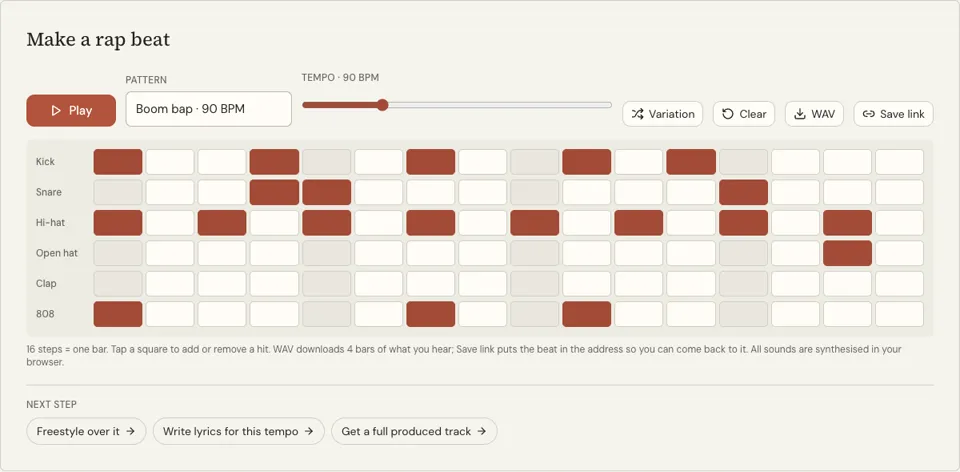
A pattern that only works on one beat is memorised, not learned. Take 8 bars you know well and rap them over three loops in the rap beat maker: Lo-fi at 78 BPM, Boom bap at 90 and Trap at 140 counted in half time. Do not rewrite between passes. Notice what breaks.
At the slowest tempo the gaps get wide, and the fix is to stretch vowels or add a rest on purpose, not to rush ahead. At 140 the hi-hats tempt you to speed up, so follow the snare. Record all three passes and match each fault to the list.
- Finishing before the bar ends: you are ahead. Hold the last word longer.
- Running into the next bar: cut one small word and keep your speed.
- Stresses falling between beats by accident: clap 2 and 4 while you rap.
- Voice going flat at slow tempo: raise the pitch on the rhyme word.
Three mistakes people make with rap flow
Writing to silence
Lines written without a beat have no fixed length, so half of them run long. Loop a drum pattern first, even a plain one, and say each line over it before you keep it.
Speeding up to fit extra words
When a bar has too many syllables, rushing makes it sound nervous. Count the syllables, cut the small words that carry no meaning, and keep the tempo of your delivery steady.
One pattern for the whole verse
A flow that never changes turns into background. A single switch at the halfway point, even just two bars of triplets, tells the listener the verse is going somewhere.
How to practise rap flow today
- 01
Loop a beat at 90 BPM (5 minutes)
Open the rap beat maker, load the Boom bap preset at 90 BPM and press play. Count "1 e and a" aloud for eight bars, then say any four lines strictly on the beat.
- 02
Run the four patterns (8 minutes)
Take one couplet and deliver it four ways over the loop: on-beat, off-beat, in triplets, then double time. Two minutes each. Add or cut small words so each version fits the bar.
- 03
Check the counts (5 minutes)
Paste the four versions into the syllable counter. On-beat lines should sit near 8 syllables, triplets near 12, double time near 16. Trim any line that is far outside its range.
Rap flow examples you can say over a loop
On-beat, 8 syllables (capitals fall on beats 1 to 4)
PACK the BAG and CATCH the LATE train SAME old SEAT, a DIFF-rent GREY rain
Off-beat entry (rest on beat 1)
(rest) I been UP since the SUN came THROUGH (rest) Got a LIST and I RUN straight THROUGH
Triplet, 12 syllables in groups of three
Run-ning it, gun-ning it, no-bod-y’s done with it Sum-mon it, drum-min’ it, some-bod-y’s stunned with it
Double time, 16 syllables
Ticking and kicking, picking the minute to finish the mission Sticking to writing, flipping the rhythm, I’m fixing the vision
Try it: Rap Beat Maker
Rap flow FAQ
What does flow mean in rap?
Flow is how your syllables are timed against the beat: how many you fit in a bar, which ones are stressed, where you pause and where the rhyme lands. It is separate from the lyrics, so the same words can carry several flows.
How do I find my own rap flow?
Practise the four basic patterns until each is automatic, then record yourself freestyling nonsense syllables over a loop. The rhythms you fall into without thinking are your natural flow. Write real words to those rhythms afterwards.
How many syllables should a rap bar have?
There is no rule, but ranges help. At 85 to 95 BPM, 8 to 12 syllables sits comfortably and 16 is double time. On a 140 BPM beat counted in half time, 10 to 14 is common. Count yours and compare.
What is the difference between flow and cadence?
People often use them as the same word. When they are separated, flow is the rhythmic pattern on the grid and cadence is the rise and fall of your voice as you deliver it: pitch, stress and tone.
What is a triplet flow?
A triplet flow fits three evenly spaced syllables into each beat instead of two or four, giving 12 per bar. It has a rolling, galloping sound. Count it as "1 and a, 2 and a, 3 and a, 4 and a".
Can I practise flow without lyrics?
Yes, and it is often faster. Scat the rhythm with sounds like "da da-da da" over a drum loop, record the patterns you like, then fit words to the rhythm. Many writers build verses in that order.
Why do I keep going off beat when I rap?
Usually the line has more syllables than the bar can hold, or you are listening to your own voice and not the drums. Count the syllables, cut small words, and practise with the snare loud in one ear until landing on beats 2 and 4 is automatic.
Related reading
Related tools
Rap Beat Maker
Press Play and a boom bap loop starts at 90 BPM. Tap squares on the 16-step grid to change the kick, snare, hats, clap and 808, then write to it. Free, no sign-up.
Syllable Counter
Paste your lines and see a syllable count beside each one, plus totals for syllables, lines and words. Counts update as you type. Free, no sign-up.
How to Rap Fast
Learn what fast rap is in beats and syllables, then follow a tempo ladder and four mouth drills that raise your speed without turning the words to mush.
Rap Rhyme Schemes
By the end you can label any verse with letters, write the three core schemes on demand, and add internal rhymes and multis without losing the meaning.
Last updated November 13, 2026