How to Make Rap Music
See the whole chain from drum pattern to released track, with the settings and counts for each stage, so you know what to learn first and what can wait.
Guide·7 min read·With exercises
How to make rap music: the four parts
Rap music is made of four parts: a beat, lyrics written to that beat, a recorded vocal and a mix that balances the two. You can do all four at home with a laptop or even a phone. Making the beat yourself is optional, since many rappers work with producers, but understanding how beats are built makes you better at rapping on them.
The usual order is beat first, then writing, then recording, then mixing, then release. Each stage has a few basics that account for most of the quality. Get the drums knocking, keep the vocal clean and loud enough, and you are most of the way to a listenable track.
This page covers the full process at a working level. If you want a walkthrough of a single track from idea to finished file, the guide on how to make a rap song goes step by step. Each stage below ends with something to try.
Start with the drums
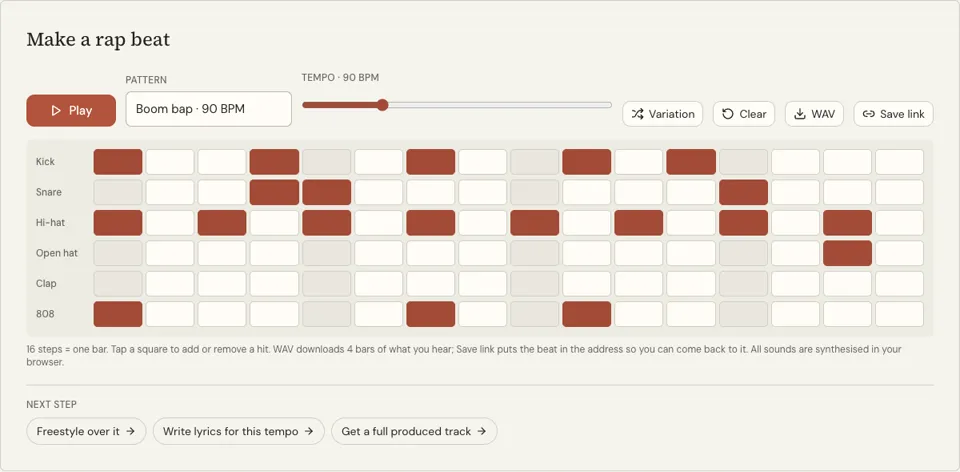
Rap beats are drum-led and in 4/4. In a 16-step grid, one bar is 16 steps and the beats fall on steps 1, 5, 9 and 13. A basic boom bap pattern puts the snare on steps 5 and 13, kicks on 1 and somewhere around 7 or 11, and hi-hats on every second step, at 85 to 95 BPM.
Trap runs at 130 to 150 BPM but feels half as fast, because the snare or clap lands once per bar on step 9. Fast hi-hats and a long 808 bass note fill the space. Program both patterns once by hand. Hearing how moving one kick changes the bounce teaches more than any preset.
Add music, or choose a finished beat
Over the drums go a bass line and one or two melodic parts: a sample, piano chords, a synth. Keep it sparse. The vocal needs the middle of the frequency range, and a crowded beat fights the rapper. Many classic-sounding beats are a four-bar loop with small changes every eight bars.
If you would rather focus on rapping, get beats from a producer. Agree terms before you release anything: beats found online usually require a licence, and a "free" tag often covers non-commercial use only. Whatever the source, ask for the tempo, and write it at the top of your lyric sheet.
Write to the tempo
Loop the beat and write with it playing. Tempo sets how many syllables fit: around 10 to 14 per bar at 90 BPM, and a similar count on trap beats when you treat them at half speed. Structure the lyrics to the standard song form.
Mark the bar numbers down the side of the page so every section has the right length before you record.
- Intro: 4 bars of beat alone or with ad-libs
- Hook: 8 bars, the part that repeats
- Verse: 16 bars, twice, each followed by the hook
- Outro: 4 bars, often the hook fading or the beat dropping out
Record a clean vocal
Room matters more than microphone. Record where there are soft surfaces: a bedroom with curtains, or facing an open wardrobe full of clothes. Stand about a hand’s width from the mic with a pop filter, or angle the mic slightly off your mouth, so "p" and "b" sounds do not thump.
Wear headphones so the beat does not leak into the mic. Set the input so your loudest words peak well below the red, around minus 10 decibels on the meter. Record three full takes of each section, then a quieter double of the hook and a pass of ad-libs. Label every take before you close the session.
Mix simply and release
A beginner mix is mostly volume. Bring the beat down until the lead vocal sits clearly on top, tuck doubles and ad-libs underneath, and pan ad-libs slightly left and right. Cut the low rumble below the voice with a high-pass filter and add gentle compression to even out loud and quiet words.
Check the result on earbuds, a phone speaker and a car or kitchen speaker. If the words are clear on all three, export. To release, upload the audio and a square cover to a digital distributor, enter the credits and choose a date. Listen to the export once more the next morning before you submit.
Arrange the beat so the song moves
A loop that never changes wears thin within a minute. Arrangement means deciding what plays in each section. Common moves are removing the drums for the intro, dropping the bass for the first four bars of a verse, and bringing every element in for the hook so it feels larger than the verses. None of this needs new sounds, only the mute button.
Small edits do a lot of work. Mute the beat for the last beat or the last bar before a hook and the return hits harder. Add an extra percussion sound or a counter-melody in the second verse so it does not feel like a copy of the first. If a producer made the beat, ask for the separate tracks, often called stems, so drops like these can be made around your vocal. Listen through your beat and write down, in bars, where one thing enters or leaves. Aim for a change at least every eight bars.
- Intro: melody alone, drums enter at the end
- Verse: drums and bass, melody thinned out
- Hook: everything in, plus doubles on the vocal
- Last bar before the hook: silence or drums only
Three mistakes beginners make when they make rap music
Burying the vocal
New mixers keep the beat loud because it sounds exciting, and the words vanish. In rap the vocal leads. Turn the beat down further than feels natural, then check on a phone speaker.
Recording in a bare room
Hard walls add a boxy echo that no plug-in fully removes. Thirty seconds spent moving to a carpeted room, or opening a wardrobe and rapping into the clothes, improves a take more than new gear.
Releasing over a beat without permission
Using a beat you do not have rights to can get a song taken down after you have promoted it. Sort out the licence or agreement with the producer before the release date, in writing.
How to practise making rap music today
- 01
Program drums for six minutes
In the rap beat maker, press Clear and build a bar by hand: snare on steps 5 and 13, kick on 1 and 11, hi-hat on every odd step. Set the tempo to 90 BPM.
- 02
Write 8 bars for seven minutes
With the pattern looping, write 8 bars on any topic, landing each rhyme on the second snare. Move one kick to a new step and notice how your delivery wants to change.
- 03
Record a demo for five minutes
Play the loop through headphones and record your 8 bars on your phone’s voice recorder, three takes. Listen back and pick the take where the words are clearest.
Patterns and checklists for making rap music
Boom bap drum bar at 90 BPM (16 steps)
Kick: steps 1, 7, 11 Snare: steps 5, 13 Hi-hat: steps 1, 3, 5, 7, 9, 11, 13, 15 Open hat: step 15, in every second bar
Trap drum bar at 140 BPM (16 steps)
Kick: steps 1, 8, 11 Clap: step 9 Hi-hat: every step, with gaps on 4 and 12 808: steps 1 and 11, following the kick
Vocal recording plan for one song
Lead verse: 3 takes each Hook lead: 3 takes Hook double: 2 quieter takes Ad-libs: 1 pass, reacting to the end of each bar
Three-speaker mix check
Earbuds: are the words clear in the hook? Phone speaker: can you still follow the verse? Car or kitchen speaker: is the bass drowning the voice? Fix one thing, export, repeat once
Try it: Rap Beat Maker
How to make rap music FAQ
What do I need to make rap music at home?
At minimum a phone or computer, headphones and a quiet room. For better results add a USB microphone, a pop filter and free recording software. You also need a beat, either one you build or one you have permission to use.
Do I have to make my own beats?
No. Many rappers work with producers or license beats. Learning basic drum programming still helps, because you hear where the kick and snare fall and write tighter lines. Always agree usage terms with the producer before releasing a song.
What tempo is rap music?
It varies by style. Boom bap sits around 85 to 95 BPM. Trap and drill are written at roughly 130 to 150 BPM and felt at half that speed. Slower lo-fi styles can be under 80. Pick the tempo that suits your delivery.
Can I export beats from the Punchline drum machine?
Yes, in a limited way. The WAV button downloads four bars of the current pattern as a 16-bit WAV, and Save link keeps the pattern in a web address. There is no MP3 and no song-length export, so treat it as a tool for learning patterns and rehearsing.
How do I get my rap music on streaming services?
Through a digital distributor. You create an account, upload the finished audio file and square artwork, fill in the title and credits, and set a release date. The distributor delivers the song to the streaming stores for you.
How loud should my vocal be in the mix?
Loud enough that every word is understood on a phone speaker without straining. As a starting point, set the vocal first, then raise the beat underneath until it supports the voice without covering consonants.
Related reading
Related tools
Rap Beat Maker
Press Play and a boom bap loop starts at 90 BPM. Tap squares on the 16-step grid to change the kick, snare, hats, clap and 808, then write to it. Free, no sign-up.
AI Beat Maker
Pick a style, press Generate beat and get a rap instrumental in about a minute, with no vocals, as an MP3 download. Each beat costs 4 credits.
Make a Rap Song
Follow one song from a one-line idea to a finished file: a 64-bar map, a hook, two verses and a demo recorded in a single sitting.
Make Rap Beats
You will be able to read a 16-step grid, program a boom bap and a trap drum pattern from memory, and place a bass line that follows the kick.
Last updated November 12, 2026