How to Find Your Rap Voice
You will have a repeatable test for finding the pitch, energy and tone that suit you, plus breath and diction drills to make that voice hold up for 16 bars.
Guide·6 min read·With exercises
How to find your rap voice: start from how you talk
To find your rap voice, record yourself speaking naturally, then rap the same eight bars at three pitches and three energy levels, and listen back the next day. The take that sounds like you on a confident day, and that you could repeat for a whole song, is your starting voice.
Most beginners sound unnatural because they copy the tone of a rapper they admire. A borrowed voice is tiring to keep up and listeners hear the strain. Your own speaking voice, slightly louder and more precise, is nearly always the right base.
Voice is two things: sound and character. Sound is pitch, volume, tone and diction. Character is word choice, humour and what you notice. This guide works on the sound; the character arrives as you write more. You need both, but sound is the part you can train in a week.
Record your baseline
Open the voice recorder on your phone and tell a two-minute story about your day as if a friend were in the room. Do not perform. Then read eight bars of your own lyrics in the same tone, without a beat.
Listen once and note three things: how high or low you speak, how fast, and which words you naturally stress. Almost everyone dislikes their recorded voice at first, because it lacks the resonance you hear inside your head. Listen three times before judging anything.
Record in the same spot each time, about a hand’s width from the microphone, so that differences between takes come from you and not from the room. A wardrobe full of clothes or a parked car is a quiet enough booth for these tests.
The three by three test
Loop a beat at a moderate tempo and record the same eight bars nine times, changing one thing at a time. Label every take aloud before you start it.
The aim is to compare, not to perform. Small steps are enough: a tone or two up or down, not a different character. Most people find that one pitch feels easy and two feel like acting.
- Pitch: slightly below your speaking voice, at it, and slightly above.
- Energy: conversational, firm, and near shouting.
- Keep the words and the flow identical in all nine takes.
- Wait at least a few hours, then rank them without looking at the labels.
Breath: the engine of tone
A thin or shaky voice is usually a breath problem. Breathe low, so your stomach moves out and your shoulders stay still, and rap on a steady stream of air instead of pushing from the throat.
Drill it without a beat. Inhale for four counts, then say "one, two, three" and keep counting on a single breath at an even volume. Note the number you reach. Do five rounds a day; the number climbs within a week, and long bars stop falling apart at the end.
Posture changes the result. Stand with your feet apart and your chin level, or sit forward on the edge of a chair. Slumping folds the space your lungs need, and tilting the head back tightens the throat.
Diction: be understood at speed
Clarity comes from consonants. If your T, K, P and D sounds are soft, lines blur as soon as the tempo rises. Over-pronounce in practice so that normal delivery ends up clear.
Take four bars and say them slowly with exaggerated mouth movement, then at tempo, then at tempo with a pen held lightly between your teeth, then normally again. The last pass will feel easy. Do this for five minutes before any recording session.
Speed is the last thing to add. Find the fastest tempo at which every word of the four bars is clear, and practise there. Raise the tempo by 5 BPM only when a recording at the current speed is fully understandable to someone who has not read the lyrics.
- Finish the last consonant of every rhyme word
- Keep vowels long on the rhyme, short elsewhere
- Do not drop volume at the end of the bar
Delivery: match the voice to the line
One voice does not mean one setting. A boast, a confession and a joke need different amounts of volume and space. Mark your lyric sheet: underline the words to hit, put a slash where you pause, and draw an arrow down where the voice should drop.
Record a verse twice, once "flat" and once following your marks. The marked take nearly always sounds more like a person talking, which is the goal.
Tone carries emotion more than words do. Try the same bar smiling, then with a clenched jaw, then nearly whispered. Listeners can hear a smile. Pick the tone that matches what the line means, and note it in the margin.
Keep the voice consistent
Once you have a starting voice, use it for ten songs before changing anything. Consistency is how listeners learn to recognise you within two bars. Save your chosen take as a reference file and play it before each session to tune yourself.
Look after the instrument: drink water, warm up for five minutes with humming and lip trills, and stop when your throat hurts. Hoarseness after every session means you are pushing from the throat, not the breath.
Layering is part of the sound as well. A second take of the same verse played quietly under the first thickens the voice, and ad-libs in a different tone add character. Learn your single voice first, then add layers.
Three mistakes people make finding their rap voice
Copying a favourite rapper’s tone
An imitation invites comparison with the original and you will lose it. It also strains the throat, because that pitch and rasp belong to someone else’s body.
Judging the voice from inside your head
What you hear while rapping is not what a microphone hears. Decisions about pitch and energy only make sense when you listen to a recording, ideally a day later.
Forcing a deeper voice
Pushing your pitch down to sound tougher flattens your tone and cuts your breath short. A relaxed voice at your natural pitch carries more weight than a strained low one.
How to practise finding your rap voice today
- 01
Set up a loop and eight bars (4 minutes)
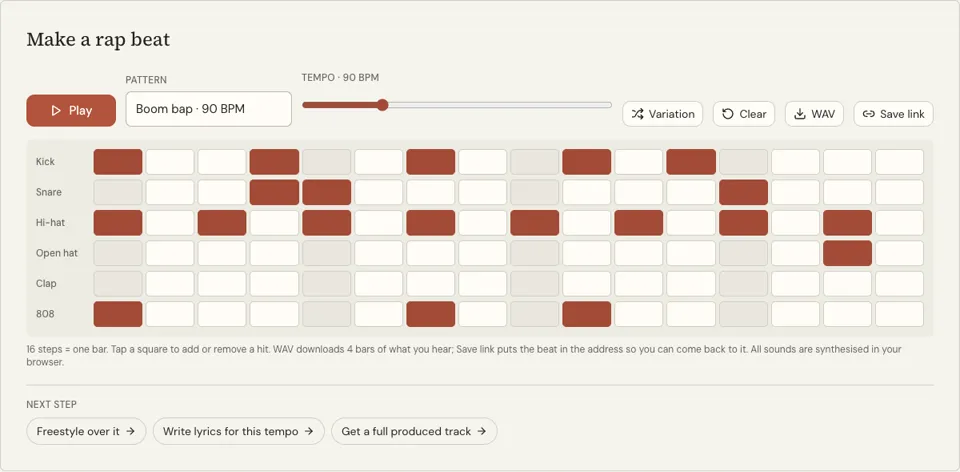
Start the West Coast preset in the rap beat maker at 96 BPM. Choose eight bars you know well, or write a quick eight with the rap bars generator and edit them into your words.
- 02
Record the nine takes (10 minutes)
With the loop playing through headphones, record the three pitches at firm energy, then the three energy levels at your natural pitch, then three takes of your favourite pairing.
- 03
Breath and diction drill (5 minutes)
Do three rounds of the counting-on-one-breath drill, then say your eight bars slowly with exaggerated consonants. Leave the recordings until tomorrow and rank them then.
Rap voice examples: one bar, four deliveries
Conversational (natural pitch, low energy)
I told them I’d be back by ten. (pause) I meant it, then.
Firm (stress on capitals)
I TOLD them I’d be BACK by TEN / I MEANT it, THEN
Marked lyric sheet
I _told_ them / I’d be back by _ten_ ↓ (breath) I _meant_ it / then ↓
Diction drill line
Packed bags, back taxes, cracked glass, last matches Say it slowly, hit every T, K and D, then say it at tempo.
Try it: Rap Beat Maker
How to find your rap voice FAQ
How do I find my natural rap voice?
Start from your speaking voice. Record yourself talking, then rapping the same bars at a few pitches and energy levels, and choose the take that sounds like you with more confidence. Avoid judging in the moment; listen back later.
Why do I hate how my voice sounds when I rap?
Recordings remove the bone-conducted resonance you hear when you speak, so your voice sounds thinner than expected. Everyone goes through this. It fades after a few weeks of regular recording and listening.
Should I rap in a deeper voice?
Only if it is comfortable for a whole song. A forced low pitch sounds flat and tires the throat. Most people sound strongest at or just below their natural speaking pitch with good breath behind it.
How do I make my rap voice sound stronger?
Work on breath support and consonants. Breathing low and rapping on a steady stream of air adds body, and clear T, K, P and D sounds add punch. Standing up to record helps too.
Do I need an accent or a persona?
No. Your own accent is an advantage because it is yours and you can keep it up without thinking. A persona can come later, as an exaggeration of traits you already have.
How long does it take to find your voice?
The sound can settle within a few weeks of recording regularly. The character, meaning what you say and how you see things, keeps developing over years of writing. Both come from finishing songs.
Related reading

Related tools
Rap Beat Maker
Press Play and a boom bap loop starts at 90 BPM. Tap squares on the 16-step grid to change the kick, snare, hats, clap and 808, then write to it. Free, no sign-up.
Freestyle Word Trainer
Press start and a drum loop plays while a new random word appears every few seconds. Work each word into a bar before the next one lands. Free, no sign-up.
Rap Flow Guide
After this guide you can count a bar, place syllables on or off the beat on purpose, and switch between four flow patterns inside one verse.
Start Rapping
Seven short sessions take you from never having rapped to a recorded 8-bar verse. Each day has one task, a time limit and a way to tell you did it right.
Last updated November 12, 2026