Rapper Interview Questions
You will leave with a preparation routine, 25 questions grouped by theme, and three follow-up moves that turn short answers into stories.
Guide·7 min read·25 questions
How to run a rapper interview that gets real answers
A good rapper interview comes from three things: you listened to the music closely, you ask about specific moments instead of general feelings, and you follow up on what the artist just said instead of moving to your next line. The question list matters less than those three habits.
Plan 10 to 12 questions for a 30-minute conversation and expect to ask about eight. Open with something easy and concrete, put the questions about craft in the middle, and keep one question in reserve that nobody else would ask, taken from a detail in the lyrics.
The 25 questions below are grouped by theme so you can pick two or three from each group. Reword them in your own voice and replace the general phrases with the names of the artist’s actual songs. A real title in the question shows you listened.
Prepare for one hour before you write a question
Listen to the latest project from start to finish with the lyrics open, and write down three lines that made you stop. Read or watch two earlier interviews and note what the artist has already been asked, so you can skip it or go one layer deeper.
Then confirm the basics with whoever booked the interview: how to say the stage name, how long you have, whether it is audio, video or print, and whether any subject is off limits. Put the finished notes on a single page you can glance at.
If you record, test the microphone and the room for thirty seconds beforehand and bring a second device as backup. Losing the audio of a good conversation is the one mistake you cannot fix by editing.
- Three lyric lines with the song title and bar position
- Two facts that are public and checked: home city, release date
- One thing earlier interviews missed
- Your opening question, written out word for word
Questions about beginnings
Origin questions are warm-ups, but they work only when they ask for a scene. "How did you start?" gets a rehearsed answer. A question about a place, a person or a first attempt gets a story. Choose two.
- Where were you the first time you rapped in front of someone, and who was it?
- What did the first verse you wrote sound like, and do you still have it?
- Who in your family or neighbourhood heard your music first, and what did they say?
- What did your stage name mean when you chose it, and has the meaning changed?
- What were you doing for money when you recorded your first song?
Questions about writing and recording
Artists rarely get asked how the work is made, and most enjoy explaining it. Tie each of these to one named song so the answer stays specific.
- On this song, which came first: the beat, the hook or a single line?
- Do you write on paper, on a phone or in your head, and why?
- How do you decide a verse is finished?
- Which bar on the project took the longest to get right?
- What does a normal recording session look like for you, from arriving to leaving?
- How do you choose beats, and what makes you turn one down?
Questions about the new project
This is the part the artist came to talk about. Ask about decisions, because a decision always has a reason behind it.
- Why is this song first in the track order?
- What got cut from the project, and was that hard?
- Who is the person you had in mind when you wrote the second verse of the single?
- What did you want the cover to say before anyone presses play?
- If a new listener has time for one track, which one and why?
Questions about the business and the city
Independent artists handle their own release plans, shows and money. These questions respect that work. Ask them plainly and do not push for figures.
- What is one thing about releasing music yourself that you wish you had known earlier?
- How did your last live show change the way you perform these songs?
- What does your city sound like right now, and where do you fit in it?
- Who are you working with next, and how did that come about?
- What does a good year look like for you from here?
Follow up, then close
The strongest question is often four words long: "What happened after that?" When an answer is short, do not rescue it with your next question. Wait two seconds, then ask for an example, a name or a place. If the artist mentions a turning point, stay on it for two more questions before returning to your page.
Close with two standard questions: "Is there anything I did not ask that you want people to know?" and "Where should people find the music?" Before you publish, check every song title, name spelling and date against the release itself.
Listen for words the artist repeats and for places where the voice changes. Both mark something that matters to them. Repeat the word back as a question, such as "You said borrowed twice. Borrowed from whom?", and then stay quiet.
- Ask for the scene: "Where were you when that happened?"
- Ask for the example: "Can you give me one line where you did that?"
- Ask for the change: "Would you do it the same way now?"
- Ask for the cost: "What did you give up to finish it?"
Three mistakes people make in a rapper interview
Asking what the internet already answers
Age, home town and "who are your influences" are in every bio. Using your limited minutes on them tells the artist you did not prepare, and the answers come out flat.
Reading the list in order
When you move to question six while the artist is halfway into a story, you lose the story. Treat the list as a safety net and let the conversation choose the order.
Asking two questions at once
A double question gets half an answer, usually to the easier part. Ask one short question, stop talking, and let the silence do some of the work.
How to practise for a rapper interview today
- 01
Build a one-page brief (8 minutes)
Pick any independent rapper you could realistically reach. Listen to one song with the lyrics open and write down three specific lines, two checked facts and one opening question.
- 02
Draft ten questions (7 minutes)
Choose two questions from each group above and rewrite them with that artist’s song titles. Read them aloud. Cut any question that takes longer than eight seconds to say.
- 03
Learn the craft words (5 minutes)
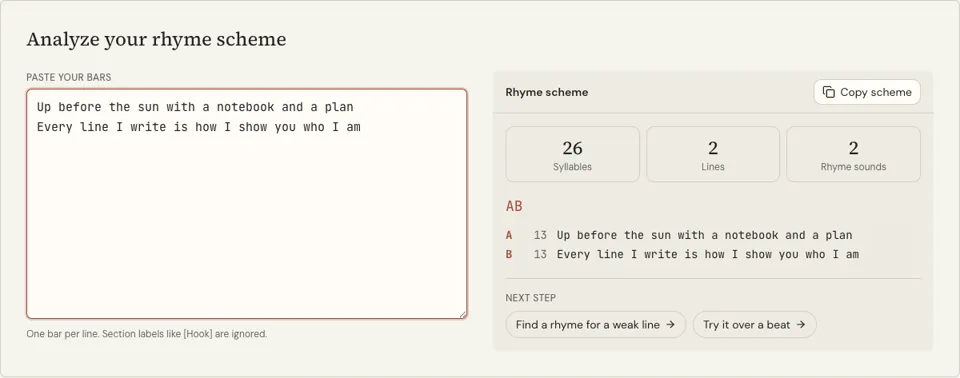
Paste one of the artist’s verses you transcribed into the rhyme scheme analyzer and note the pattern. Asking "why did you hold one rhyme for eight bars?" shows you listened.
Rapper interview examples: weak question, stronger version
Opening with a scene
Weak: How did you get into rap? Stronger: Take me to the first room you ever rapped in. Who was there?
Asking about a specific bar
Weak: What inspires your lyrics? Stronger: In the second verse of the single you mention a bus stop at 5 a.m. What was that morning?
Following up on a short answer
Artist: It was a hard year. You: What was the week that made it hard?
Closing questions
Is there anything I did not ask that you want people to hear? Where should someone start with your music, and where can they find it?
Try it: Rhyme Scheme Analyzer
Rapper interview FAQ
What are good questions to ask a rapper in an interview?
Questions tied to a specific song, decision or moment. Ask which line took longest to write, why a track sits first in the order, or where the artist was when they first performed. Specific questions get stories; general ones get slogans.
How many questions should I prepare?
For a 30-minute conversation, prepare 10 to 12 and expect to use about eight. For a 10-minute slot, prepare five and mark the two you must ask. Follow-ups will fill more time than you expect.
How do I get an interview with a local rapper?
Send a short message to the contact address on their profile or to their manager. Say who you are, where it will be published, how long you need and one specific thing you liked about a recent song.
Should I send questions in advance?
Send the topics, not the full list, unless the artist’s team asks for it. Topics let the artist prepare without rehearsing answers. Always agree in advance on anything that is off limits and respect it.
What should I avoid asking?
Avoid rumours, questions about other artists’ private lives, and anything that asks the artist to confirm illegal activity. Avoid asking for exact earnings. If a hard subject is relevant, ask once, plainly, and accept the answer.
How do I record and credit the interview?
Ask permission to record before you start and say so on the recording. Quote exactly, mark any edits for length, and credit song titles as they appear on the release. Offer to send the link when it is published.
Related reading
Related tools
Rhyme Scheme Analyzer
Paste a verse or poem and see its rhyme scheme as letters, one per line, with a syllable count beside each. Results update as you type. Free, no sign-up.
Rap Topic Generator
Give it one word, feeling or place and get ten song topics back in seconds, each with a title and a sentence on the angle. Free, no account needed.
Hip Hop Slang Glossary
You will be able to follow any conversation about writing, recording or releasing rap, with 99 terms defined in plain words and grouped by where you will hear them.
Become a Rapper
This guide lays out the real sequence: skill, name, songs, releases, stages and audience, with a number attached to each step. No promises of fame or income, only work you control.
Last updated November 12, 2026