How to Write a Rap Verse
You will be able to plan and finish a 16-bar verse in one sitting: one subject, four blocks of four bars, and an ending that sets up the hook.
Guide·7 min read·With exercises
How to write a rap verse: the short answer
To write a rap verse, choose one subject, split 16 bars into four blocks of four, and give each block a job: open, develop, turn, close. Write each line over the beat so it fits one bar, end most lines on a rhyme that lands on beat 4, and finish with a line that points at the hook.
A standard verse is 16 bars in 4/4 time, and one written line normally equals one bar. At 90 BPM that is about 43 seconds of rapping. Shorter 8 and 12-bar verses are common on songs under three minutes. Either way the method is the same.
Most first verses fail from having too many subjects, not too few rhymes. Pick one scene, one argument or one memory, and stay inside it for all 16 lines. A narrow subject gives you details, and details are what make bars sound specific to you.
Choose one subject and one angle
Before any bars, write one sentence: "This verse is about ___ and I feel ___ about it." A subject alone, such as money, is too wide. A subject with an angle, such as the first time you were paid for music and how small the amount was, gives you pictures to describe.
Then list ten concrete details: objects, places, names of streets, things people said, times of day. You will use five or six. Set a timer for four minutes and write the list for your next verse now.
Decide who is speaking and to whom. A verse addressed to one person, a friend, a rival, your younger self, stays more focused than a verse addressed to everyone. Write "I am talking to ___" under your subject sentence.
Plan four blocks of four bars
Sixteen empty lines are intimidating; four small paragraphs are not. Give each block one job and write a note for it before writing any lines.
Think of it as a short essay or a scene in a film. The listener needs to know where they are, then needs a reason to keep listening, then a surprise, then a payoff. Four bars is long enough to do each job and short enough to hold in your head while you write.
- Bars 1 to 4, open: where we are and who is talking. Start with a picture, not an explanation.
- Bars 5 to 8, develop: add the detail or the problem. Change the flow slightly here.
- Bars 9 to 12, turn: something shifts. A new fact, a change of mood, a faster pattern.
- Bars 13 to 16, close: the strongest lines, ending on the thought the hook picks up.
Write to the beat, one bar per line
Loop the instrumental, or any drum pattern at the same tempo, and say each line aloud before you write it down. A line belongs in the verse only if it fits between one beat 1 and the next without rushing. For most tempos that means 8 to 14 syllables.
Draft fast and badly first. Fill all 16 lines in fifteen minutes with whatever comes, in plain speech, even if nothing rhymes. A finished rough verse is far easier to improve than four polished bars and twelve blanks.
Leave room to breathe as you draft. If you run out of air while saying a line at tempo, it is too long, whatever the syllable count says. End most bars with a tiny gap after the rhyme word and you will have a breath point built in.
Add the rhymes in a second pass
Now go back through in pairs. For each couplet, keep the line that says the most and rewrite its partner to rhyme with it. Near rhymes are fine. When a pair works, look for one word in the middle of either line that can match the end sound.
Change rhyme sound at the block boundaries, bars 5, 9 and 13, so each block sounds like a new paragraph. If you are stuck on a word, look it up in a rhyme tool, read twenty options and pick the one that fits the meaning, not the cleverest one.
Do not let a rhyme change what you meant. When the only word that fits says something untrue or vague, keep the meaning and loosen the rhyme, or swap the order of the two lines so a different word ends the bar.
Edit by counting
Count the syllables in every line and write the number at the end. Neighbouring lines should be within two or three of each other unless you intend a switch. A 15 next to a 9 will make you rush or drag.
Then cut. Remove filler words such as "just", "really", "like" and "you know" wherever the bar still makes sense. Replace any line that explains a feeling with a line that shows a thing. Read the verse over the beat three times and mark each place you stumble; those are the lines to rewrite.
Check the opening and closing lines last. The first bar should work even if the listener hears nothing else, and the final bar should be the line you would quote if someone asked what the verse says. If a stronger line is buried in the middle, move it to bar 16.
- Every line fits one bar at tempo
- Syllable counts are within three of the line above
- A breath is possible at least every two bars
- The last line leads into the hook’s first words
Give each verse in the song a different job
The four-block plan organises one verse. A song usually has two or three, and they should not do the same work. If verse two covers the same ground as verse one with new rhymes, the listener has no reason to stay.
A reliable division is scene, pressure, result. The first verse shows the situation. The second adds what makes it difficult or what is at stake. A third, if there is one, shows what changed or what it cost. Each still has its own open, develop, turn and close inside it.
Before writing a second verse, finish this sentence under your subject line: "Verse two tells the listener something verse one could not, which is ___." If you cannot fill the blank, the song may only need one verse and a longer hook.
- Verse one, scene: where, who, what is normal
- Verse two, pressure: what goes wrong, who objects, what is at risk
- Verse three, result: what you did, and what it cost or gained
Build a four-bar block one line at a time
Knowing a block's job still leaves four empty lines. Give each line a role as well. Line one makes a plain statement. Line two backs it with something you can see or hear. Line three bends it with a doubt, a contrast or a "but". Line four lands the point and carries the strongest rhyme.
The list shows a block about missing a younger brother's football game, written with those four roles. The first two lines have 10 syllables and the last two have 10 and 12, close enough to rap evenly.
The third line is the one beginners leave out. Without a bend, four bars read as a list of facts on one level. Take any block from your draft and label its lines with the four roles. If two lines do the same job, rewrite one of them as the bend.
- Statement: Told him I'd be standing by the fence at three
- Evidence: Boots by the door, number nine on the tee
- Bend: But the shift ran long and the bus ran slow
- Landing: Made the gate at the whistle, saw him turn to go
Land the stressed words on the beat
Syllable counts tell you if a line can fit. They do not tell you if it will sit well. English words carry a natural stress, and a bar feels locked when the stressed syllables fall on the beats, especially 2 and 4, where the snare usually hits. When a weak word such as "the" or "of" lands on the snare, the line sounds clumsy even with the right count.
Test it by speaking the line over the loop and clapping on 2 and 4. "Waiting at the station for the last train home" puts WAIT, STA, LAST and HOME on the four beats. Pad it out to "I have been waiting at the station for the very last train home" and five extra weak syllables have to squeeze in between those stresses. Most beginners let the stresses slide late instead, and the bar limps.
There are three fixes. Cut weak syllables between the stresses, change the word order so a strong word ends the bar, or start the line half a beat early so the first stress still hits beat 1. Go through bars 1 to 4 of your verse, clap on 2 and 4, and underline the syllable under each clap. Rewrite any bar where you underlined a filler word.
Shape the density and leave space
A verse where every bar has 12 syllables in the same rhythm is tidy and flat. Keeping neighbouring lines close in count stops you stumbling, but across the whole verse the density should have a shape. Listeners feel a busy bar after a sparse one as a lift in energy.
Plan the shape with the blocks. A common curve is medium, medium, busy, then sparse at the very end so the last line is easy to hear. Step up or down by two or three syllables at a block boundary, where the ear already expects a change.
Space is part of the rhythm. A bar that stops on beat 3 and leaves beat 4 empty makes the next bar hit harder, and it gives you a breath. Put one such gap in every block. Write the target counts from the list in the margin before your next draft.
- Bars 1 to 4: 10 to 11 syllables, steady
- Bars 5 to 8: 11 to 12, with one bar ending early on beat 3
- Bars 9 to 12: 13 to 14, the busiest stretch
- Bars 13 to 15: 11 to 12
- Bar 16: 8 to 10, slow enough to be heard clearly
Turn general lines into specific ones
First drafts lean on phrases anyone could have written: working hard, coming up, staying real. They fit the beat and say nothing. The edit that most improves a verse is replacing each general line with the particular thing behind it.
Ask three questions of every vague bar: where was I, what could I see, and what exactly happened. The answers are your new line. The three pairs in the list show the swap.
Notice that the specific versions are no longer than the general ones, and that none needs a filler "yeah" to reach the end of the bar. Learning how to write a rap verse that sounds like you is mostly this swap, repeated. Find the three most general lines in your current draft and replace each with a detail only you would know.
- Before: I been working hard, yeah, every single day. After: Alarm at five, grey van, wet motorway
- Before: People doubted me, they never thought I'd make it. After: Teacher wrote "distracted" on the last report
- Before: Now I'm doing better than I ever was before. After: Now the rent's paid early and the fridge is full
What changes when you plan a rap verse this way
You finish verses
Blocks of four turn one large task into four small ones. Each has a job, so you always know what the next line needs to do, and the blank page stops being the obstacle.
The verse sounds like one thought
With a single subject and an angle chosen first, every line draws from the same list of details. Listeners can retell what the verse was about, which is the test of a clear one.
Recording gets easier
Lines that were written over the beat and checked by count already fit. You spend studio time on delivery and tone instead of squeezing words into bars.
How to practise writing a rap verse today
- 01
Plan it (4 minutes)
Write your one-sentence subject and angle, then one note for each of the four blocks. If you have no subject, take one from the rap topic generator and make it personal.
- 02
Draft 16 lines over a loop (10 minutes)
Start the Boom bap preset in the rap beat maker at 90 BPM. Say and write one line per bar until you have 16. Do not stop to fix rhymes.
- 03
Count and tighten (6 minutes)
Paste the draft into the syllable counter. Fix any line more than three syllables away from its neighbour, then rewrite two couplets so their end words rhyme.
Rap verse examples, block by block
Bars 1 to 4: open with a picture
Six a.m., the heater ticks, the window’s wet Uniform is folded on a chair I haven’t paid for yet Kettle on, a notebook open by the bread One line from last night still running through my head
Bars 5 to 8: develop the problem
Boss says overtime, I say I’ll see Studio is booked from nine to three Can’t be two places, but I’m trying to be So I write on the bus with the pad on my knee
Bars 9 to 12: the turn
Then a message comes through and the screen lights up Somebody played the tape in the back of a truck Said it got him through a shift when the night got rough And I read it three times, that was payment enough
Bars 13 to 16: close and hand to the hook
So I clock out late and I clock in tired But the page stays full and the pen stays wired They can keep the title, they can keep the chair I’m never home, but I’m getting there
Try it: Rap Verse Generator
How to write a rap verse FAQ
How many bars is a rap verse?
The standard is 16 bars. Verses of 8 or 12 bars are common on shorter songs and as guest spots, and 24 or 32 bars appear in storytelling tracks. One written line usually equals one bar.
How long does it take to write a 16-bar verse?
A rough draft can be done in 15 to 20 minutes if you plan the four blocks first. Editing takes longer than drafting. Many writers come back the next day with fresh ears for the second pass.
How do I start the first line of a verse?
Open with something a camera could film: a time, a place, an object or an action. A concrete first line pulls the listener in and gives you details to build the next three bars from.
Should every line in a verse rhyme?
Most lines should end on a rhyme, because rhyme is what marks the end of a bar for the listener. An occasional unrhymed line can add weight, but use it on purpose and rarely.
How many syllables should each line have?
Between 8 and 14 fits most tempos from 85 to 100 BPM. What matters more is consistency: keep neighbouring lines within two or three syllables unless you are deliberately switching the flow.
Can a generator write my verse for me?
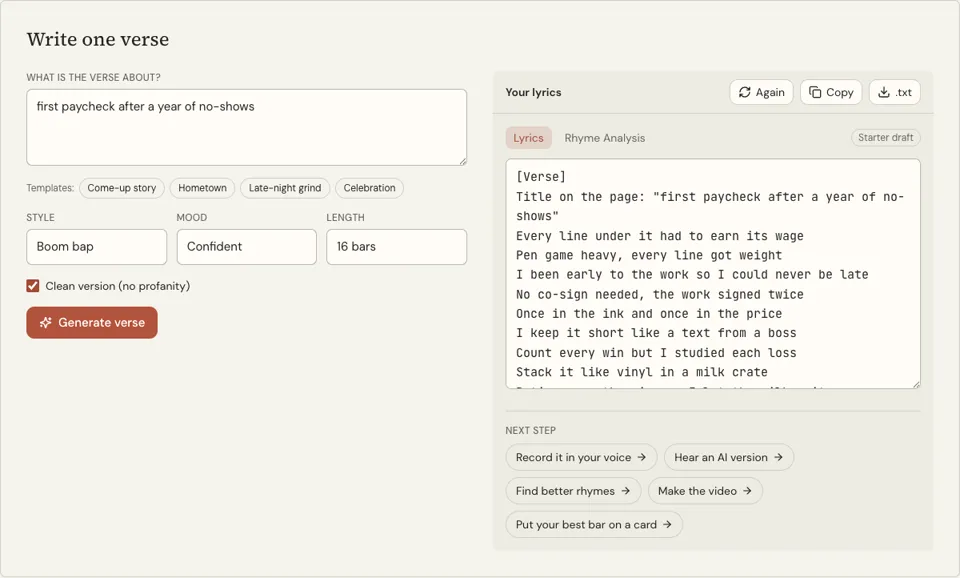
The rap verse generator on Punchline gives you a free draft from a topic and style, which is useful for seeing structure. Treat it as raw material: replace its details with your own and rewrite the lines in your voice.
Should the second verse be the same length as the first?
Usually, yes. Matching lengths keep the song balanced, so two 16-bar or two 12-bar verses are the norm. A shorter final verse can work when the story is nearly told. What must differ is the content: new information, not a restatement.
How do I know if my verse fits the beat?
Record it over the instrumental and listen without reading along. If the stressed words fall on the beats, every word is clear and you never gasp, it fits. Rushed endings, swallowed words or a late rhyme point to bars that need trimming.
Related reading
Related tools
Rap Verse Generator
Say what the verse is about, choose a style, a mood and a bar count, and one complete verse lands in the result box within seconds. No hook attached, no account, no charge.
Syllable Counter
Paste your lines and see a syllable count beside each one, plus totals for syllables, lines and words. Counts update as you type. Free, no sign-up.
Write a Hook
After this guide you can turn a song idea in any genre into a four or eight-bar hook with a title phrase, a simple rhythm or melody and one line that changes.
Bars in a Verse
You will know the standard lengths for a verse, hook, intro and bridge, be able to count bars on any beat, and choose the right verse length for a song.
Last updated November 13, 2026