How to Make Rap Beats
You will be able to read a 16-step grid, program a boom bap and a trap drum pattern from memory, and place a bass line that follows the kick.
Guide·7 min read·With exercises
How to make rap beats: the order that works
To make rap beats, set the tempo for the style, program the drums first (snare, then kick, then hi-hats), add a bass line that hits with the kick, put one simple melodic loop on top, and then remove anything that crowds the space where the vocal will sit.
Drums come first because rap is a rhythm music. A beat with strong drums and a two-note melody works. A beat with a rich melody and weak drums does not. You can learn the drum part in a browser before you touch any other software.
A beat is usually a one or two-bar pattern repeated and varied. If you can program one bar that makes your head nod, you can make a beat. The rest is choosing which hits to leave out and when to change the pattern.
Pick the tempo by style
Tempo, measured in beats per minute, decides the feel before you place a single drum. Choose the style, set the number, and change it only by small steps afterwards.
If you are making a beat for a particular rapper, ask them to say a verse without music and tap along. The speed they fall into is close to the tempo that suits them.
- Lo-fi: 70 to 85 BPM. Slow, loose and soft-edged.
- Boom bap: 85 to 95 BPM. Hard kick and snare, head-nod pace.
- West Coast bounce: 90 to 100 BPM. Laid back, with space between hits.
- Trap: 130 to 150 BPM, felt in half time, so the pulse you nod to is half that number.
- Drill: 138 to 145 BPM, also half time, with sliding bass and skipping hats.
Read the 16-step grid
A step sequencer shows one bar as 16 boxes. Each box is a sixteenth note. Steps 1, 5, 9 and 13 are beats 1, 2, 3 and 4. The steps between them are the off-beats, where groove comes from.
Each row is one drum. Click a box and that drum plays at that moment every time the bar loops. Before programming anything, count "1 e and a, 2 e and a" while pointing at the boxes, so you can name any step: step 7 is the "and" of beat 2.
Because the pattern loops, what you place at the end of the bar leads back into step 1. A hit on step 15 or 16 acts as a pickup that pushes the groove forward, which is why so many patterns have one there.
Program the drums: snare, kick, hats
Start with the snare, because it is the anchor. In boom bap it goes on steps 5 and 13, beats 2 and 4. In half-time trap it goes on step 9, beat 3, and a clap can double it.
Next the kick. Put one on step 1, then add one or two more on off-beats and listen: step 8 or step 11 are classic choices at 90 BPM. Fewer kicks hit harder. Finally add closed hi-hats on every second step (the eighth notes), and an open hat on one off-beat near the end of the bar.
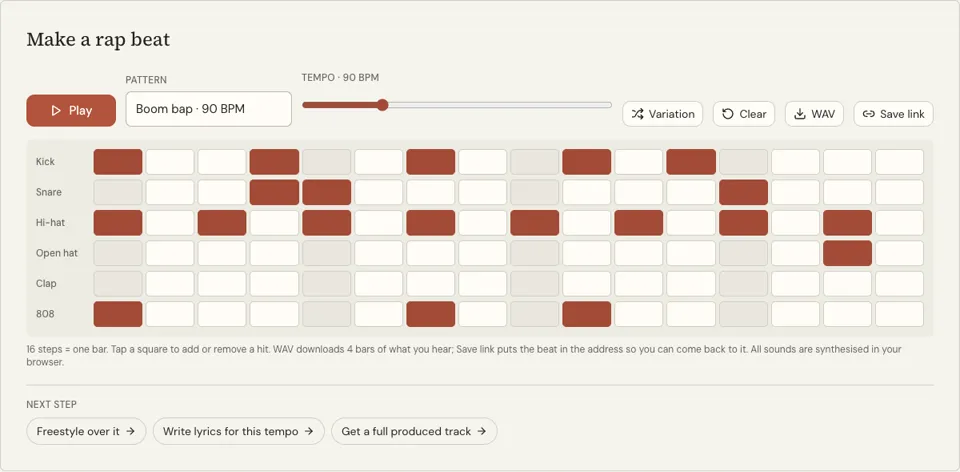
- Boom bap: kick 1, 8, 11. Snare 5, 13. Hats on odd steps.
- Trap: kick 1, 7, 11. Snare or clap 9. Hats on every odd step, with a burst of every step in the last four.
- Drill: kick 1 and 8. Snare 9 and 15. Hats grouped 3, 3, 2 across the bar.
Make the bass follow the kick
In most rap the bass, often an 808, plays when the kick plays. Stacked together they sound like one big drum with a note in it. Start by placing the 808 on the same steps as your kicks, then remove it from one of them so the pattern breathes.
When you move to a full production program, tune the 808 to the key of your melody and keep the notes few: the root note for most of the bar and one move at the end is enough. Avoid letting two long bass notes overlap, because the low end turns to mud.
Check the low end on more than one speaker. Small phone speakers hide bass, and headphones can exaggerate it. If the 808 disappears on a phone, the pattern still needs to make sense from the kick and snare alone.
Add one loop and leave room for the vocal
The melodic part can be a two-bar piano phrase, a sample you have the right to use, or a single sustained chord. One idea is enough. If you add a second, make it answer the first in the gaps and not play over it.
A voice sits in the middle of the frequency range and in the centre of the mix. Keep busy melodies out of that area, and drop instruments out during verses. A useful test is to rap or mumble over the beat for 16 bars. Wherever you feel crowded, mute something.
Arrange eight bars into a song
A full instrumental is your loop with parts added and removed every four or eight bars. Take the kick out for the last bar before a hook. Bring the open hat in only on hooks. Strip verse 2 down to drums and bass for its first four bars.
Sketch the arrangement on paper as blocks: intro 4, verse 16, hook 8, and so on. Mark what plays in each block before you build it.
Finish more beats than you polish. Ten simple instrumentals teach you more about groove than one that you adjust for a month, and rappers tend to choose the simple ones anyway.
Three mistakes people make when making rap beats
Filling every step
A kick on eight of the sixteen steps has no impact, because nothing is left to contrast with it. Groove comes from the gaps. Start with three kicks and add only if the bar feels empty.
Starting with the melody
An hour spent on chords often ends with drums squeezed in underneath. Build the drum pattern until it works alone, then find a melody that fits the pocket you made.
Forgetting the rapper
A beat that sounds full on its own can leave no room for a voice. If you cannot comfortably talk over it, simplify the middle before you call it finished.
How to practise making rap beats today
- 01
Study a preset (5 minutes)
Open the rap beat maker. It is a 16-step drum machine with six tracks: kick, snare, hi-hat, open hat, clap and 808. Load Boom bap at 90 BPM and note which steps are lit.
- 02
Rebuild it from empty (8 minutes)
Press Clear. Program snare on 5 and 13, kick on 1, 8 and 11, hats on odd steps, then put the 808 on two of the kick steps. Press Variation to compare ideas.
- 03
Change the style (5 minutes)
Load Trap at 140 BPM and Drill at 142 and compare where the snare sits. Then clear the grid and program a half-time pattern yourself. Press Save link to keep it, or WAV to download four bars.
Rap beat patterns on a 16-step grid
Boom bap, 90 BPM (x = hit, . = empty)
Kick: x . . . . . . x . . x . . . . . Snare: . . . . x . . . . . . . x . . . Hat: x . x . x . x . x . x . x . x .
Trap, 140 BPM, half time
Kick: x . . . . . x . . . x . . . . . Clap: . . . . . . . . x . . . . . . . Hat: x . x . x . x . x . x . x x x x 808: x . . . . . x . . . . . . . . .
Drill, 142 BPM
Kick: x . . . . . . x . . . . . . . . Snare: . . . . . . . . x . . . . . x . Hat: x . . x . . x . x . . x . . x .
Arrangement sketch
Intro 4: melody only Verse 16: drums, bass, melody low Hook 8: everything, open hat in Verse 16: first 4 bars drums and bass only Hook 8 Outro 4: drums out
Try it: Rap Beat Maker
How to make rap beats FAQ
What do I need to make rap beats?
A computer or phone, headphones and beat-making software. Many programs have free versions. You can learn drum programming first in a browser drum machine, then move to full software for melody, mixing and export.
What BPM is rap?
It depends on the style. Boom bap sits around 85 to 95 BPM, West Coast styles 90 to 100, and trap and drill around 130 to 150 counted in half time, which feels like 65 to 75.
Should I start with drums or melody?
Drums, while you are learning. The drum pattern sets the groove and the tempo, and it shows you how much room is left. Experienced producers start either way, but a weak drum part cannot be rescued by chords.
What is an 808?
It is a deep, sustained bass drum sound named after a classic drum machine. In rap it usually acts as the bass line, tuned to notes and placed on the same steps as the kick.
Can I download a beat I build in the drum machine?
Yes, four bars at a time. The WAV button saves the loop as an audio file, and Save link stores the pattern as an address. The machine is meant for learning patterns and practising over a loop. For a finished instrumental file, see the AI beat maker, which uses credits.
How long should a rap beat be?
Long enough for the song: usually two and a half to four minutes. That is an intro of 4 to 8 bars, two or three 16-bar verses, 8-bar hooks between them and a short outro.
Related reading
Related tools
Rap Beat Maker
Press Play and a boom bap loop starts at 90 BPM. Tap squares on the 16-step grid to change the kick, snare, hats, clap and 808, then write to it. Free, no sign-up.
Trap Beat Maker
Press Play for a 140 BPM trap loop with rolling hi-hats, a clap on beat three and an 808 under the kick. Edit any of the 16 steps. Free, no sign-up.
AI Beat Maker
Pick a style, press Generate beat and get a rap instrumental in about a minute, with no vocals, as an MP3 download. Each beat costs 4 credits.
Make Rap Music
See the whole chain from drum pattern to released track, with the settings and counts for each stage, so you know what to learn first and what can wait.
Last updated November 12, 2026