How to Write a Rap Song
Learn the writing decisions behind a complete song: what it says, what it is called, how the hook and verses differ, and how to edit until every bar earns its place.
Guide·6 min read·With exercises
How to write a rap song that holds together
To write a rap song, decide what it says in one sentence, turn that sentence into a title, build an 8-bar hook around the title, outline two 16-bar verses that approach the idea from different sides, then write the bars and edit them aloud. The outline is the step most beginners skip, and it is the one that makes a song feel written instead of collected.
A song differs from a verse in one way: it has a centre. Every line either moves toward the hook or sets it up. When you know the centre before you start, the blank page stops being a problem, because each section has a job you can describe.
This guide is about the page. Beats, recording and arrangement are covered separately, so here you only need a loop at your chosen tempo and something to write on. Everything below can be done in a single evening with a notebook, and the drills at the end take about twenty minutes.
Say the song in one sentence
Write a single sentence with a subject, a feeling and a change: "I moved cities and I miss my friends more than I expected." That is a song. "Life is hard" is not, because nothing happens in it. If you cannot write the sentence, you are not ready to write bars.
Decide who is speaking and to whom. A song addressed to "you", one specific person, usually has more force than one addressed to everyone. Decide the tense as well, and stay in it. Write three candidate sentences and choose the one you could talk about for ten minutes.
Pull a title out and build the hook on it
Circle the two to five words in your sentence that carry the most weight. That is your working title, and it belongs in the hook, ideally as the first or last words of the line. A listener should be able to guess the title after one chorus.
Hooks are simpler than verses on purpose: fewer syllables, longer notes, more repetition. A dependable pattern is the title line, a response line, the title line again, and a twist. Write four versions of the hook, each in under three minutes, then say them all over the loop and keep the one that is easiest to remember.
Outline the verses before writing them
Split each 16-bar verse into four blocks of four bars and write one plain sentence saying what each block covers. Eight sentences give you the whole song in prose. Now you can see if verse two repeats verse one, or if the story jumps.
A simple arc for a first song looks like this.
- Verse one, bars 1 to 4: where and when, with one image the listener can see
- Verse one, bars 5 to 16: the situation and what is wrong or wanted
- Verse two, bars 1 to 8: the turn, something changes or is decided
- Verse two, bars 9 to 16: where that leaves you, ending on a line that hands over to the hook
Make the sections contrast
If the hook and verses have the same rhythm and density, the song blurs. Give the verses 11 to 14 syllables a bar and the hook 6 to 10. Change the rhyme scheme as well: couplets in the verse and one repeated sound in the hook, or the reverse.
Place a small event every four bars in the verses: a pause, a repeated word, a switch from end rhyme to internal rhyme. These keep attention without a new idea. Mark on your outline where each one goes, then check the finished verse still has them.
Edit in three passes
First pass, sense: read the lyrics as prose and delete any bar that does not serve the one-sentence idea, however clever. Second pass, sound: rap it over the loop and mark every place you stumble or run out of beat. Rewrite those bars, usually by cutting a word.
Third pass, breath: perform the whole song without stopping and note where you gasp. Shorten the bar before each gasp by one or two syllables. Leave a day between passes when you can. Fresh ears catch weak lines that tired ones excuse. Finish by reading the title, then the hook, then the last bar, and check they agree.
Write the joins, and a bridge if you need one
The joins between sections decide whether a song feels like one piece. Listeners rarely notice a good transition, and they always notice a bad one. The last two bars of each verse should lean toward the hook: raise a question the chorus answers, or end on a word that rhymes with the title phrase. The first bar after a hook should reset the scene quickly, with a time, a place or a name.
A pre-hook is a 2 or 4 bar passage before the chorus with a simpler rhythm than the verse, used to build anticipation. A bridge is 4 to 8 bars near the end that steps away from both verse and hook: a new angle, a quieter delivery, sometimes spoken. Neither is required. Add one only if the song feels flat on the third hook. To test your joins, read just the last line of each verse followed by the first line of the hook. If the pair makes sense alone, the transition works. Rewrite any pair that does not.
- Verse ending: a question or an unfinished thought
- Pre-hook: 2 to 4 bars, fewer words, rising energy
- Bridge: 4 to 8 bars, new angle, placed before the last hook
Beat first or words first
Both orders work, and each has a cost. Choosing a beat first gives you a tempo, a mood and a bar length before you write a word, so lines arrive already shaped to fit. The cost is that the beat can decide the subject for you. Writing words first protects the idea, and you then have to trim or stretch lines when the music arrives.
For a first song, pick the beat early: after the one-sentence idea and before the hook. Look for a tempo you can talk over comfortably, usually 85 to 100 BPM for a boom bap feel, or 130 to 150 counted at half speed for trap. If you have no instrumental yet, a drum pattern at the right tempo in the rap beat maker is enough to write to.
Then find your pocket, the rhythmic space where your voice sits comfortably against the drums. Loop 4 bars and mumble nonsense syllables for two minutes, trying a few different rhythms, and record it on your phone. The rhythm you fall into most easily is your pocket for this song, and the hook should use it.
Count bars, not lines
A bar is a unit of time: four beats of the instrumental. A line is a unit of paper. They usually match, one line per bar, but not always. A long sentence can run across two bars, and a short phrase can fill half of one. When a verse is called 16 bars, that means 64 beats of music, whatever the page looks like.
This matters when the sections are assembled. If your hook is 8 lines and each line takes only two beats, you have a 4-bar hook, and it will be over before the listener settles in. Count along with the loop while you rap: "1, 2, 3, 4" for bar one, "2, 2, 3, 4" for bar two, and so on. Write the bar number in the margin wherever a new bar starts.
Use the snare as your anchor. In most rap beats it hits on beats 2 and 4, and the rhyme word usually lands on or near beat 4. Take the hook you wrote and mark where beat 4 falls in each bar. If the rhyme words sit there, the section will feel locked. If they drift, move a word.
- One line, one bar: Boxes in the hall and the kettle in a bag
- One line, two bars: I said I'd come and visit when the weather turned, and then the weather turned and I was working
- Two lines, one bar: Train's late. / Phone's dead.
Keep a rhyme bank for the song
Stopping mid-line to hunt for a rhyme breaks concentration and tends to bend the sentence toward whatever word turns up. A rhyme bank separates the two jobs. Before drafting the verses, collect sounds. While drafting, choose from them.
Take the 6 to 8 words that matter most to the song: the title words and the main nouns from your outline. Put each at the top of a column. Under it, list 8 to 10 rhymes and near rhymes, including two-word phrases. The rhyme finder gives perfect and near rhymes grouped by syllable count, which fills a column in under a minute.
The bank is a menu, not a script. A word belongs in a bar only if it says something the song needs, so expect to use about a quarter of what you collect. Build the bank for your current song now, and star the three words in each column that suit the subject.
- Chat: back, that, flat, unpacked, came back, fall flat, map, laugh
- Home: phone, alone, known, tone, on my own, ringtone, postcode
- Miss: this, list, exist, dismiss, insist, reminisce
Choose a structure that fits the song
The standard layout is a starting point, not a rule. Structure decides when the listener first hears the hook and how long they wait for it to return. The three layouts in the list cover most first songs. Lengths assume 90 BPM, where 8 bars last about 21 seconds.
Pick by asking where the strongest material is. If the hook is the reason the song exists, let it open. If the verses carry a story, start with the first scene. If you have one and a half good verses, go short instead of padding. A song that ends early gets replayed, and one that drags does not.
Write your chosen layout as a column of section names with bar counts down the left side of a page, and fill in what you already have.
- Hook first: intro 4, hook 8, verse 16, hook 8, verse 16, hook 8, outro 4. That is 64 bars, about 2:50. Suits a song whose chorus is its strongest part.
- Verse first: verse 16, hook 8, verse 16, hook 8, bridge 8, hook 8. Also 64 bars. Suits a story that needs setting up before the chorus makes sense.
- Short form: hook 8, verse 12, hook 8, verse 12, hook 8. That is 48 bars, about 2:10. Suits a simple idea that would wear thin over three minutes.
Record a rough take before you polish
The page hides problems that a recording reveals in seconds. As soon as you have a hook and one verse, record them over the beat on your phone.
Listen back once without the lyrics in front of you and note four things: any word you cannot make out, any place you hear yourself rush, any bar where your energy drops, and whether you can still recall the hook an hour later. Each note points to a specific fix: a clearer word, a shorter bar, a stronger line, a simpler hook.
Set a limit on revising. A workable first session is 50 minutes: 5 for the idea and title, 10 for the hook, 20 for a rough first verse, 5 to record, and 10 to listen and fix the two worst bars. Stop there. Learning how to write a rap song is mostly a matter of finishing rough ones. Book those 50 minutes for a specific day this week.
Three mistakes beginners make when they write a rap song
Writing verses with no hook in mind
Verses written first tend to wander, and the hook added later feels attached. Start from the title phrase and the chorus so the verses have something to lead into and return from.
Saying the same thing twice
A second verse that restates the first makes three minutes feel like six. Outlining in prose exposes this in seconds. Give verse two a turn: later in time, a different view, or a decision.
Keeping lines for their cleverness
A sharp bar that does not belong pulls the listener out of the song. Move it to a notes file for another track. Songs are remembered for a clear idea, not for the cleverest spare line.
How to practise writing a rap song today
- 01
Sentence and title in four minutes
Write three one-sentence song ideas, pick one and circle its title words. Write the eight outline sentences for two verses underneath, one per four-bar block.
- 02
Hook in six minutes
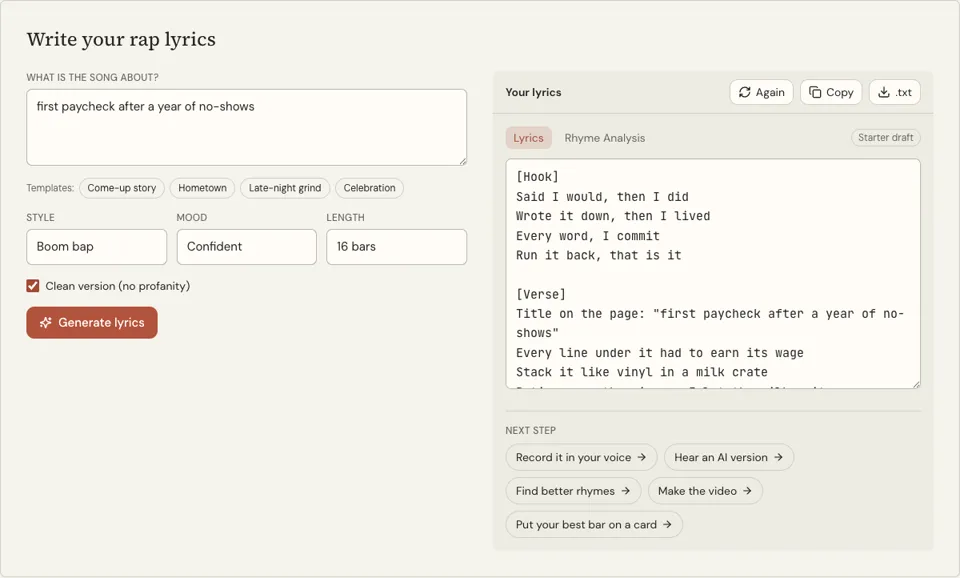
Write two 4-bar hooks that use the title. In the rap lyrics generator, enter the same idea as the topic, pick a Style and Mood, and compare how its draft handles the subject.
- 03
First block and check in eight minutes
Write bars 1 to 4 of verse one from your outline. Paste them with the hook into the rhyme scheme analyzer and confirm the two sections show different letter patterns and syllable counts.
Worked examples for writing a rap song
From sentence to title
Sentence: I moved cities and I miss my friends more than I expected. Title options: "New Postcode", "Miss the Table", "Same Group Chat" Chosen: "Same Group Chat" Hook job: say that the chat is all that is left of home
Hook built on the title
New keys, new street, same group chat, Three hours behind but I still write back, New job, new sheets, same group chat, Home is a screen and I’m fine with that
Verse one outline (one sentence per four bars)
Bars 1 to 4: boxes in the hallway on the first night Bars 5 to 8: the quiet, compared with Friday at the old flat Bars 9 to 12: scrolling photos of a dinner I missed Bars 13 to 16: typing a joke so nobody worries
Edit pass: cut to fit the beat
Before: I was sitting on the floor because I still had not bought any chairs yet After: Sat on the floor, no chairs yet Before: And my phone it was buzzing with the messages they sent After: Phone kept buzzing with the jokes they sent
Try it: Rap Lyrics Generator
How to write a rap song FAQ
How do you start writing a rap song?
Begin with one sentence that states what the song is about, including a feeling and a change. Pull a short title from it, write the hook around that title, then outline the verses in plain sentences before writing any rhymed bars.
What is the structure of a rap song?
The common structure is intro, hook, verse, hook, verse, hook, outro. Hooks are usually 8 bars and verses 16. Some songs add a 4-bar pre-hook or an 8-bar bridge before the final chorus for contrast.
How long does it take to write a rap song?
A first draft of a hook and two verses can be written in two or three focused hours once the outline exists. Editing across a couple of days improves it noticeably. Speed rises with practice, so early songs take longer.
Do rap songs have to rhyme on every line?
End rhyme on most lines is the convention, but it is flexible. You can rhyme inside the bar, use near rhymes, or leave a line unrhymed for emphasis. What matters more is that the rhythm is steady and the rhymes land on strong beats.
What should I write a rap song about?
Something specific that you know well: a place, a person, a day that changed something, a habit you want to break. Small real subjects produce stronger detail than large general ones. The rap topic generator can suggest starting points.
Can an AI tool write the song for me?
The rap lyrics generator will draft bars from a topic, and that draft is useful for seeing structure and rhyme options. Rewrite it with your own details and voice. A song about your life needs facts only you have.
Should I choose the beat or write the lyrics first?
Either can work. Beat first gives you tempo, mood and bar length to write into, which makes fitting easier for beginners. Lyrics first protects the idea but needs trimming later. A middle route is to settle the idea, then pick a beat before writing the hook.
What is the difference between a bar and a line?
A bar is four beats of music. A line is a row of words on the page. They often match, but a sentence can cross two bars or fill half of one. Count bars against the beat when you measure a hook or verse.
Related reading
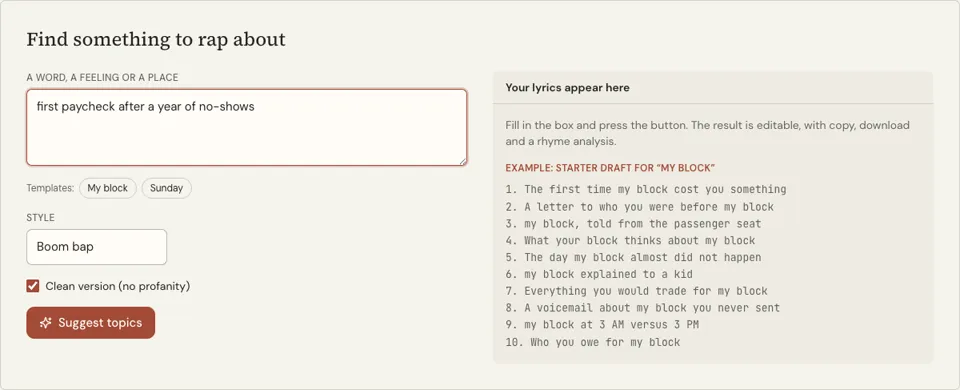
Related tools
Rap Lyrics Generator
Describe your song in a sentence, choose a style, mood and length, and a four-line hook plus a verse comes back in a few seconds. Free, with no sign-up and no credits.
Rhyme Scheme Analyzer
Paste a verse or poem and see its rhyme scheme as letters, one per line, with a syllable count beside each. Results update as you type. Free, no sign-up.
Make a Rap Song
Follow one song from a one-line idea to a finished file: a 64-bar map, a hook, two verses and a demo recorded in a single sitting.
Write a Hook
After this guide you can turn a song idea in any genre into a four or eight-bar hook with a title phrase, a simple rhythm or melody and one line that changes.
Last updated November 13, 2026